So, here we are again ladies and gents and this time I thought we could look at one of those weird and wacky machines from the interbellum that made the thirties so interesting; the Tancik vz.33 or the Model 1933 Tankette.

The history of the tankette in the Republic of Czechoslovakia began to be written in 1929. In this year for the first time the word 'tankette' starts to appear in the army of military ideas that were flooding Europe.
The tankette phenomenon came from British General J.F.C Fuller, the Chief of Staff of the Armoured Corps, whose idea of a small modern army, in which the basic building block would be a highly mobile, armoured and with strong weaponry captured the imagination of many European nations. More designers put the idea of the tankette into practise with Mr Carden and Mr Lloyd proving to be the most successful with their offering.
Tankettes were constructed of various sizes, ranging from 1.5 to 3 tons with a crew of one or two men. They carried a range of different armaments ranging initially from light and heavy machine guns right up to mortars, flame throwers and autocannons by the end of their operational period in history. There were even unarmoured versions, such as the Renault UE that was used as a supply and/or tow vehicle.
The common and much cited negative trait of this genus of armoured vehicle however was the weak armour, inefficient engine, restrictive interior layout and low reliability. Despite these handicaps however the Carden-Lloyd license was sold to several countries where they were used to develop further and nominally more advanced designs such as the Italian Fiat-Anslado CV-33 and CV-35, the Soviet T-17, T-23 and T-27, the French Renaults, the Polish TK series and the Japanese Type 94 Te-Ke.

History of Development
When the Czechoslovakian armed forces were established the idea of tankettes never even entered the thoughts of the military hierarchy, however despite this by 1929 conversations were being had entertaining the idea of testing the suitability of tankettes for introduction to the armed forces.
The first purchase initiative came from Lieutenant-Colonel Albrecht, Department Head of the Military Technical Institute, who in 1929 visited Vickers-Armstrong with a delegation representatives from the military accompanied by delegates from the CKD (Ceskomoravska-Kolben-Danek) factory in order to view their new tankette.
On returning to Czechoslovakia they enthusiastically recommended the tankette as an ideal light armoured vehicle for inclusion into infantry divisions.
Later the same year, the CKD factory participated in the negotiations and on 14 October 1929 they offered the army the purchase of a license to manufacture 300 of the Carden-Lloyd Mk. VI. The costs of the license however had been inflated by CKD too far, the army smelled a rat and declined, stating that the offer was unacceptable.
However the army felt keenly the lack of armed vehicles in their own army not only to increase the strength of the armed forces but more especially the lack of opportunity for training their infantry in combined arms manoeuvres and operations. This particular aspect played a large part in the decision to adopt the tankette into the armies equipment.
During the meeting of the Ministry of the Army on 4 November 1929 the representatives of the army categorically stated that they did not consider the tankette an appropriate weapon and that they believed that the army had no need or use for such a machine. However there was a lot of movement being conducted behind the scenes and on account of this it was finally decided that three examples of the Carden-Lloyd Mk VI would be purchased through CKD to verify their technical values and tactical characteristics. It was only after they had been conducted to thorough rounds of field tests that the army and ministry would make any final decisions on further orders.
On 25 February 1930 a contract was signed between CKD and Vickers-Armstrong to purchase a further three sample Carden-Lloyd Mk.VI's, one trailer and one trolley for the tankette and at the same time purchased a license for their production in Czechoslovakia, until 1 December 1939. The army was supposed to pay for one third of £12,000 (approx. CZK 660,000), the balance of which was to be paid after the introduction of the vehicle into the equipment rolls of the army. In addition a £75 per unit license fee was to be charged for each machine produced.
The new tankettes and its accessories arrived in Prague on 10 March 1930, followed by the first public demonstration rides conducted in front of representatives of the army across Duletin Meadow. In the following weeks the tankettes had intensive testing conducted on their on and off road performance.

On 20 June 1930 CKD purchased a further three samples, each for CZK 150,000, paying CZK 488,745 for the entire delivery, including trucks, subsequently paying a further CZK 40,000 for a series of test drives. Yet the machines remained in the factory, with the army stating that it planned to take receipt of them in July. The vehicles were registered on 21 July 1930, specifically being taken into the test vehicles group in the Military Technical Institute. The operational care of the vehicles was at this time assumed by the armoured battalion based in Milovice.
On taking receipt of the license CKD started to produce four more tankettes in the Praga car factory that had been taken over by CKD in 1927. Three of these tankettes went to the army whilst one remained at the factory to be used as a test bed for further developments. Arming the tankette with a Schwarzlose machine gun was initially considered. The designation of the new machines was given as CL-P (Carden-Lloyd-Praga). Representatives of CKD submitted an offer for CZK 221,325 per vehicle i.e more than twice the initially considered price. Because of the fact that CKD built four tankettes it is likely that the price of the fourth was divided amongst the price of the first three that were delivered to the army. CKD later donated this final fourth one to the Iranian emperor in order to sell the AH-IV and the TNH-P tanks.
On 14 August the Ministry of Defence ordered the three new machines to conduct military tests and long distance road travel from Prague to Ceske Budejovice and back again. A number of tests however were failed and as a result of these the treads were stripped off of the vehicle, the rubber wheels were removed from the wheels, the engine continually over heated and the oil pipes cracked. These repairs took until late September to put right and by the end of the year they had gone through all of their technical tests successfully.
All six of these machines; the three British Carden-Lloyd MkVI and the other three produced by CKD, were to be examined and tested by a number of departments within the army (in July they were to be tested by 11th Infantry Regiment, 1st and 2nd Cavalry Brigade and 1st Infantry Division) to include participation in the annual manoeuvres that were being held between 28 July and 8 September. Due to unexpected technical obstacles however only the original British Carden-Lloyds were able to take part.
These exercises however, confirmed all of the fears that were loudly proclaimed by the military establishment. In addition to the persistent technical problems were the newly identified tactical shortcomings. The crews vision was critically limited, the range of the on board weapons was deemed insufficient as well as its lack of accuracy exacerbated by the rattling of the vehicle whilst the engine was running. Communication was also cut to practically zero between the two crew members themselves because their heads were ensconced in pyramid hatches and so couldn't see each other let along hear each other due to the noise of the engine and communication between vehicles was almost impossible.
Likewise the engines performance was deemed insufficient for its task and the ammunition, which was stored in external ammunition cases were unsafe for retrieval by the gun operator. Most of these vehicles were left idle for long periods of time due to excessive crew stress and an inordinately high mechanical failure rate.
The OA vz.30 armoured cars, with their equipment held within the turret ring was able to accomplish all of the same tasks asked of the vz.33 to a much higher standard and yet despite this the powers that be stated that the tankette idea was a good idea but that the current vehicles had too many shortcomings to warrant serious consideration and were far off from being a maturely developed combat vehicle. Amongst other ideas it was suggested that the on-board weapons were placed in a revolving tower, which may also go some way in mitigating the visibility issues. On the basis of these suggestions the machines were purchased and taken over by the army.

Tankette PI
All of the aforementioned issues forced a major rebuild of the vehicles superstructure. Therefore, engineers dismantled the tankette and studied all possibilities for adjustment and exchange of some mechanical parts for domestic production. This included the power units and other items from the Praga cars or armaments. This all resulted in a redesigned tankette which CKD designated as the PI. The original structure was left with the running gear and the steering mechanisms but everything else was reworked according to military requirements. The unofficial factory designation can be considered to be the abbreviation of AH resulting from the propulsion unit. The petrol engine of the A series, which had been adapted for caterpillar vehicles (H).
The years 1931 and 1932 were, for CKD, a period of great reconstruction and modernisation. By the end of 1931 one Czechoslovakian CL-P had been constructed for CZK 115,363. The mounting of the machine gun had been changed into the ball carriage and sliding armour curtain which increased the field of fire and a second machine gun was added for the driver. All the ammunition was now placed within the combat compartment with additional visors added to the sides and rear of the hull to improve the view from the vehicle. Improved driving characteristics, the door to the radiator in the rear of the hull was replaced by more practical louvres. Armour was reinforced according to military specifications and demands up to 12mm on the front armour face, 8mm at the sides and 4mm on the bottom, as opposed to the original 9mm, 6mm and 3mm.
In the spring of 1932 the finished reconstructed piece was handed over to the army for testing. Throughout the factory and army tests in the years 1931-32 the first machine drove a total of 4350km but the army hesitated again from submitting a large order. Negotiations over the introduction into the army's ordnance, the numbers to be built etc were continued ad nauseum. The second two prototype CL-P tankettes were gradually rebuilt taking into consideration new demands. Following the rebuild the CKD representatives were able to pressure the army representatives into accepting the tankettes and they were accepted into the armoured regiment on 17 October 1932 in Slany.
Around this time the consequences of the Great Depression were starting to make themselves felt even within CKD. The army, still disunited over the role of the tankette, still resisted the submission of a large order. CKD then applied political leverage to the Minister of Defence, Bohumir Bradac, probably by way of threatening to dismiss workers and limit future production capacities. On 21 February 1933 the Minister of Defence submitted instructions for the army to order 15 PI's, with a possible extension if necessary. CKD offered a price of CZK 130,000 for each tankette whilst the army demanded a price of less than CZK 100,000 be offered.
On 19 April 1933 the army finally issued an order for 70 tankettes. The price per unit without any periscopes or weapons included came to CZK 131,000 plus the license fee of £32. Already by 5 April the ministry had approved the entry of the PI tankette into the army's inventory and shortly thereafter on 30 June 1933 it received the designation Tancik vz.33 (Tankette model 1933). The introduction of the vehicle into the army inventory was significantly influenced by both political and economic reasons but it was also argued that there was a pressing need to increase the readiness of the army, which at this time only had seven Renault FT-17 tanks that it could call on for use, an outdated and obsolete model that hailed from the First World War.
CKD undertook to deliver 40 machines by the end of 1933 and the remaining 30 by September 1934. The start of serial production had significantly adjusted due to a collection of complications that had occurred, not least of which was the unsatisfactory work of the Polda Steelworks who were responsible for the manufacture of the armour plates. Production line work began in earnest on 9 November 1933. The first series of 10 pieces were completed in the factory by the beginning of January 1934 but representatives of the Ministry of Defence only took them from the factory in Slany on 6 February 1934 (registration numbers 13.430 to 13.439). Subsequent units were able to produced at a faster rate with another 20 units being delivered in March, 10 in April, 20 in August and by 10 October 1934 the order had been completed with the last 10 vehicles being handed over.
Army acceptance tests were fixed with each vehicle having to conduct a 400km journey between Prague-Milovice-Prague. and a 5 hour protracted field test. To achieve a speed of 35km/h, successfully negotiating a 1.2 meter ditch, successfully wading through a water obstacle of 0.6m depth and overcoming a slope of 45 degrees. On receipt of the vehicles ballistic tests against the vehicles armour was also conducted on the vehicle before acceptance with any perforations being recorded and the vehicle refused. For example Tancik voj. ev. No.13.437 from the first series when being handed over on 6 February had its armour shot through by a rifle at a distance of 75m.
At the end of 1934 all of the vehicles, except for the first replacement batch, a total of 40 vehicles, participated in final military manoeuvres where unfortunately all concerns about the usability and quality of the vehicles was confirmed. Cross country capability was low, firing potential was limited and communications between crew members and vehicles within the platoon, even with the help of flags and signals was extremely compromised. Even light reconnaissance duties assigned to these tankettes was problematic due to the poor visibility that the vehicles visors allowed. The crews also suffered appreciable fatigue due to the noise and temperature of the engine, limited interior space and poor ventilation.
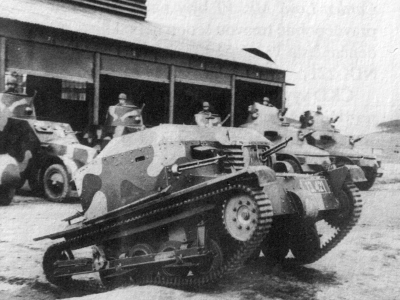
Post 1934, after obtaining a license to export the tankette from the army, CKD unsuccessfully offered the tankette vz.33 abroad to Argentina, Brazil, Bolivia, Estonia, Lithuania, Sweden, China, Persia and Yugoslovia. The foreign service however only received one piece which was the one that became a gift for the Persian Shah.
Service in the Czechoslovakian Army
The tancik vz.33 was conceived and manufactured for the army as a light reconnaissance and combat vehicle for use at a divisional level. The army took receipt of the tankette into the Armoured Regiment in Milovice and was distributed amongst the following armoured battalions:
1st Tankette Company - 15 vehicles
2nd Tankette Company - 15 vehicles
3rd Tankette Company - 10 vehicles
Milovice Replacement Depot - 30 vehicles
In 1935 the tankettes were redistributed amongst the newly established Armoured Regiments
1st Armoured Regiment in Bohemia - 20 vehicles (all in Milovice) in two companies in the 1st Battalion
2nd Armoured Regiment in Moravia - 16 vehicles (five in Olomouc, nine in Vyskov and two in Praslavice)
3rd Armoured Regiment in Slovakia - 30 vehicles (14 in Turcianske Svaty Martin, eight in Bratislava and eight in Kosice), all of these ones came from the Replacement Depot so suffered a limited amount of wear and tear.
4 remaining tankettes were used in the Armoured Regiment school in Milovice.
From September 1938 the newly received tankettes were allocated to the newly established 4th Armoured Regiment in Kolin (on 15 September of that year). Armoured Regiment 4, after its completion, took over the tasks of Armoured Regiment 1 that had siphoned off its own tankettes to arm the newly created 1st and 4th Mobile Divisions. During times of mobilisation all of the armoured regiments had to create a total of 23 tankette platoons for distribution to the border areas.
Between 1934 and 1936 the tankettes were intensively used for training instead of using the small LT vz.34 light tanks. In addition there were still failures due to poor design, inexperienced factory processes and the use of unsuitable materials for components that still needed addressing. All factors resulted in excessive wear and frequent failure. Conversely some of the parts originating from trucks made replacement and repairs much easier.
Combat Performance
At the time of the deteriorating political situation in 1938 it was decided to deploy the tankettes as support vehicles in platoons of three. During the partial mobilisation in the spring of 1938 the tankettes were assigned to strengthen the border units (to the sum of 23 platoons). By regulation of the Ministry of Defence, followed by a decree from the Chief of Staff on 25 July 1938 military emergency units were set up, deployed directly into the border areas. In the 15 newly established emergency units were, amongst others things, three tankette platoons from Armoured Regiment 1 and 2 which were allocated to 5th Division in Czech Budejovice, Infantry Regiment 44 in Liberec and to Infantry Regiment 34 in Bruntal.
In the end the tankettes were actually used in the border combats against the German Freikorps through August and September. Between 12 September and 4 October there were 69 engagements that involved the presence of armour, and of course at least in part with the participation of the tankettes.

Because these machines fought exclusively against lightly armed insurgents, they experienced a measure of success. Because the insurgents did not target the tankettes, none of them received any damage. For their own troops they provided great support and a good boost to morale. However again, their unreliability and failure rate was made manifest when they were frequently forced to drop out of service at critical moments amounting to a mere two, or even one at some points, platoons being available for use.
Most of the unit commanders ratings for these vehicles were extremely negative. After Munich, all of the troops from Moravia and Bohemia returned to their home units.
Their last appearance in the forces of the Czechoslovakian army was in 1938 and 1939 within Carpathian Ruthenia (vehicles from Armoured Regiment 3) but only in rare cases. For example on 10 October Czechoslovak infantry supported by two vz.33's surrounded and captured a Szabadcsapatok group (a Hungarian insurgency unit) whilst in the latter half of October two infantry battalions supported by an armoured platoon destroyed a battalion strength Szabadcsapatok in the woods near Salanek, the armour penetrating the forest and surprising the Hungarians in their camp. About 300 Hungarians were captured.
After the German Occupation
After 15 March 1939 the Germans appropriated 40 vehicles from the Armoured Regiments in Bohemia and Moravia along with all three prototypes. The Wehrmacht captured the machines stored or transferred to the driver training school due to obsolescence or failure rate but they were only used briefly. They most probably remained in the Protectorate of Bohemia and Moravia. They were likely used as static machine gun posts or for target practise.

The Republic of Slovakia
After the declaration of an independent Slovak State the 30 tankettes of Armoured Regiment 3 were stationed in Slovakia; vehicles 13.460 to 13.489. Whilst the Slovaks kept the tankettes in a ready state they were not deployed for a long time and did not participate in the short border war against Hungary, the invasion of Poland or the invasion of the Soviet Union.
In May 1939 after the first Slovak reorganisations of their forces the 1st Battalion of the Slovak Armoured Regiment had four tankettes assigned to it with registration numbers 13.462 to 13.465. These found active service in 3rd Platoon of the 1st Armoured Car Company. After the restoration of the 1st Armoured Regiment in February 1940 four tancik vz.33's were included in 2nd Platoon of the 1st Company in 1st Battalion. Whilst three were on active duty the fourth was held back as a replacement vehicle. Other tankettes that the Slovak military had access to were used to train drivers.
At the beginning of 1941 all Model 1933 Tankettes were transferred to the Ministry of Defence's reserve depot and placed into storage. In 1942 the Security Division vainly requested seven tankettes to be drawn from the reserve depot as replacements for their armoured losses.

22 tankettes were allocated to the drivers of Motorised Battalion 11 and were transferred in January 1944 to the Military Training headquarters for allocation to the National Defence Guard. In May, after the completion of the driver training, the machines were divided into units as reinforcements for the National Defence support units. They were allocated as follows:
Mounted Reconnaissance Unit 1 (JPO 1) in Bratislava - 5 machines
Armoured Regiment in Turcianske Saint Martin - 3 machines
Motorised Battalion 11 in Banska Bystrica - 3 machines
Motorised Battalion 2 in Presov - 3 machines
Corps Vehicle Pool in Trencin - 3 machines
Border Defence Company 1 in Humenne - 1 machine
Border Defence Company 2 in Bardejov - 1 machine
Border Defence Company 3 in Brezno nad Hronom - 1 machine
Border Defence Company 4 in Presov - 1 machine
Border Defence Company 5 in Michalovce - 1 machine
These tankettes were allocated permanently to these units and were utilised for driver and gunner training. In 1944 the Police units were preparing themselves and their tankettes for fighting against insurgents but this did not happen due to the abolition of the border defence units in June of the same year.

In March 1944 General Jozef Turanec ordered the dispatch of three tankettes with drivers to Pioneer Battalion No.1 in Trencin, No.2 in Michalovce and No.11 in Nove Mesto nad Vahom as a tool for training strike teams in close combat against tanks.
The Minister of Defence, General Ferdinand Catlos ordered the incoming German troops to occupy all communications from Bratislava. On the night of 24 June 1944 the five tankettes from the Mounted Reconnaissance Unit 1 took their designated positions.
At the time of the outbreak of the Slovak Uprising the tankettes were already hopelessly outdated and worn out. However they saw some use as non combat vehicles, especially as transport vehicles has been noted. Several tankettes served as ammunition transport vehicles in the area of Turciansky Svaty Martin or else were employed as guard units and tractors at the Tri Duby airfield. Other vehicles served as reconnaissance vehicles within the Weinhold Rebel Group.
After the rebellion was crushed by the Germans they confiscated the four remaining vz.33 tankettes; three in Zlatovice from the Corps Vehicle Pool and one from Pioneer Battalion No.11 in Nove Mesto nad Vahom.
To this day no known example of a tancik vz.33 has survived.
So there we have it; a summarised history of these little tin coffins on treads.
Now we come to the modelling and as you have already read so many times I wont bore you with the basing as its the same for absolutely everything that I do so we will just get straight into the painting.

The first thing that I do on any of my vehicles is always the green base colour.
The main paint scheme of the tankettes is done by airbrush using my MIG Aircobra for the Priming and Basecoating and my Harder & Steenbeck for all of the shading and highlighting as my H&S has a 0.15 needle and provides a hell of a lot more control... but the MIG is SOOOOO easy to clean it just makes sense to use it where I can...
The Airbrushing steps are as follows:
i) The model is primed with a Matt Black Etch Primer
ii) The basecoat is Tamiya's XF-58's Olive Green
iii) The first highlight is LifeColors UA221 Khaki Olive Drab applied in a panel highlight fashion
iv) The second highlight is LifeColors UA224 Olive Drab Faded Type 2 applied as above but a bit lighter and gathered in along the edges and prominent areas
v) The third highlight is a 50/50 mix of LifeColors UA224 Olive Drab Faded Type 2 with LifeColor 01 White. This is applied sparingly just along the edges and prominent areas.
So that's the airbrushing complete and don't be overly concerned if your third highlight was too heavy as the next two steps will, if done correctly, tone the whole contrasted effect down.
vi) The next step is to apply the colour swatches over the body of the vehicle that will provide the camouflage pattern. With the green camouflage base now finished off I add swatches of Vallejo's 914 Green Ochre and Vallejo's 826 German Camo Med. Brown to leave an equal balance of all three colours in an intentionally smoothed edge blotted pattern.
vii) Now we apply the Filter over the whole thing to unify the colour aesthetic and clip the contrast a little. I apply MIG's Filter 1506 Brown for Dark Green.
viii) Once dry wipe of any serious excess from where it may have pooled but otherwise leave it untouched.
ix) At this point I apply the first layer of Varnish. It doesn't matter which varnish you choose so long as it fixes the Filter layer to the miniature as its an oil based layer.
Once the varnish is dry its time for the next layer which is where the real depth starts to come out.
x) Over every detail laden part of the model apply a Wash. I use AK Interactives Wash 075 Wash for NATO Camouflage Vehicles. Don't be shy with this step. Slap it on aplenty! Then leave to dry for a while.

xi) Once its dry (or dry-ish) use cotton buds (cue tips for you Yankees out there...) and use a gentle white spirit to wipe away the excess leaving great detail and shadowing around all of your detail areas and a general lowering of the overall luminosity. Personally I use Winsor & Newtons Artists White Spirit as I had a bad experience with normal white spirit stripping away four layers of paint and primer and have no wish to repeat the disaster!
xii) Once the whole piece is dry to the touch apply another layer of varnish to fix everything in place.
xiii) The last thing to do with paint is to lightly airbrush a layer of Vallejo's 826 German Camo Medium Brown across the wheels and the lower third of the vehicle. This layer has a highlight of Vallejo's 914 Green Ochre mixed in whatever ratio you want with the German Camo Medium Brown already in the airbrush and is then applied in splotches to provide some variance in the muddy weathering.
xiv) A final varnishing is applied to the vehicle which are then finally fixed to their bases.
So there we have it ladies and gents. Another mini project finished and one (read three) more items to place onto the table alongside the rest of my Slovak forces
Onwards and Upwards Ladies!
Fix bayonets!


