Therein lays the rub however! As many who read my blog will by now be aware, there is a paucity of decent models out there with which to represent said 10BK, there are very few that are appropriate at all and those that are appropriate are, for the most part, absolutely appalling miniatures. Many people would quite understandably tut and let it rest there.
Now, this is such a big and involved project with SOOOOOO much research that can be done on it that I have decided that I am going to release my blogs that are related to the Black Brigade in a certain order... and of course this is an order that involves as much hair pulling, eyeball mincing and late nights as is humanly possible... oh, and a certain volume of writing I guess!
Because this all represents so much solid text I have decided to also break this biography series up with a series of blogs actually about the Black Brigade itself and potted histories of each of the constituent parts of the Brigade, with each blog having included within it the modelling and painting of the corresponding part of the Brigade.
So to get the ball rolling I thought I would do an introduction to the Black Brigade, give a brief history and a Brigade level organisational breakdown of this formation and as its modelling element include the Command and Control element of the Flames of War force afterwards explaining how I went about doing them.
So who exactly were these titans of modern warfare that history recalls as 'The Black Brigade'
The History
 |
| A Polish 24th Uhlan in summer uniform |
Well the Black Brigade is the nickname bestowed by the German Heer onto the Polish 10th Motorised Cavalry Brigade who they so labelled on account of the Black leather jackets that all of the officers, NCO's and motorcycle troops wore in the Brigade. When you combine a mid thigh length leather jacket with knee high black boots and black berets, and in the case of the Motorcycle troops oversized black gloves its easy to see where the nomenclature came from.
Poland, in the years following the First World War was not the most modern of country's and in fact there is a solid argument that over the years the military hierarchy became less capable and more entrenched in tradition. For the modernisers in the Polish army it became an uphill struggle to get the General Staff and those others whose decisions counted for something, to consider moving away from the Cavalry and Infantry based forces that Poland's military foundation was quagmired in.
 |
A Warlord Games plate showing the Black Brigades
armoured troop uniform on the left and Officer and
NCO issued black brigade uniform on the right. |
In the face of aggressive modernisation programs in Nazi Germany and the Soviet Union the Polish hierarchy eventually gave the go ahead for wargames that would test modern Poland's capabilities. The findings were sobering to say the least. One of the most sobering of facts was that there was only enough ammunition in the country's depots to provide its forces for three months war.
A motorised brigade was assembled in order to prove the concept as unworkable across the Polish landscape. It was formed in 1937 as a cross between a normal motorised brigade and a French model Division Legere. Resistance to the idea from cavalry based officers was fierce however.
Testing of the new unit was to be done in a specially formed training ground near Kielce, as well as using the Armoured Units Training School to train the armoured elements of the brigade.
Conceived as an emergency unit in the Commander in Chief's Central Reserves it was to be thrown at any serious fire where it could plug the gaps that the enemy were able to create in the Polish lines. It was conceived that it could be tasked with screening the movement of slower moving troops and to engage enemy armoured units that were getting a bit precocious!
 |
| 10th Mounted Rifles (10. PSK) barracks in Lancut |
Initially, owing to financial pressures only a few elements, the mounted cavalry regiments, were to be constituent parts of the Brigade with other battalions and companies to be subordinated to the Brigade during times of war. The new brigade emerged from the transformation of the traditionally horse mounted 10th Mounted Rifle Regiment (10 pulk strzelcow konnych), from Lancut, and the 24th Uhlan Regiment (24 pulk ulanow), from Krasnik. The first commanding officer of the Brigade was nominated as Colonel Antoni Trzaska-Durska
 |
| One of the Brigades Terrain Battalions |
Whilst all of the troopers of the newly reformatted regiments were still being trained according to the cavalry manuals the organisation of the regiments had been adjusted. Each of the regiments was now divided into two Battalions with one of the battalions mounted in trucks (Polski Fiat 621L) and the other mounted in wz.34 Half Tracks. These were termed the 'wheeled' and 'terrain' battalions. Each battalion now had a command and staff unit, a communications section, two rifle squadrons and a machine gun squadron. There were also a collection of other vehicles that each of the battalions would be called to use such as the Polski Fiat 508/III Furgon pick up truck and the Sokol 1000 motorcycle.
 |
The trucks pulling their trailers that were routinely used
before the outbreak of war in September '39 |
Trucks used were initially in such short supply that they had to borrow the majority of them off of other organisations and until just before the war a trailer that carried 6 men was used in great numbers.
In July 1937 the two regiments of the Brigade travelled by road to the Barycz Training Camp near Konskie. They were soon joined by the other brigade assets from other formations where they all began to undergo intensive squadron and battalion manoeuvres. In August gunnery training was conducted with exercises in cooperation at the regimental level and above.
 |
| 24th Uhlan Officers showing the Brigades pre'38 uniform |
In September '37 the 10th Brigade joined other brigades in Wielkopolska to conduct further exercises which led to a multi divisional field exercise in Pomerania,between the Warta and Notec rivers between September 10th-13th. The Brigade gave a satisfactory performance although the higher staff accepted that it needed to be strengthened in both men and material.
As a result of these exercises the Brigade was formally entered into the military rolls of the Polish army by the Minister of Defence, with some of the smaller units seconded to the Brigade temporarily with a view to becoming a part of the Brigade permanently. A communication unit followed by a two squadron anti-tank battalion were formed in the town of Rzeszow where the Brigades headquarters was already situated.
Renewed discussions of the formation of the Brigade took place again at the start of 1938. On April 20th 1938 the Ministry of Defence issued a proclamation delineating the formation of the Brigade and the towns where each of its assets would be stabled. This is where it would remain until war broke out in 1939
 |
| Motorcycle platoon of the Reconnaissance Battalion |
In June 1938 there was a significant change in the formation of the regiments. A reconnaissance squadron consisting of the addition of a tankette platoon, an anti tank platoon and a motorcycle platoon were added to each regiment. Simultaneously the sub units of the Brigade were reorganised and classified as squadrons.
On 1st July 1938 the Brigades Reconnaissance Battalion was created and stabled in Rzeszow. It quite simply represented a combined arms formation that was like a microcosm of the Brigade as a whole. It comprised a Tankette squadron, a motorised rifle squadron of four platoons, and a platoon each of heavy machine guns, anti-tank guns, motorcycles and communications.
A further addition in 1938 was the Traffic Control platoon which was handed the responsibility of coordinating the movement between regiments and battalions. These guys would prove to be an exceptionally foresighted addition during the fighting in the Karpaty and Beskides in September '39.
 |
| The Brigades tankette squadron on manoeuvres in 1937. Note the trailer. |
 |
| The 121st Light Tank Company on manoeuvres with the 10BK |
In August 1938 the Brigade once again made its way to Barycz to conduct intensive training. Arriving in Barycz on 8/9th September the Brigade was transported by train to Rowne in the Wolyn voivodship. These three day manoeuvres were conducted between 15th to 18th September near the Horyn and Seret rivers. The purpose of these exercises was to test the feasibility of a motorised brigades performance across the flat and hilly countryside of Wolyn.
Theses exercises were a disappointment with General Fabrycy reporting the Brigade in his summary as a 'rather harmless doorknocker'. It should be noted here that other than inefficiency in certain logistical areas the failure of the brigade came largely as a result of poor tactical leadership, as well as the specifics of the assignment itself which the Brigade was not yet appropriately equipped with in order to fulfill the role as an assault unit.
 |
| At Mokotow Fields displaying their pre '38 uniforms |
A parade at Mokotow fields at Luck ended the manoeuvres and the Brigade was loaded back onto its trains. However instead of returning back to their depots they were deposited at Cieszyn in Silesia (Slask Cieszynski), disembarking at the town of Skoczow on 22nd September.
 |
| Reconnaissance Battalion motorcycles on their way to Zaolzie |
Independent Operational Group Slask was intended as a show of force and if necessary an assault formation. It was being concentrated due to the Nazi occupation of the Sudetenland
in Czechoslovakia and to reinforce the Polish claim to the Zaolzie region. As it happened the Czech government capitulated to Jozef Becks gunboat diplomacy so the Brigade never needed to be deployed in anger. The Brigade was instead assigned the important task of occupying the important rail network junction at Bohumin before the Germans could get there.
On October 8th 1938 the Brigade departed from Skoczow and marched along the border entering Bohumin from the north, securing the border and preventing the possibility of German militia moving into Bohumin.
 |
| The 10th Motorised Brigade conduct their progress through the annexed territories with flags unfurled and on display! |
 |
| Marshal Rydz-Smigly inspects 10BK in Bohumin |
On 11th October an official ceremony and parade were held in Bohumin with the town covered in flags. This then led to a progression through the newly acquired region of Zaglebie Karwinskie, the Brigade marching with banners unfurled and on display.
In the middle of October the Brigade was relocated to Bielsko becoming the reserve of Independent Operational Group Slask. Training began anew this time with the troops being able to familiarise themselves with the Czech fortifications which covered the area.
 |
| The Brigade on parade in 1938 |
 |
| Col. A Trzaska-Durska |
At this time there was also a change in commander with Colonel Antoni Trzaska-Durska being unceremoniously booted out and Colonel Stanislaw Maczek taking over. (Looks like somebody finally reminded himself what this man achieved in the three wars he had already fought in with collections of motor vehicles!). This change came as a result of a number of tactical blunders that Trzaska-Durski had apparently committed being somewhat overburdened with the task in front of him.
 |
| Colonel Stanislaw Maczek discussing map things... |
Maczeks appointment however came with a caveat. The commander of Independent Operational Group Slask said that the group had performed poorly in the previous manoeuvres and if such things did not improve then the motorised experiment would be abandoned. Thankfully though, Maczek was well received by the men who knew his reputation as an outstanding officer with a perfect war record which can only have served to make his job a little easier.
In November Independent Operational Group Slask was able to secure further territories at the Slovakians expense, appropriating the small region of Czadczyzna and after this parts of Spisz and Orawa as a result of the partition of Czeckoslovakia. For the operation in the latter two area the 'Podhale' Operational Group was established with Maczek taking the helm.
 |
| The 121st Light Tank Company on the march in Czadczyzna |
After nearly six weeks at Bielsko the Brigade moved on to Nowy Targ arriving on November 25th. The next day three combat groups were formed and moved into position with Colonel Cielinski's group comprising mostly 10th Mounted Rifles securing part of Pieniny, whilst the second combat group under Major Swiecicki with his Reconnaissance Battalion taking the towns in Orawa, where conflicts with Czeck army officers almost brought the troops to blows over the particulars of the division although this was avoided at the last minute.
The final group of troops under the command of Lieutenant Colonel Dworak of 24th Uhlans was assigned to acquire the area of Jaworzyna Spiska. They took the town of Jaworzyna with no issue but were then confronted with Czechoslovakian units in the Zdzarska Pass. A dispute over the dividing line erupted resulting in an exchange of fire. One Polish officer became a casualty of enemy fire before the Czechoslovakian units withdrew to the town of Zdzar.
 |
10th Motorised Cavalry positions at the Zdarska Pass
|
On December 1st 1938 the 10th Motorised Brigade was removed from the rolls of Independent Operational Group Slask, concentrating near Nowy Targ and Zakopane ready for transportation back to their garrison towns. Maczek recalled that "Not judging in any form, the Zaolzie operation, just the mere fact of concentrating and utilising the entire Brigade, otherwise assembled only once in a while for manoeuvres, did the Brigade good!"
Despite the fact that nearly all observations drawn by the Polish Military through the extended exercises and manoeuvres of the Brigade drew the conclusion that the Brigade needed to be strengthened. True to their professional form, in December 1938 the Army's General Headquarters authorised a new unit composition of lower strength. The Regiments were reorganised with Command Units at Battalion level being dissolved. The Regiments were now to consist of four line squadrons and a heavy machine gun squadron whilst the regimental reconnaissance squadron was also dissolved.
 |
| Maczek discusses issues with his Reconnaissance troops |
These organisational changes, which consistently highlighted the fact that the troops needed to be supported with more mobilisation capability and the whole Brigade should be furnished with much wider reconnaissance capabilities, were not driven by military doctrine but rather by a serious deficiency of available equipment... and finance.
In keeping with his character Maczek put forward a counter proposition for a new form of reorganisation after consultations with his staff in January of 1939. Maczek emphasised the need for expansion of the Brigade, not so much in manpower or size but in ordnance. First in artillery and then in armour. Unfortunately only a few of his ideas were implemented before war broke out.
In March 1939 Germany finally took the step of occupying the 'rump' of Czechoslovakia, effectively dismembering the state, leading to the creation of Slovakia, Nazi Germany's first ally.
 |
At least the suggestion of an increase in the anti-tank artillery support was agreed to, with a compliment of 27 Bofors
37mm guns being provided to the Brigade across assets. |
As a result of these political tensions the Polish government ordered an increase in the state of readiness of the Brigade with the 24th Uhlans moving from Krasnik to Rzeszow where it was concentrated in readiness.
 |
| The Brigade conducting battlefield exercises in mid 1939 |
Intensive training and operational coordination of the Brigades units took place. The aim of one of these exercises was to engage a column of enemy armoured vehicles in order to prevent it reaching the vicinity of Rzeszow. Amongst the observers at these exercises was the French military attache General Louis Faury, former chief of the General Staff Academy who stated "You should have a few of such brigades!" Colonel Stefan Rowecki, the future commander of the Warsaw Armoured Motorised Brigade was also present.
At the end of July Maczek ordered all Brigade elements to concentrate at Rzeszow but before this could be done a Marching Alert was issued on August 12th.
Two days later the Brigade elements all headed to Krakow to become the Army Reserve of Armii Krakow.
Which neatly dovetails into the biography of Stanislaw Maczek part IV outlining the Black Brigades struggle across Poland in September 1939. This is one serious post so if there is anybody that really wants to know what the Black Brigade went through I feel confident in being able to guarantee that you will not find ANYTHING more comprehensive about their fights in the English language, and you would do well to find additional information in German (maybe even in Polish! *cough* ) :D
 |
| The Brigades Tankette Squadron, here represented by a TKS, on the mid 1939 manoeuvres |
The Organisation
The organisational structure of the Polish 10th Motorised Brigade when war broke out was as follows:
Command
Quartermaster Squadron
Communications Squadron
Medical Platoon
Traffic Control Platoon
(Officers: 15 Soldiers: 168)
Motorised Regiments x2 (24th Uhlans and 10th Mounted Rifles)
Each comprising:
4 Line Squadrons
Heavy Machine Gun Squadron
Anti-Tank Platoon
Pioneer Platoon
Motorcycle Platoon
(Officers: 34 Soldiers: 940)
Reconnaissance Battalion
Motorised Infantry Squadron
Reconnaissance Tank Squadron
Heavy Machine Gun Platoon
Anti-Tank Platoon
Motorcycle Platoon
Communications Platoon
(Officers: 15 Soldiers: 363)
Anti-Tank Battalion
2 Anti-Tank Gun Squadrons
Communications Platoon
(Officers: 12 Soldiers: 241)
Motorised Artillery Battalion
100mm Howitzer Battery
75mm Field Gun Battery
(Officers: 21 Soldiers: 394)
Pioneer Battalion
Obstacle Company
Construction Company
(Officers: 24 Soldiers: 424)
Anti-Aircraft Battery
4 Anti-Aircraft Platoons
(Officers: 6 Soldiers: 163)
Light Tank Company (121st Light Tank Company)
Commanders Tank
3 platoons of 5 tanks each
(Officers: 4 Soldiers: 110)
Reconnaissance Tank Company (101st Reconnaissance Tank Company)
Commanders Tank
2 platoons of 6 tanks each
(Officers: 3 Soldiers: 50)
2 Transportation Columns and Petrol Column
Passenger Cars x3
Petrol Carriers x23
Cargo Trucks x43
Motorcycles x6
(Officers: 6 Soldiers: 201)
Workshop Unit
Workshop Vehicles x2
Cargo Trucks x4
Motorcycles x1
(Officers: 1 Soldiers: 29)
Modelling the Headquarters Elements for the Black Brigade
 |
| A big picture view of the entire Black Brigade for Flames of War completed! Thank God and good riddance! :D |
Why choose the Black Brigade? It smacks of being a bit of a cliché to choose the only formation in Poland that was never beaten but in all fairness when you take a look at them it sticks out like a sore thumb that they do have a very unique look and sport a variety of equipment that you just wouldn't have access to with any other formation, and that my friends is reason enough to dive in... That and the fact of course that over the last two years I've covered almost every other eventuality that Poland can field in games based in 1939.
 |
| The complete Command elements for the Brigade. |
The command elements for the Black Brigade in Flames of War (using Alex's 'Poland in Flames' supplement of course) give good overall representation of the different uniforms and vehicles that are available so I figured that it would be a good starting place for all of the Black Brigade modelling blog posts. I had to sculpt vehicles and parts, do figure conversions and the usual rigmarole of modelling the Poles and their weird little vehicles.
Not much in the way of infantry here, just the Brigade command, the 2iC, a couple of motorcycle and vehicle crews and a couple of bases of 82mm mortars. I had to do a little bit of conversion work here as the True North command figures has one of the officers in a Czapka and other than on official parades when dress uniforms would be worn, they were dispensed with in favour of the new style berets.
This then required some head swapping for which I pulled out some of my Peter Pig heads with Polish berets and duly converted them.
 |
| The Brigade Command and 2iC bases showing the beret headswaps. |
After this was completed all mortars were built and all infantry made ready for painting along with the motorcycle and vehicle crews and primed in black.
 |
| Another view of the command elements exhibiting the leather... oh so much leather! |
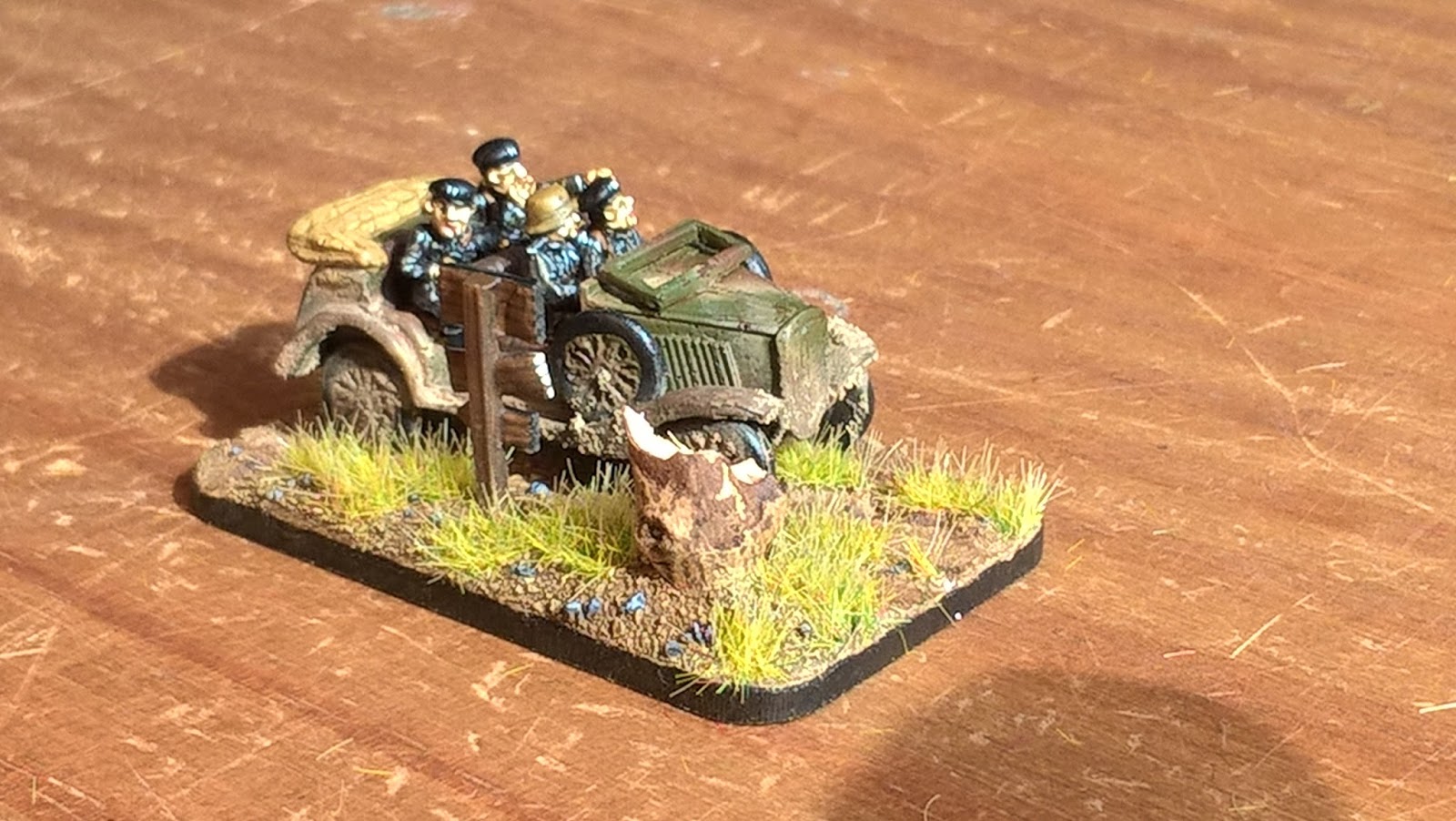
Where the vehicles are concerned, the staff car (Polski Fiat 508 Lazik) had to be sculpted because I wasn't happy with what few sculpts are out there in 15mm. I think the sculpt I've done is OK, it definitely has its problems but I think its probably more accurate than what else is out there at the moment. After a lot of searching around I settled on using Skytrex German vehicle crews to crew out all of my staff cars, motorised tczankas and light tractors... With a few modifications, mainly head swapping for berets, clipping off water bottles and cutting down SMG's etc but after painting and putting them into the vehicles I think they work a treat.
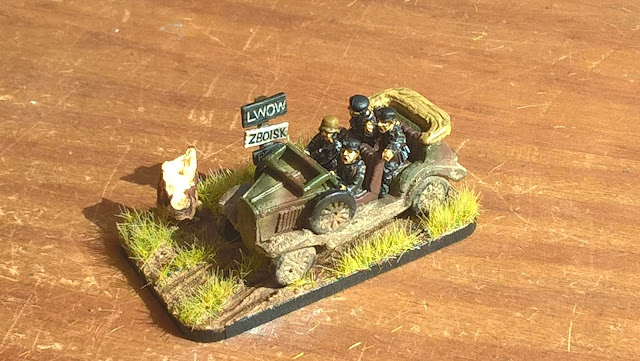 |
| One of the scratch built Polski Fiat 508 Laziks with 4 occupants to indicate the Brigade Command. |
So where the troops are concerned the steps in the painting that I went through is pretty consistent with all of the other Polish troops that I've painted and am likely to paint in the future.
 |
| Another view of Maczek in his staff car. |
There are obviously two types of uniforms that need to be covered here. Of primary interest is the officers, NCO's and motorcycle troops leather attire which is really what attracts most people to modelling the Brigade in the first place, whilst all of the other troops are wearing their summer uniforms in the scorching heat of this hottest of hot Septembers.
 |
| The dispatch rider base showing the base sculpting and exhibiting the leather jackets worn by Motorcycle troops |
All miniatures were primed using Games Workshops Chaos Black undercoat.
Painting the Leather Jackets
Leather is leather is leather, and that means its brown... even when its black! :D I undercoat the leather jackets of the Black Brigade troops with Vallejo German Camo. Black Brown. This then has three coats of black ink put over it, or at least enough so that there is only the merest hint of brown in the final appearance. Once these coats are dry, I apply a drybrush over all of the leather coat with a
subtle (or not so subtle in some of my cases!) Vallejo Yellow Ochre.
 |
| Another view of the dispatch riders |
At this point the jackets will look like they have nosedived. Don't worry, its intentional. The Yellow Ochre is only a supporting chroma and will be almost totally disguised by the final step whilst still adding its organic feel to the overall leather-i-ness!
The final step on the leather jackets is to use Vallejo Ivory, or Vallejo Offwhite to paint fine lines on the most pronounced areas of the jackets, with the occasional line (just two or three should be fine) wet blended into the background of the jacket.
Be VERY careful here. You need to think about where you are putting these lines as in just the right places and in just the right amount it can make the jackets look real but if their positioning is poorly thought out and you use too many, or even make them a little too thick it can look a bit crap unfortunately. Its also a nice touch to wet blend with water some of these lines as it can disperse the hard edge effect somewhat and allow the yellow ochre to provide an organic background resonance to the miniature.
Painting the Textile Uniforms
 |
| A view of the complete Mortar platoon with transport |
All other uniform parts on all other miniatures, except boots and berets but including helmets then had a Vallejo Brown Violet base coat applied. This was followed by a highlight of Vallejo Green Brown for all areas of Violet Brown except for the Helmets which are highlighted with Vallejo's Khaki Grey. All of these areas that started with a Violet Brown than had a layer of AK Interactives Filter for Nato Vehicles. This was then left to dry for a few hours when, using Cotton Buds and White Spirits was washed/rubbed off of the raised areas. Once again it was left to dry completely.
 |
| The Brigades mortar section showing their textile uniforms with the NCO's wearing leather jackets. |
Once this was all dry a layer of Army Painters anti shine varnish was applied. I hate this varnish with a passion. It just looks SOOO good when its on your miniatures but I have never had the problems with clogged nozzles and wasted half full cans that I've had to throw away and replace with any other varnish!!!!
Painting the Ammo Pouches, Y-Harness and Officers Map Case
The Black Brigade were still wearing cavalry uniforms and as such the ammo pouches and Y-Harness (or Yolk, depending on what terminology you use) was made of brown leather. For this I base coated them Vallejo Chocolate Brown and then highlighted with Vallejo Flat Earth
 |
| A view of the rear of one of the Mortar bases showing the leather Y straps and canvas straps on the gas mask tins. |
Painting the RCS Gas Mask Tin, Radio and Mortars
A small piece of equipment but quite important as it provides a colour contrast on the miniature itself. The tin itself is basecoated with Vallejo German Camo. Dark Green and then highlighted, by painting bars on the basecoat in a 1:1 mix of Vallejo Yellow Olive and Vallejo Dark Yellow with a final glaze of Vallejo Russian Green being applied to the top. This step may seem overly detailed for such a tiny element but when you are painting 50+ troops at a time it doesn't seem so bad... and looks good so happy days!
The Radio and Mortars go through exactly the same process...
Painting the Vehicles of the Black Brigade's Command
I primed in black. Once dry I airbrushed the vehicles in Tamiya Olive Green and then applied the colour swatches of Tamiya Flat Brown and Tamiya Buff by airbrush as well. Once dry an AK Interactive Filter for Nato Vehicles was applied and left to dry.
 |
| The two Polski Fiat 621L trucks provided for the mortar section accompanying the Brigade command. |
Once dry the excess filter was removed using white spirits' and cotton buds and again left to dry. Once dry a matt varnish was applied to seal the layer.
All little bits and pieces like wheels and windows were painted. Generally in black with white flashes on the window to indicate reflectiveness.
Where the actual weathering of the vehicles is concerned I had a choice pretty much forced upon me. If you study the photos of the Brigades vehicles in '39 it is very obvious that it was a very dry summer with only a light dust over the vehicles. So I could keep a measure of uniformity across my army, and because I had been forced to be a little heavy handed with the casts I decided that making the wheels and sides of the vehicles muddier than they were in reality was probably my best option.
 |
| A look at the mud and weathering applied to the truck on its sculpted base. |
With that in mind I grabbed my pot of pre mixed European Mud by Mig and used it to fill all of the areas that had noticeable holes in them followed by a light stipple of the mud over the rest of the track section. This is then left to dry. It won't look great at this point due to the size of the granules but don't worry. Migs muds are really designed for 1/35th models so even the grains in it feel too big but in our 15mm models its there to provide some heavy layering of the mud.
The next, and in my case the final step is to paint all of the areas around the wheels and treadboards that you want to affix pigments to with a pigment fixer. The pigment of your choice, in my case it was Vallejo's European Earth, is then heavily brushed into the areas you applied the fixer to and is left for about 15 minutes. Once the time is up I use a soft toothbrush to brush away any excess pigment that is left over.
Once you are satisfied with the weathering it's finally ready to base them but that's a post for another time...
So there we have it ladies! The Black Brigade is finished and the blog posts have begun. Feel free to comment as I would love to hear any thoughts and ideas from you all...