The Reconnaissance Battalion of the Polish 10th Cavalry Brigade was, at the commencement of the second world war, essentially representative of a microcosm of the Brigade as a whole.
Fulfilling the ostensible function of the eyes and ears of the Brigade as a whole they were nonetheless through the fighting of September '39 signed off to operate in areas on their own whilst the remaining organic reconnaissance elements still present with the other formations such as the 24th Uhlans and 10th Mounted Rifles would fulfil the immediate reconnaissance requirements of these formations.
When the Brigade was reborn as a trial motorised formation in 1937 it was originally envisioned that each of the two newly motorised cavalry regiments would have its own organic reconnaissance formation at Squadron strength. Although this process was started, due to financial constraints by 1938 the Army High Command had issued a volte face and decreed that the regimental organic reconnaissance troops would now only be of platoon strength whilst an entire Battalion would designed and integrated into the overall structure of the Brigade.
 |
| A composite of images showing the Brigades motorcycle troops in various circumstances |
When the Brigade was reborn as a trial motorised formation in 1937 it was originally envisioned that each of the two newly motorised cavalry regiments would have its own organic reconnaissance formation at Squadron strength. Although this process was started, due to financial constraints by 1938 the Army High Command had issued a volte face and decreed that the regimental organic reconnaissance troops would now only be of platoon strength whilst an entire Battalion would designed and integrated into the overall structure of the Brigade.
 |
| A Motorcycle platoon of the 10th Cavalry Brigade |
This was achieved in April 1938 where command was handed to a new commanding officer:
______________________
Major Ksawery Swiecicki.
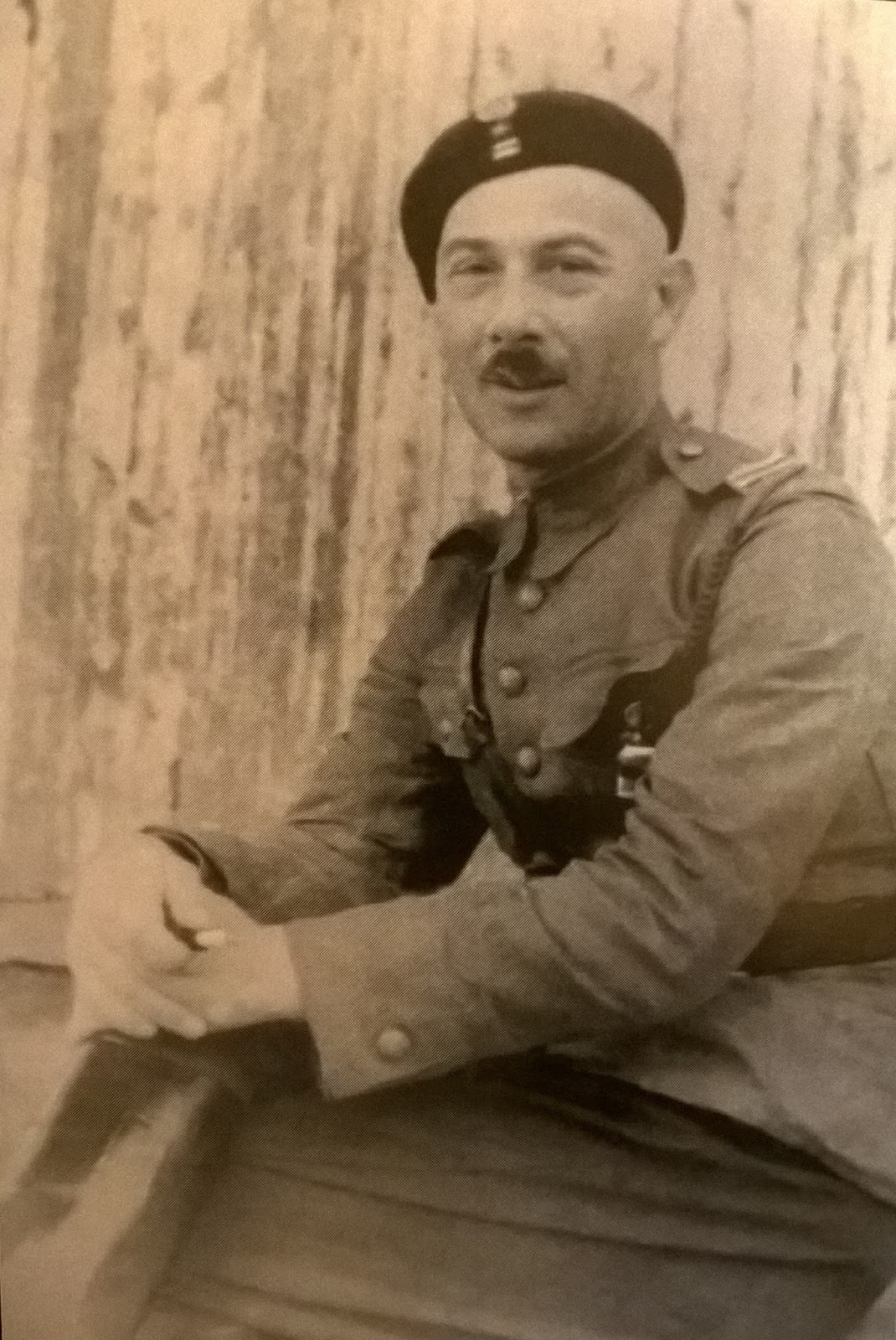
On the outbreak of the first world war in 1914 he joined the Polish legions, serving in the 1st Lancers Regiment quickly rising to the rank of Corporal. As soon as Poland gained her independence from the Central European powers Swiecicki quickly signed up with the nascent Polish army with the 11th Lancers Regiment, as a result of which he fought in the Polish Bolshevik War and the Polish Ukrainian War rising to the rank of Lieutenant of Cavalry.
Throughout the interbellum he rose through a quick series of academic positions with a succession of different regiments eventually being rewarded with command of the 10th Cavalry Brigades Reconnaissance Battalion. Leading this hard core little force through the September Campaign saw him awarded with the Silver Cross to the Virtuti Militari, Poland's highest award for valour.
 After the fall he carried on fighting for Poland and most especially alongside Maczek, the commander of the Black Brigade, escaping from Hungary to rejoin the fugitive forces in France, then fleeing to Britain when the French attempted to sell the Poles out to the Nazi's. Between December 4th, 1940 and November 8th, 1943 he served with the newly constituted Polish 10th Armoured Cavalry Brigade, serving as commander of the Reconnaissance Battalion of the 10th Dragoons.
From here he parted ways with Maczek however as he was given command of a distribution camp that was set up for former Polish prisoners of war that had been freed from German captivity where he served all through 1944 - 1945. It was at this time that he achieved the rank of Colonel.
After the war Ksawery Swiecicki opted not to return to Communist occupied Poland and decided to remain in London where he died in 1966 at the age of 71.
He is laid to rest in Streatham Park Cemetery.
___________________________________
According to order 6277/ Org.Tjn.37 of the General Command Department of the Ministry of Military Affairs it seems that the 10th Mounted Rifles based in Lancut were to form the nucleus of the entire Brigades reconnaissance facilities but this was never achieved and in fact an entirely new battalion was formed and garrisoned in Rzeszow under order L. dz. 1525/ tjn. z20 of April 20th 1938.
The unit was accommodated in the barracks of the former 10th Artillery Squadron and thus became a permanent organic component of the 10th Cavalry Brigade.
On 15th August 1938 this small force was listed as being composed of 12 officers, 24 NCO's and around 150 serving men.
From September 8th, 1938 the Reconnaissance Battalion took part in the Volhynian manoeuvres as a consistutent component of the 10th Cavalry and immediately following the military parade at Moktow Field they accompanied the rest of the Brigade in taking a part in occupying Zaolzie returning to their depots on December 8th, 1938.
The Reconnaissance Battalion was listed as being one of the Mobilisation Units according to Plan 'W' where it would continue to serve with the command of the 10th Cavalry Brigade.
...and by now of course you will be aware of just what kind of fight these boys put up before crossing the border with Hungary having lost almost half of their number in the tooth and nails fights that they had.
Reconnaissance Battalion Structure - 1st September 1939
Headquarters Platoon
Officer in Command - Mjr Ksawery Swiecicki
2nd in Command - Rtm Stanislaw Siewicz
Adjutant - cf. Stefan August Piklikiewicz
Technical Officer - kpt. Tadeusz Pobralski
Doctor - Tadeusz Przezdziecki
7 officers, 36 NCO's
8 Pistols, 1 Rkm, 34 Carbines
2 Polski Fiat 508 III Lazik, 4 motorcycles with sidecars, 4 motorcycles, 1 Polski Fiat 508 III Furgon, 1 Polski Fiat 621L Truck.
Mounted Rifle Squadron
Squadron Commander - rtm. Stanislaw Kazimierz Krahelski (murdered by the Soviets in Kharkov, 1940)
4 officers, 20 NCO's and 90 Serving Soldiers
10 pistols, 10 Rkm's, 3 AT Rifles, 89 Carbines
2 Polski Fiat 508 III Lazik, 8 Polski Fiat 621L Trucks, 3 motorcycles with sidecars, 1 motorbike, fuel bowser
Reconnaissance Tank Squadron
Squadron Commander - rtm. Lucjan Pruszynski
3 officers, 20 NCO's and 35 serving soldiers
32 Pistols, 1 Rkm, 25 Carbines
13 TKS tanks, 1 Polski Fiat 508 III Lazik, 1 Polski Fiat 508 III Furgon, 1 Polski Fiat PF618 radio van, 1 Tanker, 2 Polski Fiat 621L Truck, Field Kitchen, 2 tracked trailers (for use with the TKS' for carrying repair equipment), 1 motorcycle, 4 motorcycles and sidecars
Anti Tank Platoon
Platoon Commander - por. Jan Fedoruk
1 officer, 6 NCO's and 23 serving soldiers
1 Pistol, 29 Carbines, 4 Bofors wz.36 37mm anti tank guns
1 Polski Fiat 508 III Lazik, 4 Polski Fiat 508/518 light tractors, 2 TKS-D's
Communications Platoon
Platoon Commander - see. Maciej Nowicki
1 officer, 6 NCO's and 19 serving soldiers
1 Pistol, 25 Carbines
1 Polski Fiat 508 III Lazik, 1 Polski Fiat 508 III Furgon, 1 Polski Fiat PF618 radio van, 2 motorcycles and sidecars, 3 motorcycles
Motorcycle Reconnaissance Platoon
Platoon Commander - see. Jan Jaroszewicz
1 officer, 8 NCO's and 32 serving soldiers
2 Pistols, 6 motorcycle mounted Rkm's, 51 Carbines
1 Polski Fiat 508 III Lazik, 1 Polski Fiat 508 III Furgon, 1 Polski Fiat 621L Truck, 19 Motorcycles with sidecars, 2 motorcycles and 1 Fuel Bowser
Heavy Machine Gun Platoon
Platoon Commander - por. Otto Saxl
1 officer, 6 NCO's and 26 serving soldiers
6 Pistols, 27 Carbines and 4 Ckm heavy machine guns
4 Polski Fiat 508 III Lazik, 1 Polski Fiat 508 III Furgon, 1 Polski Fiat 621L Truck, 1 Fuel Bowser
Sapper Platoon
Platoon Commander - kpr. Bronislaw Chojnacki
5 NCO's and 7 serving soldiers
1 Pistol, 11 Carbines
3 Polski Fiat 621L Trucks
Modelling the elements of the Reconnaissance Battalion for the Black Brigade
If there is any part of the Black Brigade that truly deserves the epithet it is the reconnaissance battalion.
All parts of this little force can be put together using elements that I have already built and will be covering as parts of other posts outlining how I put this monster together over the last 8 months.
There are two parts however that I have allocated to this post where I actually get to talk about the Reconnaissance Battalion and that is the motorcycle troops and the TKS-D's!
Now, the Motorcycle troops are quite possibly the most attractive of any of the troops of the Black Brigade, both mounted on their bikes and dismounted to skirmish, and that is because ALL of these troops wore the black leather jackets! If there is ever any reason to paint all of your Polish mounted troops in black leather jackets then this is it.
Apart from the limited numbers of photographs available of the Brigade fighting in September '39 leading to most manufacturers sculpting their miniatures in textile greatcoats the other option we get is jackets that go down to just above the knee... and these of course are the wz.36 Kurtka Skorzana (shown to good effect in the photo below).
Finally we have a force that all of those manufacturers out there can turn around and say " See? We did sculpt and paint our miniatures correctly after all!" Ha ha

If you take a close peek at these guys all mounted on their motorcycles you may notice that there are two different manufacturers represented here.

Anybody who has been following my blog will by now know that I hold no truck with sticking square pegs through round holes where they relate to appropriate equipment for a force. I'm not total anal about accuracy and have bodged many things in my days BUT where errors are glaringly obvious I just cant bring myself to settle. I have suspected for a LONG time that the uniforms that are being sculpted for the Black Brigade troopers are inappropriate for September '39 but I didn't have proof until long after I bought all of my miniatures so I have just had to suck it up and get on with things.

I'll be posting a blog giving a detailed breakdown of the Brigades uniform items after I finish my Stanislaw Maczek series for anybody who is interested?!?!?

I bought a 10BK motorcycle from True North miniatures a while ago and realised that their motorcycles, whilst being nicer sculpts than those from Battlefronts were just totally the wrong design. This wouldn't have been a deal breaker if it was just the bike but it wasn't... and isn't! Its the sidecar and its as different as a Landrover from a Lada from the 80's!!!

Whilst Battlefront without a doubt produce the absolute worst figure sculpts for the Polish on the planet their bikes for the Polish are, however close to perfect... and this put me in a dilemma! I couldn't settle for the whole package with either of these manufacturers and as such I decided that I should just stump up the cash and get the correct numbers from both manufacturers and mix the BF bikes with the True North crews... the pillion rider notwithstanding.
A couple of headswaps for berets and the pillion riders all having German helmet heads later, and we were good to go.

It also turned out somewhat serendipitously that I had just enough rogue Black Brigade troopers from Forged in Battle and True North left over to put together a dismounted base for each of the Motorcycle bases in the force, again doing some tidy beret headswaps and providing each base with an NCO with binoculars to indicate reconnaissance troops for the game rules.
The real key to these miniatures is obviously the leather jackets that they all wear... if you remove the bases and faces from consideration that is... oh yeah, and the bikes they are all sitting on! :D
The leather jackets are such a key point that I think they require dwelling on a little.
So, just to quote a previous blog post I wrote:

Leather is leather is leather, and that means its brown... even when its black! :D I undercoat the leather jackets of the Black Brigade troops with Vallejo German Camo. Black Brown. This then has three coats of black ink put over it, or at least enough so that there is only the merest hint of brown in the final appearance. Once these coats are dry, I apply a drybrush over all of the leather coat with a subtle (or not so subtle in some of my cases!) Vallejo Yellow Ochre.
At this point the jackets will look like they have nosedived. Don't worry, its intentional. The Yellow Ochre is only a supporting chroma and will be almost totally disguised by the final step whilst still adding its organic feel to the overall leather-i-ness!


Throughout the interbellum he rose through a quick series of academic positions with a succession of different regiments eventually being rewarded with command of the 10th Cavalry Brigades Reconnaissance Battalion. Leading this hard core little force through the September Campaign saw him awarded with the Silver Cross to the Virtuti Militari, Poland's highest award for valour.

From here he parted ways with Maczek however as he was given command of a distribution camp that was set up for former Polish prisoners of war that had been freed from German captivity where he served all through 1944 - 1945. It was at this time that he achieved the rank of Colonel.
After the war Ksawery Swiecicki opted not to return to Communist occupied Poland and decided to remain in London where he died in 1966 at the age of 71.
He is laid to rest in Streatham Park Cemetery.
 |
| Polish graves in Streatham Cemetery |
 |
| A good look at a 10BK Motorcycle and sidecar with crew |
The unit was accommodated in the barracks of the former 10th Artillery Squadron and thus became a permanent organic component of the 10th Cavalry Brigade.
On 15th August 1938 this small force was listed as being composed of 12 officers, 24 NCO's and around 150 serving men.
 |
| Rtm. Krahelski. Officer in charge of the Mounted Rifle Squadron |
The Reconnaissance Battalion was listed as being one of the Mobilisation Units according to Plan 'W' where it would continue to serve with the command of the 10th Cavalry Brigade.
...and by now of course you will be aware of just what kind of fight these boys put up before crossing the border with Hungary having lost almost half of their number in the tooth and nails fights that they had.
Reconnaissance Battalion Structure - 1st September 1939
Headquarters Platoon
Officer in Command - Mjr Ksawery Swiecicki
2nd in Command - Rtm Stanislaw Siewicz
Adjutant - cf. Stefan August Piklikiewicz
Technical Officer - kpt. Tadeusz Pobralski
Doctor - Tadeusz Przezdziecki
7 officers, 36 NCO's
8 Pistols, 1 Rkm, 34 Carbines
2 Polski Fiat 508 III Lazik, 4 motorcycles with sidecars, 4 motorcycles, 1 Polski Fiat 508 III Furgon, 1 Polski Fiat 621L Truck.
Mounted Rifle Squadron
Squadron Commander - rtm. Stanislaw Kazimierz Krahelski (murdered by the Soviets in Kharkov, 1940)
4 officers, 20 NCO's and 90 Serving Soldiers
10 pistols, 10 Rkm's, 3 AT Rifles, 89 Carbines
2 Polski Fiat 508 III Lazik, 8 Polski Fiat 621L Trucks, 3 motorcycles with sidecars, 1 motorbike, fuel bowser
Reconnaissance Tank Squadron
Squadron Commander - rtm. Lucjan Pruszynski
3 officers, 20 NCO's and 35 serving soldiers
32 Pistols, 1 Rkm, 25 Carbines
13 TKS tanks, 1 Polski Fiat 508 III Lazik, 1 Polski Fiat 508 III Furgon, 1 Polski Fiat PF618 radio van, 1 Tanker, 2 Polski Fiat 621L Truck, Field Kitchen, 2 tracked trailers (for use with the TKS' for carrying repair equipment), 1 motorcycle, 4 motorcycles and sidecars
Anti Tank Platoon
Platoon Commander - por. Jan Fedoruk
1 officer, 6 NCO's and 23 serving soldiers
1 Pistol, 29 Carbines, 4 Bofors wz.36 37mm anti tank guns
1 Polski Fiat 508 III Lazik, 4 Polski Fiat 508/518 light tractors, 2 TKS-D's
Communications Platoon
Platoon Commander - see. Maciej Nowicki
1 officer, 6 NCO's and 19 serving soldiers
1 Pistol, 25 Carbines
1 Polski Fiat 508 III Lazik, 1 Polski Fiat 508 III Furgon, 1 Polski Fiat PF618 radio van, 2 motorcycles and sidecars, 3 motorcycles
Motorcycle Reconnaissance Platoon
Platoon Commander - see. Jan Jaroszewicz
1 officer, 8 NCO's and 32 serving soldiers
2 Pistols, 6 motorcycle mounted Rkm's, 51 Carbines
1 Polski Fiat 508 III Lazik, 1 Polski Fiat 508 III Furgon, 1 Polski Fiat 621L Truck, 19 Motorcycles with sidecars, 2 motorcycles and 1 Fuel Bowser
Heavy Machine Gun Platoon
Platoon Commander - por. Otto Saxl
1 officer, 6 NCO's and 26 serving soldiers
6 Pistols, 27 Carbines and 4 Ckm heavy machine guns
4 Polski Fiat 508 III Lazik, 1 Polski Fiat 508 III Furgon, 1 Polski Fiat 621L Truck, 1 Fuel Bowser
Sapper Platoon
Platoon Commander - kpr. Bronislaw Chojnacki
5 NCO's and 7 serving soldiers
1 Pistol, 11 Carbines
3 Polski Fiat 621L Trucks
Modelling the elements of the Reconnaissance Battalion for the Black Brigade
If there is any part of the Black Brigade that truly deserves the epithet it is the reconnaissance battalion.
 |
| A TKS-D fording a river in Poland '39 |
There are two parts however that I have allocated to this post where I actually get to talk about the Reconnaissance Battalion and that is the motorcycle troops and the TKS-D's!
Now, the Motorcycle troops are quite possibly the most attractive of any of the troops of the Black Brigade, both mounted on their bikes and dismounted to skirmish, and that is because ALL of these troops wore the black leather jackets! If there is ever any reason to paint all of your Polish mounted troops in black leather jackets then this is it.
Apart from the limited numbers of photographs available of the Brigade fighting in September '39 leading to most manufacturers sculpting their miniatures in textile greatcoats the other option we get is jackets that go down to just above the knee... and these of course are the wz.36 Kurtka Skorzana (shown to good effect in the photo below).
 |
| A study of Vehicle and Uniform... see where they got the epithet now? |
Finally we have a force that all of those manufacturers out there can turn around and say " See? We did sculpt and paint our miniatures correctly after all!" Ha ha

If you take a close peek at these guys all mounted on their motorcycles you may notice that there are two different manufacturers represented here.

Anybody who has been following my blog will by now know that I hold no truck with sticking square pegs through round holes where they relate to appropriate equipment for a force. I'm not total anal about accuracy and have bodged many things in my days BUT where errors are glaringly obvious I just cant bring myself to settle. I have suspected for a LONG time that the uniforms that are being sculpted for the Black Brigade troopers are inappropriate for September '39 but I didn't have proof until long after I bought all of my miniatures so I have just had to suck it up and get on with things.

I'll be posting a blog giving a detailed breakdown of the Brigades uniform items after I finish my Stanislaw Maczek series for anybody who is interested?!?!?

I bought a 10BK motorcycle from True North miniatures a while ago and realised that their motorcycles, whilst being nicer sculpts than those from Battlefronts were just totally the wrong design. This wouldn't have been a deal breaker if it was just the bike but it wasn't... and isn't! Its the sidecar and its as different as a Landrover from a Lada from the 80's!!!

Whilst Battlefront without a doubt produce the absolute worst figure sculpts for the Polish on the planet their bikes for the Polish are, however close to perfect... and this put me in a dilemma! I couldn't settle for the whole package with either of these manufacturers and as such I decided that I should just stump up the cash and get the correct numbers from both manufacturers and mix the BF bikes with the True North crews... the pillion rider notwithstanding.
A couple of headswaps for berets and the pillion riders all having German helmet heads later, and we were good to go.

It also turned out somewhat serendipitously that I had just enough rogue Black Brigade troopers from Forged in Battle and True North left over to put together a dismounted base for each of the Motorcycle bases in the force, again doing some tidy beret headswaps and providing each base with an NCO with binoculars to indicate reconnaissance troops for the game rules.
The real key to these miniatures is obviously the leather jackets that they all wear... if you remove the bases and faces from consideration that is... oh yeah, and the bikes they are all sitting on! :D
The leather jackets are such a key point that I think they require dwelling on a little.
So, just to quote a previous blog post I wrote:

Leather is leather is leather, and that means its brown... even when its black! :D I undercoat the leather jackets of the Black Brigade troops with Vallejo German Camo. Black Brown. This then has three coats of black ink put over it, or at least enough so that there is only the merest hint of brown in the final appearance. Once these coats are dry, I apply a drybrush over all of the leather coat with a subtle (or not so subtle in some of my cases!) Vallejo Yellow Ochre.
At this point the jackets will look like they have nosedived. Don't worry, its intentional. The Yellow Ochre is only a supporting chroma and will be almost totally disguised by the final step whilst still adding its organic feel to the overall leather-i-ness!

The final step on the leather jackets is to use Vallejo Ivory, or Vallejo Offwhite to paint fine lines on the most pronounced areas of the jackets, with the occasional line (just two or three should be fine) wet blended into the background of the jacket.
Be VERY careful here. You need to think about where you are putting these lines as in just the right places and in just the right amount it can make the jackets look real but if their positioning is poorly thought out and you use too many, or even make them a little too thick it can look a bit crap unfortunately (just take a close look at the photos to see evidence of this).

Its also a nice touch to wet blend with water some of these lines as it can disperse the hard edge effect somewhat and allow the yellow ochre to provide an organic background resonance to the miniature.
Other than that the bikes are all done with a Tamiya Olive Green by airbrush followed by an AK Interactives Filter for NATO camo vehicles and the usual dramas that go with painting awkward vehicles....
Now, the next and final piece of modelling news for this post is the results of painting the two TKS-D's that I modelled a while ago.


To be sure these were as awkward as hell to make due to all of the small parts and fine details that needed to be captured but I have to say that these are what I am possibly most proud of in my Black Brigade and I may even tentatively claim that these may even be unique on the planet. 15mm TKS-D's!


There isn't actually much to tell here about how I went about painting them as I used the same process as with all of my other Polish vehicles so let me just direct you to the blogpost covering the Black Brigades Command and Control elements at the start of August. Detailed instructions are in the vehicle modelling section at the bottom if you are interested! :D


However the work didn't stop there as these two little dragons needed to be crewed up. Now. the actual TKS-D's were crewed with four troopers each, I however could only find the room in the vehicle for three in each...and for these I had to quite a bit of nip and tuck to get them to fit.


As with all of the other vehicles for my Black Brigade I opted to use Skytrex's German vehicle crews reasoning that when sat in a vehicle you wouldn't be able to tell much of a difference. The Polish wz.36 kurtka was almost an identical cut to the German cotton field jacket. The German y-straps were almost identical to Polish cavalry straps. The packs and pouches on the back of the Germans could be cut off as they would be sat on anyway. Early war Germans along with all German officers through the war wore boots and with some headswaps for berets when a correctly coloured paintjob had been applied you could barely, if at all tell the difference.
Bosh! Job done!!!!


...and of course the bases will all be covered in a Blog post I'm putting together about Black Brigade uniforms as its modelling component!


So.... ummm... Fix Bayonets?


