Showing posts with label September 1939. Show all posts

Monday, 9 December 2019

FoW: Slovak Armour (LT vz.35 tanks)

Finally we have reached that part of our Slovakian odyssey that was such a draw for me in the first place; the funky armour with its funky colours! The Skoda CKD LT vz.35 light tank.


Now there are those out there that will claim that this tank was no less than the best tank in the world when it rolled off of the production lines, and whilst I may categorically disagree with this claim it is a matter of historical record that this tank was good enough early in the war to comprise almost the entire armour park of the Slovakian army, took centre stage in the Romanian and Bulgarian armoured services, provided the base model for the Hungarian Turan II and III and formed almost 10% of the total German tank strength being seen as a good proxy for the Panzer III until such times as German manufacturing could meet the Heers needs.

A total of 434 of these tanks were built by Skoda by the time the Reich had occupied Czechoslovakia and production ceased. The Germans immediately appropriated 244 of them in March 1939. 

When Slovakia were pushed into declaring their independence they were able to retain the 52 LT vz.35's that were a part of the incomplete 3rd Fast Division.

It was constructed with a framework of steel 'angle iron' beams onto which armoured plates were riveted. A 4mm firewall separated the engine block from the crew compartment and the engine block also allowed access via a number of mesh coverings which also served to assist in keeping the engine cool. The engine also assisted the general cooling of the vehicle by drawing air through the commanders cupola.


This was an advantageous feature insofar as dispersing gunfire combustion fumes but also proved to be problematic in that the draft generated by the engine would only serve to exacerbate the freezing weather conditions and there was an increased risk of engine fires reaching the crew compartment. The noise of the engine and the heat that it gave off also appreciably affected the crews fatigue levels.

The driver sat on the right hand side of the crew compartment using a 15.4 in by 3.5 in vision port protected by 2.0 in of bulletproof glass. 

Communication with the driver was via a three coloured light system. The radio operator sat to the left of the driver using a vision port with a 5.9 in by 3.0 in slit using the same protection as the drivers. The radios were mounted on the left hand wall of the crew compartment whilst the hull machine gun was mounted in a ball mount with 30 deg traverse, 25 deg elevation and 10 deg depression. Most of the barrel protruded from the ball mount although the ball and body were protected by an armoured trough. The ball mount had an integrated spotting scope although if a hull plug was removed it could be fired over open sites as well. If it became necessary the driver himself could lock the machine gun in position and fire it himself by using a 'Bowden Cable'. 

One weak spot however was the drivers access hatch which stood proud of the hull and could be damaged by incoming fire.

The turret ring had a relatively tight diameter of only 49.9 inches. The turret itself had a flat frontal face in the centre of which was mounted the 37mm main armament to the right of which was another 7.92mm machine gun in another ball mount.


The commander had four episcopes in his cupola and a monocular mirror with a periscope which the commander could extend once he had removed its armoured cover in the vehicles hatch, to give vision whilst 'buttoned up'.

The tanks 8.62 litre Skoda T-11/0 four cylinder, water cooled engine produced 120 horsepower at 1,800 rpm. Two fuel tanks were fitted, the main tank with a capacity of 124 litres on the left hand side of the engine and the auxiliary tank, carrying a further 29 litres on the other side. The engine was capable of running on gasoline, an alcohol-gasoline mixture and 'Dynalkohol'; an alcohol benzine mixture.

The engine was mounted in the rear alongside the six speed transmission which drove the rear mounted drive sprockets. The tanks suspension originated with the Vickers 6-Ton tank, eight small pairs of road wheels on four bogie assemblies per side with each pair of bogies sprung with a single leaf spring, a front idler wheel and four track return wheels. An unsprung road wheel was located directly underneath the idler wheel to improve obstacle crossing.

The transmission, brakes and steering were all mechanically assisted using compressed air, reducing driver fatigue. This feature proved problematic in the extreme environmental conditions of the Eastern Front.


The main armament was a Skoda UV vz.34 gun with a pepperpot muzzle brake and a prominent armoured recoil cylinder above the barrel designated A3 by Skoda. It fired a 0.815 kg armour piercing shell at 690 m/s. At a 30 deg inclination the AP round could penetrate 37mm at 100m, 31mm at 500m, 26mm at 1000m and 22mm at 1500m. Kliment and Francev recorded a penetrative ability of 45mm of vertical plate at 500mm.

The machine guns ball mount could be either coupled to the main gun or operated independently. Both weapons could elevate 25 deg and depress by 10 deg. Initially the tanks were supplied with the Zbrojovka Brno ZB vz.35 machine guns although in 1938 they were all exchanged for the more modern ZB vz.37's (commonly known in British armoured circles as the Besa HMG).

The tank was equipped with 78 rounds of ammunition (24 AP and 54 HE) along with 2700 rounds of HMG ammunition.

The gun mantle had an armour thickness of 25mm which was concurrent with the thickness of all other frontal armour across the vehicle. The sides and rear areas were almost all 16mm thick although the Hull rear had 19mm of armour and the turret side had only 15mm.


When the Germans forced the Slovaks to declare their independence the nascent, and vastly understrength 3rd Fast Division was stationed within Slovakian borders although its strength was much depleted due to the exodus of the Czechs serving in the 3rd and its assets were garrisoned around Slovakia and not concentrated at any one point.

The Division had started to receive its new LT vz.35's as early as September 1937 just after establishment and by March 1939 had received 52 of them although when Germany annexed the Czech rump nine of the tanks were in Pilsen for repairs. The Germans immediately confiscated these and transferred them to Paderborn to become a part of Panzer Regiment 11. However, very soon after the loss of these nine vehicles a further nine were secured by transfer from the 2nd Armoured Regiment.

These nine vehicles had fought against the Hungarians in Transcarpathian Ruthenia and after the latter was occupied these vehicles had retreated into Slovakia where the authorities confiscated them and subsequently handed them to the 3rd Armoured Regiment as replacements.

Following the return home of the Czech manpower from the 3rd Fast Division, the Slovaks were left with all of the equipment but hardly any qualified staff to man and repair it. The senior remaining officer was Staff Captain Cani who was instructed by the Defence Ministry to reform what was left into an armoured battalion. On 28 April 1939 he submitted his organisational proposal to the ministry for the battalion which was to include two tank companies of LT vz.35's. Due to the manpower shortages however he was forced to request a further 288 men who had some mechanical experience.


The Ministry gave the green light! Army headquarters instructed Infantry Regiments 1-5 to provide the requisite manpower that Cani needed.

By 6 July 1939 Cani had received most of his personnel draft but was forced to complain bitterly that only 28% of the provided manpower had any mechanical experience at all. Some units had even attempted to pass him illiterate soldiers, and even gypsies which he unceremoniously refused.

The battalion was renamed 'Martin', after the home base it was stationed in and started to repair, reorganise and train its staff and equipment. With regards to the repair and maintenance of the tanks Cani was forced to request that Skoda assigned some qualified mechanics to help the new mechanical staff to master the complicated systems of the LT vz.35's.

Skoda dispatched four mechanics who had the entire vehicle park up and running in no time!


In the autumn of 1939 after the limited exposure during the Polish campaign, the battalion was reorganised again, this time having its armoured complement expanded from two to three companies of LT vz.35's with the third company serving as a 'reserves' company. Additional reinforcements meant that the battalion now, once again, became an armoured regiment.

At this time however there were some organisational complications as the battalions had been farmed out in support of the infantry divisions whilst the armoured cars had been attached to the cavalry. This situation ended in May 1940 when all mechanical assets were once again collected together under the regimental umbrella.

At this time the low level organisational structure of the regiment was changed from the old Czech structure to fall in line with German tactical doctrine with the numbers of platoons in a company changing from three to five, although the strength within the platoons went down from five tanks to three. The overall strength therefore did not change but the tactical flexibility did. The strength of the company remained the same at 16 tanks. Five platoons of three and one command vehicle.

This changed in 1941 to 19 vehicles with the addition of a commanders group of three tanks.


As early as September 1939 the Defence Ministry inquired of Skoda about the purchase of a further ten tanks but Germany sat on the permission until April 1940 by which time production of the LT vz.35's had ceased and the Ministry had to look elsewhere.

Through 1940 the regiment was training under peacetime conditions and the tank drivers were first taught in tankettes, then progressing to the obsolete LT vz.34's before finally graduating to the LT vz.35's. The regimental testing track was in nearby Bukovina, live firing was carried out on the ranges at Oremov Laz. The regiment was also providing details for parades in areas such as Bratislava, Michalovce, Banska Bystrica and Martin.

On one occasion they even had to provide a detail of four LT vz.35's to assist in suppressing a miners strike in Handlova in late 1940. Thankfully this was quelled peacefully before the armoured assets even arrived on site.

From January 1941 there was another new organisation with all three armoured companies being collected into their own battalion.


When Germany invaded the Soviet Union the Slovaks sent a combined group of 47 tanks over the border as a part of Brigade Pilfousek a.k.a The Mobile Brigade. Of these 47 tanks 30 were LT vz.35's. At this time the tanks really proved their worth and despite the mountain of technical obstacles that needed to be overcome it seems that by July 1941 these issues had all been resolved and the tanks were running true.

Within the ranks of the Slovak field army at this time however were many officers with very strong anti fascist sympathies who from the beginning had strong connections back home with the nationalist  underground. They were strongly of the opinion that the tanks would be better served at home in preparation for an uprising against the regime rather than being frittered away on the Eastern Front serving Nazi Germany. For these reasons members of the 1st Tank Company were able to sabotage the engines of three of their tanks and have them shipped home.

In the meantime the Mobile Group was steaming ahead, having lost a single LT vz.35 which plunged off of a bridge at Wojtovka. The crew did manage to survive however. A further ten LT vz.35's had to be left behind due to mechanical failures or sabotage. All of these ended up being shipped back to Slovakia for extensive repairs.

The Mobile Brigade was reorganised on 8 July 1941 with its tank battalion now being named 'Diamant' and containing twenty LT vz.35's out of a total of thirty six tanks. A further seven  LT vz.35's were assigned to Diamant from the Field Army's former Tank Company 11 for a total of  forty three tanks.


During the battle for Lipovec, the Mobile Brigades first real contact with the enemy they lost their first LT vz.35 to a mine, abandoning it to the Red Army who destroyed it during their night retreat. Another LT vz.35 got bogged down and had to be abandoned by its crew. This was also destroyed by the Soviets during the night and they lost a third LT vz.35 during their retrograde movement from Lipovec.

The fighting within Lipovec proper was a stiff fought affair however and a further five LT vz.35's suffered heavy damage in the close quarter fighting.

The tank repair shop under Lieutenant Herha was a part of the conspiracy to preserve the nations armoured vehicles. Though perfectly capable of repairing the vehicles in the field, Lieutenant Herha, in collusion with the regiments commander Major Dobrotka, managed to persuade the Mobile Brigades headquarters, and even a German commission that all of the vehicles had to be returned to Slovakia to have repairs conducted there.

After the return of the vehicles to Turciansky sv.Martin the Armoured Regiment started to conduct its repairs which due to the reasons already mentioned progressed exceptionally slowly...


On 23 July 1941 General Catlos decided to reorganise all Slovak field forces into a Mobile Division and a Security Division. The Security Division never had any LT vz.35's assigned to it and by the time of the establishment of the Mobile Division all of the armoured assets had been shipped back to Slovakia.

By January 1942 the regiment still had a great many of its armoured vehicles out of commission. Out of forty nine LT vz.35's only seven were serviceable and capable of being in the field. Obviously the accuracy of the term 'out of commission' where these vehicles were concerned was extremely liberal with the majority within the abilities of the mechanical engineering teams to repair in the field, let alone at a home servicing depot.

By the time of the Soviet offensive of January 1943 the Mobile Division still had no LT vz.35's assigned to it only having been assigned two platoons of LT vz.38's and LT vz.40's. Only one of these vehicles survived the retreat to the Crimea and eventually found its way back to Slovakia.

The Slovakian LT vz.35's did see some limited action within the National Uprising but apart from that their story has pretty much run its course so lets now turn our attention to how we go about painting these little beauties.


The first thing that I do on any of my vehicles is always the green base colour.

The main paint scheme for these tanks is done by airbrush using my MIG Aircobra for the Priming and Basecoating and my Harder & Steenbeck for all of the shading and highlighting as my H&S has a 0.15 needle and provides a hell of a lot more control... but the MIG is SOOOOO easy to clean it just makes sense to use it where I can...

The Airbrushing steps are as follows:
i) The model is primed with a Matt Black Etch Primer
ii) The basecoat is Tamiya's XF-58's Olive Green
iii) The first highlight is LifeColors UA221 Khaki Olive Drab applied in a panel highlight fashion
iv) The second highlight is LifeColors UA224 Olive Drab Faded Type 2 applied as above but a bit lighter and gathered in along the edges and prominent areas
v) The third highlight is a 50/50 mix of LifeColors UA224 Olive Drab Faded Type 2 with LifeColor 01 White. This is applied sparingly just along the edges and prominent areas.


So that's the airbrushing complete and don't be overly concerned if your third highlight was too heavy as the next two steps will, if done correctly, tone the whole contrasted effect down.

vi) The next step is to apply the colour swatches over the body of the vehicle that will provide the camouflage pattern. With the green camouflage base now finished off I add swatches of Vallejo's 914 Green Ochre and Vallejo's 826 German Camo Med. Brown to leave an equal balance of all three colours in an intentionally smoothed edge blotted pattern.
vii) Now we apply the Filter over the whole thing to unify the colour aesthetic and clip the contrast a little. I apply MIG's Filter 1506 Brown for Dark Green.
viii) Once dry wipe of any serious excess from where it may have pooled but otherwise leave it untouched.
ix) At this point I apply the first layer of Varnish. It doesn't matter which varnish you choose so long as it fixes the Filter layer to the miniature as its an oil based layer.

Once the varnish is dry its time for the next layer which is where the real depth starts to come out.


x) Over every detail laden part of the model apply a Wash. I use AK Interactives Wash 075 Wash for NATO Camouflage Vehicles. Don't be shy with this step. Slap it on aplenty! Then leave to dry for a while.
xi) Once its dry (or dry-ish) use cotton buds (cue tips for you Yankees out there...) and use a gentle white spirit to wipe away the excess leaving great detail and shadowing around all of your detail areas and a general lowering of the overall luminosity. Personally I use Winsor & Newtons Artists White Spirit as I had a bad experience with normal white spirit stripping away four layers of paint and primer and have no wish to repeat the disaster!
xii) Once the whole piece is dry to the touch apply another layer of varnish to fix everything in place.
xiii) The last thing to do with paint (if you want to; I chose to omit this step with these tanks as I like the camo scheme too much to just cover it all up with mud!) is to lightly airbrush a layer of Vallejo's 826 German Camo Medium Brown across the wheels and the lower third of the vehicle. This layer has a highlight of Vallejo's 914 Green Ochre mixed in whatever ratio you want with the German Camo Medium Brown already in the airbrush and is then applied in splotches to provide some variance in the muddy weathering.
xiv) A final varnishing is applied to the vehicle which are then finally fixed to their bases.
xv) ...and so we come to the very last thing that I needed to do for these Slovak additions... the decals.


Now, I am capable of making my own decals BUT the experience that I have had so far has led to decals that are uncomfortably thick and ones that cannot include white unless as an overall substrate to the total image and so one of my Polish friends suggested I approach a gentleman in Poland that both he and his father had used to produce specialist decals.


I thus contracted one Bogdan Zolnierowicz through Facebook to produce for me a decal sheet with enough Slovak aircraft and tank markings to polish off everything that I thought I would need. Along with a couple of sheets of numbers and letters I had enough to produce the exact representation that I wanted and Bogdan's decals were exactly what the doctor ordered.


Incidentally if you want to approach Bogdan for help with decals he says you are all welcome to do so. He may not respond quickly but he will eventually and he is the only one on Facebook with the name.

He knocked out a sheet with a stack of tiny Slovak crosses for me which duly made it to the turrets of these armoured vehicles.

So there we have it ladies and gents. Another mini project finished and one (read twelve) more items to place onto the table alongside the rest of my Slovak Mobile forces

Onwards and Upwards!

Fix bayonets!

Monday, 27 May 2019

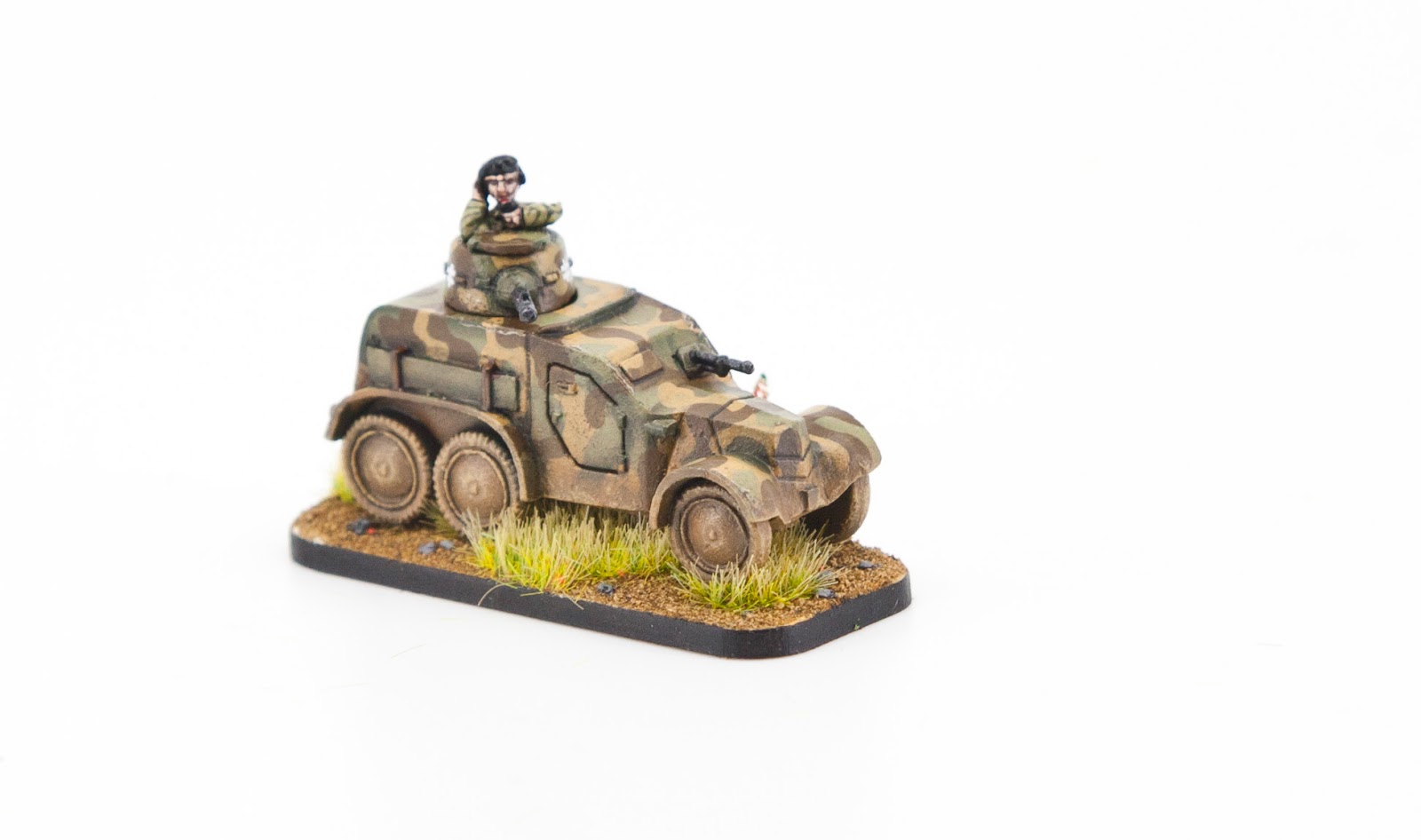
FoW: Slovak Armoured Cars (Oa vz.30's)

So, as it stands my life is upside down at the moment as I attempt to complete a relocation to the other side of the country, complete an internal transfer on the railways (and fight every inch of the way with a grossly incompetent/unproductive HR department!) and finish off buying a house...

All of this I must confess has sapped my will to live much less my will to write so I have found it remarkably hard to sit down and apply myself to the string of blog posts that I still have to do for my Flames of War Slovak army.... BUT having just sat down to watch 'How to Train your Dragon: The Hidden World' with my besties plus family I finally felt an urge to put down some words.... 

... and so here I am!

I thought I would ease myself back into things with a relatively quick and simple post covering one of my favourite Slovak vehicles; the Tatra OA vz.30 armoured car! No conversion here just good old simple painting... and a little bit of history! 

Easy right? Well, lets see!


Lets start at the beginning, when Czechoslovakia was still 'a thing' and the landscape of Europe was creaking under the weight of ideological ego!

The OA vz.30 (full title being Obrneny Automobil vzor 30 - Armoured Car model 30) was a homegrown Czechoslovakian armoured car designed by the Tatra company which through the course of its active service saw use with the Czechoslovakian and Slovak armed forces and was either appropriated or exported to other countries such as Germany, Romania and Hungary during the Second World War.

A total of fifty one of these vehicles were manufactured by Tatra before production ceased, of which the Germans seized twenty four when they occupied Bohemia-Moravia in March 1939, whilst the Slovaks retained eighteen when they declared independence from Czechoslovakia at the same time. Romania was able to bag nine when Czech troops sought refuge across the border following the Hungarian invasion of the Carpatho-Ukraine in the same month.


Here we will deal principally with the Czechoslovakian and Slovakian vehicles though, and they saw combat deployments in Poland '39, the Slovak-Hungarian War and throughout the Slovak experience on the Eastern Front when in January 1944 they were finally phased out of service as the Slovaks received PzKpfw II's to replace them although they were kept on the Army's equipment rolls... and yet their journey was not over because in late '44 when the Slovaks rose up against their former German allies the OA vz.30's were once again thrust into the combat zone in the Slovak National Uprising!

The OA vz.30's armoured body used the chassis of the Tatra 6x4 T-72 truck as its foundation. The central tube design of the chassis itself was unusual as it had independently sprung rear half axles which rendered superb cross country performance. 


The driver of the vehicle was positioned on the right side of the body and used an observation port which was protected by an armoured visor with an integral vision slit. The assistant driver sat on the left hand side with a smaller vision port through which his ZB vz.26 light machine gun protruded. This one was mounted to fire directly to the front of the vehicle. There were similar vision slits on both sides of the vehicle as well to enable all round visibility. The crew accessed the vehicle through a door on the rear wall of the vehicle.

The vehicle commander (and primary gunner) sat in a small cylindrical turret mounted on the top of the vehicle capable of a full 360 deg traverse. It included an observation port in the front alongside the turret weapon and was complemented with more vision slits on the turret sides and rear. The turrets main armament was another ZB vz.26 light machine gun mounted in a ball mount. 


It was standard practise to carry another spare light machine gun inside the vehicle as well. Over 3000 rounds of ammunition were stored in the vehicle for all of the weapons and the armour was typically between 3-6mm thick. Whilst nothing to write home about by any means, it must be stated that when this vehicle was designed in 1933 this was considered more than suitable to deflect any small arms fire from 100m or more. 

It had a 4 cylinder, 32 horsepower, air cooled Tatra 71 engine, mounted on the front of the vehicle and enabling a top speed of 37 mph, and being able to negotiate ditches up to 0.5m wide and ford water obstacles up to 0.3m deep.


The Czechoslovakian army had been evaluating a series of different Tatra truck chassis for application as armoured cars since 1926 with a number of prototypes built over the years with both wooden and metal bodies to trial a variety of different layouts. The Czechoslovakian military finally placed an order on 6th March 1933 for fifty one OA vz.30's for a projected delivery in December of that same year.

Tatra was late on the delivery and was only able to deliver the first six on 29th January 1934 followed by sixteen more in February and the final batch delivered in July on account of their destination workshops and garages in Milovice were not yet complete.


The pre-war Czechoslovakian armed forces had all of their armour concentrated into 'Mobile' Divisions of which there were supposed to be four and which had a formal organisation set down on 1st October 1937. These were based on the French Division Legere along with things gleaned from German experience. The fine details are not relevant here suffice it to say that the only part of these Mobile Divisions that had armoured cars in their TO&E's was as a part of the Reconnaissance Battalion which was directly subordinated to the Divisional Headquarters.

These Mobile Divisions never achieved full establishment strength before the demobilisation in 1938 and of the four only one, the 3rd Mobile Division was stationed in Slovakia, which was so positioned to serve as the Operational Reserve for the Czechoslovakian 3rd Army. Its 3rd Armoured Regiment was stationed in Turciansky sv.Martin where the barracks and garages, warehouses and work-shops for its vehicles were based after being built between 1935-37. By the end of 1936 the regiment had a total complement of eighteen OA vz.30 armoured cars, three OA vz.27's, thirty Vz.33 tankettes and fifteen LT vz.34 light tanks.


Despite an expansion in the Regiments tank strength, the numbers of armoured cars remained the same and other than the 3rd Replacement Battalion, all other armoured cars were allocated to the companies of the 1st Battalion along with the vz.33 tankettes.

The regiment retained its three OA vz.27's, but of its eighteen OA vz.30's it transferred eight vehicles to the Czech Gendarmerie, later acquiring another eight vehicles from the 2nd Armoured Regiment along with some tanks. These particular vehicles ended up fighting against the Hungarian invasion of Transcarpathian Ruthenia, later retreating into Slovakia where they were confiscated by the Slovak authorities before its Czech crews could sabotage them.


During the conflict with the Hungarians between 23-26th March 1939 one of the armoured cars (No. 13401) was destroyed and had to be abandoned before Hungary occupied the former Slovak territory.


After the departure of all of the Czech serving men the Regiment was left with all of its equipment but hardly any men to crew them. The most senior remaining officer was Staff Captain Cani who was placed in command and given the remit to create a full Armoured Battalion. On 28th April he proposed a battalion structure composed of a headquarters, one armoured car company, two tank companies and one anti-tank company. He was compelled to ask for a further 288 men to fully outfit the battalion. 


By 6th July 1939 the battalion had achieved its manpower targets and was renamed Armoured Battalion 'Martin' and training with its vehicles and assets was began. In the autumn of 1939 the organisation of the Battalion changed again with the reconnaissance assets being amalgamated into a 'group' with a single platoon of three armoured cars only.

Following a limited deployment of the OA vz.30's into Poland in September 1939 (the vz.27's being considered too old and obsolete for front-line service) the Battalion was reinforced again with the anti-tank battalion from Hlohovec and renamed as a Regiment. 


By January 1940 the Armoured Regiment had a structure in line with that proposed by the now Major Cani. It had the 1st of four companies in the First Battalion of armoured cars. Initially this caused some organisational complications as initially the Armoured Regiment was subordinated to the infantry, whilst some of its armoured car companies were subordinated to the heavy squadrons of the Cavalry Reconnaissance Groups No's I & II. This situation ended in May 1940 when all of the armoured cars officially became a constituent part of the Regiment, although on occasion the platoons may have been subordinated to other services temporarily to complete certain functions.

As new assets were made available and manpower shortages were overcome a reorganisation occurred once again, and from January 1941 with the following organisation:

Headquarters
Staff Company
Motorised Company (Armoured Cars)
1st Battalion (3 Tank Companies)
2nd Battalion (3 Anti-Tank Companies)
Reserve Battalion


On June 1941 the Armoured Regiment sent a combined group of 47 tanks and included a company of three armoured cars with the Mobile Group when it entered the Soviet Union. In this campaign both tanks and armoured cars repeatedly proved their quality.

Despite many serving officers in the Slovakian ranks having extreme anti-fascist leanings, and a resultant endemic sabotage of their own armoured vehicles in order to have them sent home for future use, the Slovaks were still able to maintain and armoured force in the field on the front line.


Following a further reorganisation of the Mobile Brigade on 8th July 1941, they were still able to field a Motorised Reconnaissance Group which fielded five OA vz.30's.

Slovakia's first major combat engagement against units of the Red Army was around the town of Lipovec (Lypovets in the Vinnytsia Oblast of the Ukraine). Things did not go as well as expected! The fight began at 05:00, instigated by three of the Reconnaissance Groups five armoured cars accompanied by a company of cyclists who made contact with a company of Soviet infantry dug into foxholes about three kilometres west of the town itself. By 16:00 the repeated combined arms assaults of the Mobile Brigade had managed to penetrate the defensive cordon of the Soviet 44th Siberian Infantry Division and had entered the suburbs of Lipovec itself, capturing the railway station.

It was then that disaster struck. 


Colonel Pilfousek, the commanding officer of the Mobile Brigade ordered them to advance on Lipovec because he was convinced that the town had already been taken. Advancing down a single road into Lipovec the entire Brigade was caught on the right flank by an aggressive counterattack launched by two Soviet infantry battalions supported by very accurate supporting artillery fire. 

The Soviets split the Mobile Brigade in half, isolating the front half within Lipovec itself whilst the main force on the road began to retreat in a panic only managing to bring the Soviet counterattack to a halt about 2km in front of Shchaslyva to the west of Lipovec.


Tanks from the 1st and 2nd Companies were sent forwards to assist the troops trapped in Lipovec, joining a single tank from 3rd Company. A desperate struggle broke out as the tanks broke through Soviet anti-tank defences joining the armoured cars trapped in the town. One of the OA vz.30's (13403) was hit and burned out completely. One was hit and abandoned by its crew and the final one suffered light damage. The fighting continued until 22:00 when the withdrawal from the town was complete and the Slovaks were able to pull back to the safety of their own lines, pursued by Soviet anti-tank guns knocking out further Slovak tanks. 


They were able to occupy the town the next day bloodlessly as the Soviets had withdrawn. The captured OA vz.30 had already had red stars painted over its Slovak crosses!

The battle of Lipovec revealed that the Mobile Brigade was simply not strong enough to take on divisional level forces on its own and steps were taken to strengthen the Brigade further although the road ahead was a long one and further attrition was the inevitable result.

By 1st January 1942 the regiment was still able to field many of its armoured vehicles despite having many of them shipped back to Slovakia. Out of sixteen OA vz.30's only seven were left fully repaired and operational.


In August 1942 the Ministry of Defence finally got around to bolstering the Security Division with some armoured assets included in which was assigned six OA vz.30's. They were widely used in patrolling and anti partisan actions. Two of them (13399 and 13411) were lost in action at Lojev and the rest of the company was sent back to Slovakia on 12th January 1943 at which time only one of the four remaining armoured cars was in running condition.

As a replacement for the aged and worn out OA vz.30's the Ministry of Defence placed an order for twenty PzKpfw II's to be used as reconnaissance vehicles. They managed to obtain sixteen of them in January 1944. At this time the OA vz.27's were phased out and the remaining OA vz.30's were placed into storage as no longer usable although they were still kept on the rolls.


The OA vz.30 armoured cars performed their duties magnificently, considering that they were over ten years old, lightly armoured, armed with only two light machine guns incapable of sustained fire and using an engine that was considered under-powered. These cars moved over terrain they were not designed for and were able to fight in place of heavy armoured cars and even in the place of tanks in some places.

So there we have it; an summarised combat history of these little darlings.

Now we come to the modelling and as you have already read so many times I wont bore you with the basing as its the same for absolutely everything that I do so we will just get straight into the painting.


The first thing that I do on any of my vehicles is always the green base colour.

The main paint scheme of the armoured cars is done by airbrush using my MIG Aircobra for the Priming and Basecoating and my Harder & Steenbeck for all of the shading and highlighting as my H&S has a 0.15 needle and provides a hell of a lot more control... but the MIG is SOOOOO easy to clean it just makes sense to use it where I can...

The Airbrushing steps are as follows:
i) The model is primed with a Matt Black Etch Primer
ii) The basecoat is Tamiya's XF-58's Olive Green
iii) The first highlight is LifeColors UA221 Khaki Olive Drab applied in a panel highlight fashion
iv) The second highlight is LifeColors UA224 Olive Drab Faded Type 2 applied as above but a bit lighter and gathered in along the edges and prominent areas
v) The third highlight is a 50/50 mix of LifeColors UA224 Olive Drab Faded Type 2 with LifeColor 01 White. This is applied sparingly just along the edges and prominent areas.


So that's the airbrushing complete and don't be overly concerned if your third highlight was too heavy as the next two steps will, if done correctly, tone the whole contrasted effect down.

vi) The next step is to apply the colour swatches over the body of the vehicle that will provide the camouflage pattern. With the green camouflage base now finished off I add swatches of Vallejo's 914 Green Ochre and Vallejo's 826 German Camo Med. Brown to leave an equal balance of all three colours in an intentionally smoothed edge blotted pattern.
vii) Now we apply the Filter over the whole thing to unify the colour aesthetic and clip the contrast a little. I apply MIG's Filter 1506 Brown for Dark Green.
viii) Once dry wipe of any serious excess from where it may have pooled but otherwise leave it untouched.
ix) At this point I apply the first layer of Varnish. It doesn't matter which varnish you choose so long as it fixes the Filter layer to the miniature as its an oil based layer.

Once the varnish is dry its time for the next layer which is where the real depth starts to come out.

x) Over every detail laden part of the model apply a Wash. I use AK Interactives Wash 075 Wash for NATO Camouflage Vehicles. Don't be shy with this step. Slap it on aplenty! Then leave to dry for a while.


xi) Once its dry (or dry-ish) use cotton buds (cue tips for you Yankees out there...) and use a gentle white spirit to wipe away the excess leaving great detail and shadowing around all of your detail areas and a general lowering of the overall luminosity. Personally I use Winsor & Newtons Artists White Spirit as I had a bad experience with normal white spirit stripping away four layers of paint and primer and have no wish to repeat the disaster!
xii) Once the whole piece is dry to the touch apply another layer of varnish to fix everything in place.
xiii) The last thing to do with paint is to lightly airbrush a layer of Vallejo's 826 German Camo Medium Brown across the wheels and the lower third of the vehicle. This layer has a highlight of Vallejo's 914 Green Ochre mixed in whatever ratio you want with the German Camo Medium Brown already in the airbrush and is then applied in splotches to provide some variance in the muddy weathering.
xiv) A final varnishing is applied to the vehicle which are then finally fixed to their bases.
xv) ...and so we come to the very last thing that I needed to do for these Slovak additions... the decals.

Now, I am capable of making my own decals BUT the experience that I have had so far has led to decals that are uncomfortably thick and ones that cannot include white unless as an overall substrate to the total image and so one of my Polish friends suggested I approach a gentleman in Poland that both he and his father had used to produce specialist decals.

I thus contracted one Bogdan Zolnierowicz through Facebook to produce for me a decal sheet with enough Slovak aircraft and tank markings to polish off everything that I thought I would need. Along with a couple of sheets of numbers and letters I had enough to produce the exact representation that I wanted and Bogdan's decals were exactly what the doctor ordered.

Incidentally if you want to approach Bogdan for help with decals he says you are all welcome to do so. He may not respond quickly but he will eventually and he is the only one on Facebook with the name.

He knocked out a sheet with a stack of tiny Slovak crosses for me which duly made it to the turrets of these armoured cars.

So there we have it ladies and gents. Another mini project finished and one (read six) more items to place onto the table alongside the rest of my Slovak Mobile forces

Onwards and Upwards Ladies!

Fix bayonets!


Monday, 23 July 2018

New Study Materials... excitement!

Just a very brief blog post this time.

I dont know where it came from but for as long as I can remember (although with age that is rapidly shortening!) I have had a hard on for Poland '39

I collected and read everything I could that was written in the English language... but lets be honest the sources and more especially the details are a bit thin on the ground where the English language is concerned.

... so I taught myself how to translate Polish... and wow what a world that opened up for me!

So obviously those of you who are regular readers will know that Ive done a lot of translation work relating to the Black Brigade and the National Defence...

but there are other organisations that are just tooooooooo fascinating to be ignored and I just received my latest book order from my mother in law in Poland (see image)


So what is all of this loveliness then?

Well just like I've completed a FoW document on the Obrona Narodowa for you hallowed gamers out there, next year I hope to do one of the last pillar of the Polish military triumvirate; the Korpus Ochrany Pogranicza (KOP) a.k.a The Border Protection Corps. I've now accrued about 8 books on these guys and only have a cavalry book to source for me to start work.

I'm also really interested in the Policja Panstwowe. These are essentially a state sponsored pseudo militaristic police force that even the majority of Poles have forgotten that these guys were fighting the length and breadth of Poland in '39. I now have a couple of books and half a dozen documents on their arms and organisations. Should provide something to work with.

Finally one area that I am really REALLY interested is the Polish river fleets. They didn't really play much of a part in '39 BUT the potential is fantastic and the modelling opportunities are out of this world. I just received the last issue of the Lexicon that I didn't have covering the Flotilla's. Add this to all of the other books and documents I have about this its going to provide the foundation for another document about that!

I see interesting times ahead!

Tuesday, 17 July 2018

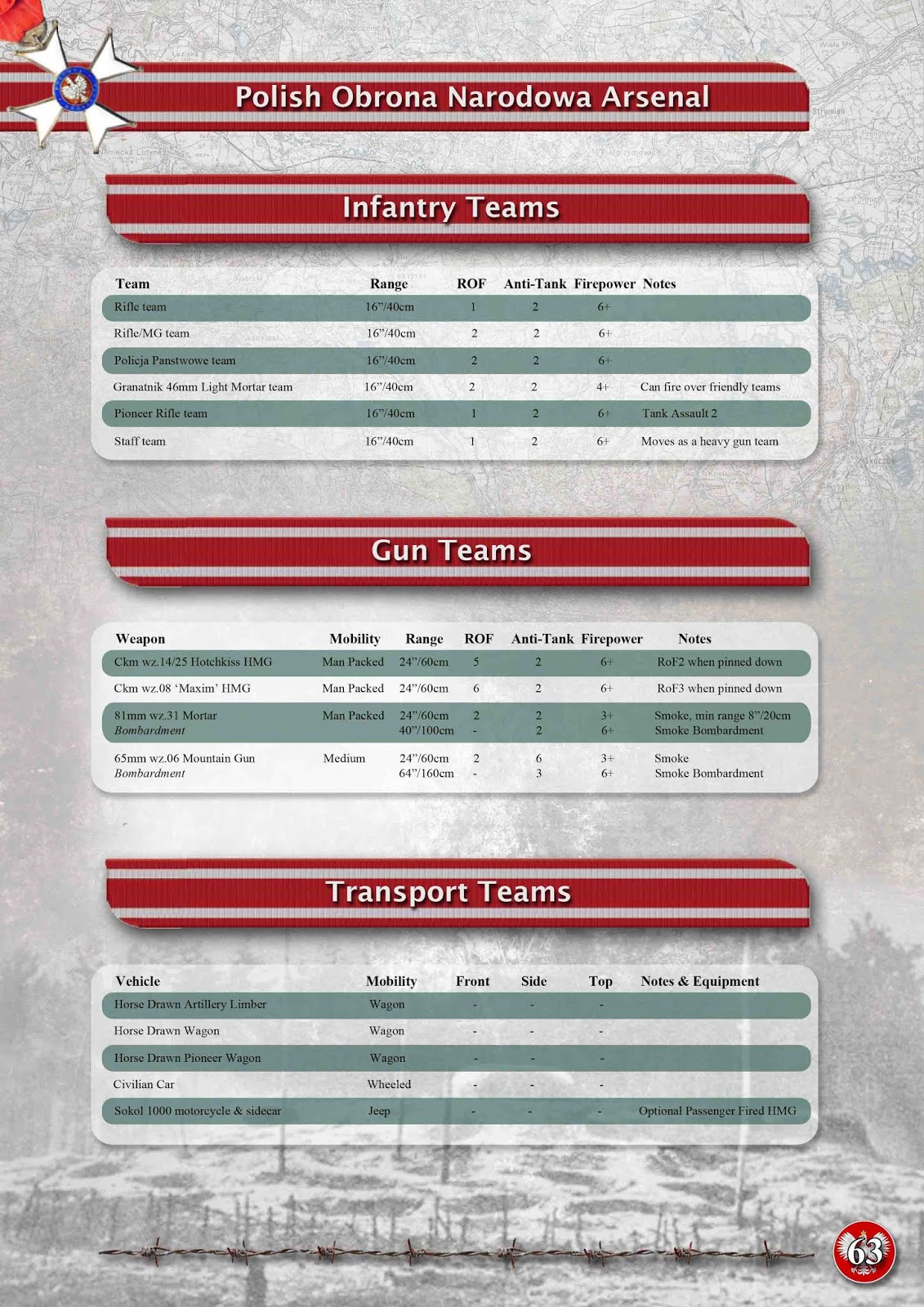
FoW: Intelligence Briefing. Obrona Narodowa 1939

Well, its done! finally! No more Obrona Narodowa will ever need to be thought about again... at least until I've fixed my bayonets and I'm ready to run a Nazi or Commie through with it and then of course I will absolutely accept no substitute!

So I'm not going to waste anybody's time with long explanations of how and why I did this, other than to say it was one massive MASSIVE learning curve... I did NOT use DTP as the last time I used  it professionally was almost 10 years ago. This whole thing has been completed in Photoshop and then combined in Adobe Acrobat Reader DC. Its not perfect BUT it is a labour of love.

Its a Flames of War V3 Intelligence Brief that I hope some of you out there will enjoy reading if not using.

Anybody that wants it can access it here:
https://drive.google.com/drive/folders/1_rQIRYNUw-1G1k6LG3xa852vMsWJk0MR?usp=drive_link

Cut and paste the link into Google and it will take you straight to it.

Anybody that just wants to have a look at the pages, well, you've come to the right place:


...and now I think its time to move onto something completely different. 

Zulus and Slovaks!

...until next time gents...