Showing posts with label Falaise Gap. Show all posts

Thursday, 31 August 2017

Stanislaw Maczek - Part 7 - The End of World War 2, Betrayal and Exile (1944-1994)


1st Polish Armoured Division in Normandy
As the resolution of the Normandy campaign began to set in for the Poles they came to realise that they would find it a massive struggle to be able to make good the losses sustained in Normandy, meanwhile geo-politics were to decide the fate of Maczek and his men who would be left behind by events. Even in September '44 their future didnt look as bleak as it was to become. Stalin's European ambitions were starting to become clear to the Polish army in exile in 1944 although many still believed that they would still be able to return to the land of their birth.


A Stuart light tank in Normandy
Maczek's immediate problem was how to maintain an operational division in the field whilst almost 2000 men below establishment. He was worried most of all about the Division being halted at the Somme area and stood down. He mulled over the numbers and considered a number of actions including amalgamating his armoured troops from four troops to three and using them for armoured reconnaissance.  The reconnaissance regiments were to have their US supplied Stuart light tanks replaced with White Scout Cars whilst the anti aircraft platoons throughout the division were to be abolished with the manpower subsequently being moved over to the infantry in light of the Luftwaffe's evaporation.

A British Staff report also took the Polish losses seriously and made recognition of the fact that the Canadians were now having to actively support the Poles in the field. They opted to leave events to play out to see how the Poles coped with the issues before the next phase of operations around the Somme area kicked off which gave the Poles about three weeks breathing space.

Allied soldiers with a liberated Ostruppen
Losses were being made good actually but sadly the replacements were coming in slower than hoped. 350 men came in the week beginning 28th August with a further 700 being made available over the next three weeks. There were also replacements coming from the German Ostruppen POW's who couldnt wait to change uniforms, although Brigadier Lloyd was insistent that these turncoats needed to go through a screening process before being fully integrated into the Polish armed forces.


Of course, a further complication was the training that these men required in order to fall into step with the 1st PAD effectively.

Polish Radio Operator 1944
Maczek raised his concerns with the Polish Army Staff but nothing appeared to be solvable and the lack of experienced recruits available came home to roost in November of '44 when the 1st Armoured Division received an official reprimand from Army Group over the lax security measures that the 1st PAD were seen to be employing in the Divisional Wireless Net. This included messages being transmitted in native Polish as opposed to being broadcast in code. This was unforgiveable because even if the Polish struggled to speak English, there was certainly no shortage of Germans who spoke Polish and even Poles who were still willing to work alongside the Nazi state.


An infantry patrol in France 1944
Maczek was also concerned with the amateur nature of the replacements he was receiving that were supposed to be making good his losses. This was brought home by the results of slack patrolling after the enemy had successfully raided the southern bank of the Maas where the 1st PAD were stationed. It was considered that Polish patrols acted inappropriately when meeting German patrols; they panicked. Patrol reports were incomplete and frequently arrived at unwarranted conclusions instead of using accurate facts to deduce results.


It was resolved that defences needed to be beefed up, patrolling should be intensified and more rigorous checking of patrol reports was to be made mandatory.

Maczek and Crerar
It wasnt all grim however, Crerar (OiC of Canadian 1st Army) wrote of the Poles in Maple Leaf on 1st November 1944 that '...during recent weeks the Poles have been fighting under extremely difficult conditions, and have established an outstanding reputation by their accomplishments... Every demand ever made on these troops has been met. Every task has been complted, no matter how bitter the enemys defences or how unsavoury the natural conditions. With such officers and men military success and final victory can never be in doubt... in all the fighting of the 1st Canadian Army during the last three months the Polish troops have set the finest of military standards'. Truly amazing words considering the hostile attitude towards the Poles that the Canadian military hierarchy harboured a mere three months earlier.

Following the Falaise dust up the Poles claimed that they were ready to fight again within a week. Casualties would have their effect however. Infantry companies were now below 100 men and the tank companies now had three platoons instead of the four... but despite this, by 31st August the Division crossed the River Dives via the 'Warsaw Bridge' and gave chase to the enemy.


The 1st Polish Armoured Divisions liberation route...


Abbeville as it appeared in 1944
One of the most important tasks of the 1st PAD was to locate and secure bridges over water obstacles. Corps had received word of an intact bridge in the Abbeville area although on moving towards the target area Reconnaissance reported that the bridge had been blown. This was 11:30 on 2nd September 1944. By 17:15 hours Polish sappers had built a bridge under fire and 3rd Rifle Brigade had stormed the river and forced a crossing.


They chased the Germans into Belgium where on 12th September they liberated Ghent then turning north clearing the countryside north of Germans to the Scheldt Estuary.

Polish armour with a bit of R&R before crossing into Holland
By the end of September  '44 they were preparing to move into their assembly area prior to the invasion of the Netherlands. After the fighting in the thick and choking environment of Normandy the Division now found itself in totally unfamiliar surroundings. Flat wetlands, frequently flooded and criss-crossed with canals for the most part bereft of bridges and what bridges there were, being bitterly defended by the Germans.


It was during this wet and marshy autumn and winter that the Division started to show absolutely superb cooperation between the Armour, Infantry and Sappers. The heroism of the Polish sappers should be a matter for historical record. They were frequently called upon to cross heavily defended watercourses and required to throw up bridges and construct fords all under furious defensive fire so that the armour and infantry could get across and continue the advance.

Casualties remained high however with Zgorzelski of the 10th Dragoons sending a battle report to Maczek following a crossing of the Axel Canal on 22nd September where he had to report the loss of 106 men in one day including 4 officers. However Maczek also reports that morale remained high amongst the men on account of the level of success that they were achieving despite the losses.

Throughout October 1944 the 1st Polish Armoured Division was engaged in this tooth and nail war of overcoming obastacles. Always well prepared for defense by the Germans, gains were always accompanied with a significant loss of men.

The Poles liberate Breda...

A Polish dispatch rider reaches Breda
30th October saw Maczek achieve one of his proudest triumphs. The capture of the city of Breda and more importantly to the civiilian population; the manner in which he captured it.


As Captain Stanislaw Grabowski oberved 'there were two ways that they had available to them. Monty's way which involved laying on an aerial bombardment of the town and then a blitz assault or shelling it and then blitz it or there was General Maczeks way which was to encircle the town and then there was a chance that street fighting could be avoided, thus he gained reknown amongst the civilian population'.


8th Infantry Brigade being greeted by the Dutch at Breda
Captain Tadeusz Wielgorski of 2nd Armoured Regiment observed something similar saying that when they were capturing Breda all of the regiments and their tanks could have fired and caused complete devastation. They did not, and that was why Breda 'greeted us so warmly'.


After passing Breda they turned north chasing the Germans until they had them trapped against the waters of the Hollandsche Diep. This unfolded into a 10 day battle, including the crossing of the Mark Canal, once again in the teeth of strenuous resistance finally culminating with the capture of Moerdijk on the coast.


In mid November 1944 the 1st Polish Armoured Division was given its first proper chance to rest, with its headquarters situated in Breda. During this period of R&R the Divisional staff had a chance to take stock of where they actually were.

The losses so to speak, and my oh my, were they sobering figures.

Brigadier General Stanislaw Maczek with Breda's Burgemeester Van Slobbe (and some other punkah wallah in uniform!)

Treating a victim of sniper fire on the battlefield
For the period of 8th August to 15th November they had lost 4,478 killed, wounded or missing, including 291 officers. Amazingly only five men had been captured by the Germans since Falaise which would suggest something of the stubborn nature of the Poles, but also may reflect the speed at which the axis forces were moving backwards. The ten week chase across the low countries had cost them 3,038 casualties with the infantry bearing the 63% brunt of the casualties and the armour next on the list with 16.25%. In addition to all of this there was a high percentage of hospitalised cases with 56 officers and a further 1,237 men.

This brought the casualties to a grand total of 5,771 men. There were a further 1,773 officers and men who were sick but who had returned to the regiments, albeit maybe not all to front line duty. It makes you wonder just who was left doing the fighting.

Polish armour moving across wide open spaces
At the beginning of the Low Country Pursuit on 9th September 1944, the strength of the Division was 736 officers and 11,950 men. This was gradually boosted by replacements from the UK  and Maczek, with the agreement of General Kopanski, the Chief of the Polish Staff agreed on setting a target of 15th February to have the Division back up to strength and combat ready. Maczek also agreed to leave the Division available for operations throughout this period of reinforcement. By the end of March 1945 the Division had received 58 officers and 4,496 men as replacements. All material shortages were made good as well which given the size of the small size of the organic permanent training staff was an incredible feat.


It was during this winter break however that many of the Poles eventually found the time again to sit down and consider what was happening in the world around them and their place in it.

Meanwhile at Yalta Roosevelt says:
"Gentlemen, lets share the world..."
It was at this time that Churchill, Roosevelt and Stalin all met at Yalta in the Middle East, purposefully excluding Poland from being invited to contribute on the discussion relating to their own future. The Yalta Conference has come to be seen as big a stab in the back for an ally that had fought, bled and died alongside us for our freedoms as that of Munich in 1938 where we left Czechoslovakia to be torn apart by the Nazis giving us 'Peace in our time' (Really?).

Whilst at Yalta, East and Central Europe were to all intents and purposes handed over to the Communists with Churchill aparently being quite ebullient about allowing the communists to expand their area of influence. Once again Anthony Eden, our man of the hour, stepped in to voice his concern about the voraciously aquisitive nature of Stalin and the Communist Regime. He categorically refused to believe that they would behave well to the new populations within their expanded sphere, merely wanting to expand their reach and most definitely at the expense of absolutely anybody who got in their way.

One of the plenary sessions at Yalta 1945
At seven of the eight plenary sessions at Yalta, Poland was the subject. Stalin and his cronies were absolutely adamant that Poland should be made strong again but only under Communist guidance and that she should be well compensated from Germanys eastern territories for her own loss of territory although what Poland gained in no way made up for the massive area of land that she had lost to the Soviet invasion of '39. It was already clear by '43 that Stalin never intended to return any of the Polish territories and had already quite systematically brutalised the population with massive programs of deportations to the east having already been undertaken... and lets not forget the Katyn atrocities.

Anders was not amused!
The Western powers were quite simply outmanoeuvred at Yalta by Stalin, and left desperately trying to make an absolute ass kicking look like some sort of moral victory for the Polish people... that is, until General Anders heard the results. He quite abruptly stated to Chnurchill that 'Yalta is the end of Poland!'

Maczek found himself considering the situation. The new Polish borders were to follow the Curzon Line which was the orignal British ideas for the Polish borders in 1918, but his home, Lwow would no longer  be Polish. He considered the death camps of Oswiecim (Auschwitz-Birkenau) and Dachau and the expulsion of the Nazi abomination from the homeland and was left wondering if the Nazis really were really still the main enemy. He wondered if he could even return home at all?

True to form though, he rejected all personal concerns and opinions and stated that 'a soldier should not speak of his fate or his future, no matter how hard or unfair it might be' Nevertheless it should also be pointed out here that the Foreign Office was acutely aware of how unhappy Maczek was with the high handed attitude that Anders was displaying towards wartime military/politics and in a wholly unusual departure for Maczek was openly critical of him.

The Poles staged at Hengelo prepare to cross the border into Germany...
There was one last episode to be played out before the Divsion's final battle and the war drew to a close and in April '45 the Division was moved 150 miles from Breda to the area of Hengelo in preparation for a new offensive. Once again they had to cross water obstacles under fire and were preparing to do so when an urgent request reached them.


It was revealed that at nearby Niederlangen there was a womans detention camp which contained women of the Armia Krajowe, captured during the Warsaw Uprising of '44. There was a concern that the nazis may try to use the women as some sort of diversionary tactic and so High Command deemed it essential that an armoured platoon be sent to the camp to liberate them.

Maczek with some of the liberated
women of Warsaw's Armia Krajowa
A platoon from 3rd Squadron, 10th Mounted Rifles was sent to the camp. The woman were set to jump over the moon when they realised that what they thought were English soldiers were actually Polish troops. One woman known simply as Mieczyslawa lauded her liberation from Stalag VI C Oberlangen by the 10th Mounted Rifles troops. Once the women heard the soldiers speak they realised that they were Polish; the most important thing for the women was to make sure that the soldiers spoke to them in Polish. It is an interesting note that one woman who was liberated wrote to Baca (this means The Good Shepherd, and its one of Maczeks nicknames that his troops bestowed on him) on his 100th birthday still thanking him for liberating her. The women displayed their military discipline and fortitude when General Maczek later arrived at the camp and the women formally paraded with their commanding officer; Lieutenant 'Jaga' Milewska of the Polish Home Army making her formal report that 1,726 women, soldiers of the Home Army in Stalag VI C Oberlangen were reporting for duty.

The fate of the failed uprising was brought into stark and ugly focus on that day.

Polish armour a bit stuck in the mud!
On the 19th April 1945 the Division breached its final water obstacle, the Kusten Canal and reached its final objective of the war; Wilmhelmshaven. Typically of Maczek he delayed the action for as long as possible in order to bring as much firepower to bear as possible without causing excessive casualties.


On 4th May the 10th Mounted Rifles and 8th Rifle Battalion halted at the outer rings of the Wilmhelmshaven defences and in the evening called in artillery support in order to open up a passage into the town but a signal had been received that an armistice had been arranged for 08:00 the next morning, 5th May 1945.

The artillery opened up and continued without pause until 07:59.

The destroyed Wilmhelmshaven docks after the capitulation in 1945

In their final offensive operations in Germany the Division had lost a further 600 men and officers but had taken 5000 prisoners and an enormous amount of materials.

Mazcek described the end of the war and the taking of the German surrender in Ostfriesland at the HQ of II Canadian Corps at Bad Zwischenahn. He recalled how in a large empty room General Guy Simonds sat behind a long table with his Chief of Staff and Divisional Commanders. No seats for the Germans indicated the hostility of the reception that they were to receive.

General Erich Straube
Six German officers entered the room; General Erich Straube, CO of the 1st Parachute Army between the rivers Ems and Weser. He was accompanied by the commanding officer of the local units of Kriegsmarine (German Navy), his Chief of Staff and three officers in charge of areas in Ostfriesland. They entered and stood to attention. Maczek considered the difference between these men and those that were captured on the field of conflict. Whereas those men were raw and exhibiting all manner of emotions, covered in dirt and dust, these men in front of him were stiff, formal and masked. They could be concealing everything or nothing.


Straube began to speak but Simonds cut him off immediately stating that he had not come here to negotiate but to listen to Simonds and accept an unconditional surrender with absolutely non-negotiable terms. Simonds read the list in a hard edged and clear voice.

The Polish flag is raised
Maczek drifted back to 1939 and considered how General Kutrzeba must have felt surrending Warsaw to the Nazi animals when he was brought back to the room by Simonds busy allocating the German areas to different Canadian organisations. Simonds had allocated the 1st Polish Armoured Division to occupy Wilhelmshaven and disarm the garrison. Hearing that a Polish formation would be the occuping force caused the German officers to grimace and from studiously avoiding looking at him, they finally had to confront Maczek sitting there in his uniform emblazoned with Polish insignia.

In a quaint turn of phrase Maczek recorded in his diary that "surely it wasnt necessary to remind them that they had unleashed this dreadful war with the attack on Poland and in the presence of one of the few Polish units still fighting they were now laying down their arms"


The 1st Polish Armoured Division, fighting in Germany, was to occupy a part of Germany. Maczek was left wondering whether or not this must have been the first time in history that this must have happened?

Surrendered German U-Boats in 1945
The haul in Wilmhelmshaven was incredible. Tens of thousands of prisoners including two Admirals and a General were taken. The quantity of captured equipment was truly astronomical; 3 cruisers, 18 submarines, 205 minor warships and support vessels, 94 fortress guns, 159 field guns, 560 machine guns, 40,000 rifles, 280,000 artillery shells and 64 million rounds of small arms ammunition. In addition to this there were stores of mines, torpedos as well as supplies of food for 50,000 men for a period of 6 months.

Even if the war had ended on a high for General Maczek and his indefatigable Polish warriors, peace was to prove a grave disappointment as wartime alliances were quickly forgotten.

Maczek back in Scotland and surrounded again...
The first signs of things not going the way they were expected to was received by Maczek a mere two weeks after the occupation of Wilmhelmshaven when he was recalled to Scotland in order to take command of the I Polish Corps. Being a smart guy he probably saw the way the wind was blowing.

What he probably couldnt have anticipated however was being stripped of his citizenship on 6th September 1946 by the Polish Communist puppet government along with a list of another 75 senior Polish officers for taking up arms under and accepting orders from another foreign power.

For the rest of his life Maczek would refuse to recognise the Polish Peoples Republic as anything other than a puppet state jiggling on Communist strings.

Polish President Jaruzelski
After years of misdeeds, once the Communist regime in Poland began to falter, the illegal Jaruzelski regime began to try to use Maczeks name and deeds as a part of their damage control utilising the idea of the Polish soldier, no matter where they were or where they served as the saviours of the nation. McGilvray raises the possibility that this was possibly just one old soldier simply reaching out to another but Maczek stoutly refused to respond to these overtures quite rightly seeing them as nothing more than an attempt to link his name and the Second Republic, which he proudly represented to the corrupt and illegal communist controlled regime that dominated Poland between 1944 and 1989.


Without starting up a long text driven debate concerning the Polish place in the UK after the war it can be said with some justification that the UK government were a bunch of gutless weasles with yellow streaks wider than the San Andreas Fault who continued the long English tradition of abandoning our allies when they have needed us the most unless our own pockets were being hit and the actions of the Communists in Poland were for the most part brushed as far under the carpet as could be managed.

It was apparently quite clear to many of the Poles what the situation in Poland would likely be if they were able to return to their homeland after 1945. Maczek did not desire to return to  Poland under those circumstances and it was with some sorrow that he held his final meeting with Colonel Dec and his future, possibly in Poland.

Franciszek Skibinski early and late in life. 
Relationships with Franciszek Skibinski had unfortunately soured remarkably however, as he had apparently embraced the ideas of Communism and had decided to return to Poland. Maczek was of the opinion that Skibinski was being opportunistic seeking to further his career, even if under the Communists. Skibinski would return to Poland, but within a year was arrested and tortured including having all of his teeth knocked out. When a more progressive form of Communism was able to supplant the Stalinist paraoia in 1956 Skibinski was quietly released and made a General.


The decision to deprive Maczek of his citizenship was overturned in 1971 but as it was the government of the Polish Peoples Republic making the decree, and therefore a Communist vassal Maczek ignored the decree. It was not until the fall of Communism in Poland in 1989 that Maczek accepted the gesture.

Lieutenant Jan Suchcitz, one of the veterans of the 10th Mounted Rifles, reflected that in the remaining 50 years of Maczeks life he never sought any accolades, was always a firm believer in an apolitical army and took no part in the political folly that had riven the Polish army for so many years.

The Virtuti Militari
Maczek did occasionally sally forth into the political arena however and was, in 1961 openly critical of the manner in which the highest Polish military accolade, the Virtuti Militari, was awarded for the September Campaign. For a campaign of such monumental failure he was of the opinion that far too many had been subsequently awarded. Again in 1961, in a letter to General Grudzinski he was critical of the mass awarding of the medal.

In contrast to some, such as General Anders, Maczek was to remain employed in humble jobs in order to support his family in Edinburgh. He received no pension from either the british or canadian government (and yes the respective governments deserve no capitalisation in this regard!) and it was only the appreciation and generosity of the Dutch people that facilitated a secure future for the Maczeks disabled daughter.

It was reported in the Polish Press in London in 1995 that Maczek did eventually receive a generous pension from the Dutch government. No doubt this was connected to the Polish liberation of Breda and Maczek being instrumental in its liberation without destruction.

The bar in the Learmont Hotel that Mr Maczek worked in
This was a sadly belated honour however as Mr Stanislaw Maczek, as he preferred to be known after the war, had to find work as a Barman and later on as a shop assistant, right up to the end of the 1960's in order to support his family. Despite these setbacks however, he was never a downhearted person. He was always attentive to his Divisions former members, always attended reunions and commemorations and he always gladly welcomed visits from his former subordinates.


The problem of senior Polish officers gaining employment in the UK after the war was one that was to haunt Maczek for the rest of his days in exile and was ironically, by association, the reason for being stripped of his Polish citizenship.


Following the surrender of Germany a census of Poles serving under Western Command was taken in the wake of the news that Poland was being handed to the tender mercies of the Communists and a total of only 17.2% were happy to return. The underlying problem with this was that the majority of the British public had, given the enormous suffering that the Soviet Union had suffered through the war, a healthy sympathy for the communist people and their politicians. Ever the slaves to public passions, the home government also had a significant distrust of Anders rabidly anti communist rhetoric and that of other members of the Polish II Corps, believing that it would likely result in political complications if left unchecked, much less actually fostered and accepted.

One of the PRC camps
Finally, the British government came up with an idea of how to discharge all of the serving Polish troops. The Polish Armed Forces (Repatriation and Resettlement Scheme), which was a vehicle by which Poles could be moved from the military either into local civilian life or even back to Poland, was established. For those that chose to remain in the U.K the Poles established the Polish Resettlement Corps (PRC). It was established to serve as a sort of halfway house in which discharged Poles could be prepared for life in the West.


An example of a Polish Resettlement Corp registration book
It was the establishment of the PRC that was to prove so problematic for the Poles as it caused tremendous anger within Communist ranks, both in Moscow and its new vassal states. The Soviets decided that any members of the PRC had taken military service under a foreign government which was actually categorically untrue. Despite the uniforms being worn the organisation was a civilian operation.

Commie puppet Marshal Michal Rola-Zymierski
The new Polish puppet Defence Minister, Marshal Zymierski had broadcast the message that anybody enlisting in the PRC would be stripped of their citizenship despite the fact that it was non military, as well as being both a logical and pragmatic step in the transition to civilian life in Great Britain.

Perhaps the most obvious way for Great Britain to provide assistance to Maczek would have been to take the step that they did with so many other senior serving Poles and offer them a comfortable pension. At a time when the average British employee was earning in the region of £24 a month General Anders, the most political of the Polish military hierarchy and certainly the deepest thorn in the side of the allies with regards to his political anti soviet rhetoric was awarded £100 a month with many others receiving between this and £75.

What beggars belief is that Maczek, who commanded I Corps, was apolitical and whose prescience and planning had pulled the allies collective balls out of the fire in Normandy was awarded nothing! Not a penny!

Thankfully not all British are so disgraceful and this decision did indeed raise comments in official circles.

Bernard Law Montgomery in 1948
McGilvray quotes a note that Bernard Law Montgomery had written to the cabinet querying how their cases were to be dealt with and I think its worth quoting in full:"... General Maczek with the 1st Polish Armoured Division played a large part in the closing of the Falaise Gap.
b) These officers at PRC have aided Britain in assisting government policy and resettled their men into the British economy.
c) These men have lost everything they possessed. Kopanski and Maczek have been publicly deprived of their Polish nationality. The majority have spent their spare money in ensuring a good education for their children and as a consequence have saved little or nothing."


Another partisan to Maczeks cause said:

"... General Maczek had most loyally handled the problem of the resettlement of Poles in Scotland and the liquidation of the Polish commitment to Scottish Command. He fought gallantly under Field Marshal Montgomery's command throughout the 1944/45 campaign in France and who, since he has been running the PRC's commitment  in Scottish Command, has absolutely no money of his own, and has a wife and two children to educate, also an idiot child whom he has to maintain. He is most anxious to know whether any provision will be made for him. I cannot help feeling that it would be an injustice, after the service rendered to us, to leave this type of man to sink or swim on his own."


The author of this note, who was writing to the Prime Minister, Clemence Attlee considered that a pension should be provided for a Polish Officer IF:

a) Of the rank of Major General, its equivalent or above
b) Had served in the Polish Armed Forces under British command during the war
c) Had served in the PRC

Minutes recorded by one Barbara Green at the Ministry of Labour and National Service are also in print as agreeing with these perspectives.

1st Polish Armoured Division is demobilised
The end for Maczeks former Division, the Black Devils came on March 1947 when a discussion was held at HQ on BAOR (British Army on the Rhine) to decide when to demobilise the Division and transport those who wanted it back to the UK and into the ranks of PRC. It was finally settled that the 1st Polish Armoured Division would cease to be at 1 minute past midnight on 1st May 1947.

That was the end of the story for one hell of a Division. Resolute in the face of seemingly insurmountable odds, stubborn, aggressive and one that had served the allied cause to the highest expectation in both good times and bad, they had fought from the first day of the war right up until the last, suffering a series of catastrophic reverses across Europe before remodelling themselves and striding back the other way across Europe and dishing out emphatic wallopings as they went!

Maczeks immediate fate after demobilisation is that he never received a pension from the British government worth mentioning! At the age of 57, with no skills other than understanding the nature of waging combined arms mobile warfare, he had to go out into the British job market in order to support his family.

The Learmonth Hotel in Edinburgh. Now a Travel lodge.
A former NCO from Maczek's Division gave him a job and as ever, uncomplaining, Maczek rose early  in the morning and took a 30km bus journey to Edinburgh where he worked as a barman at the Learmonth Hotel. Maczek, being a naturally upbeat and optimistic person never let his personal circumstances get him down though and he still managed to find a smile for his patrons.


Life was a series of struggles for the Maczek family but he never complained and they never asked for help. An insignificant pension from the British government was provided but was so inconsequential that it served very little practical purpose within the household so he carried on working in the bar. Every time his veterans stopped by for a pint they would stand to attention in recognition of his rank.

16 Arden Street in Edinburgh. Mr Maczek's family home.
The details of how Maczeks life unfolded after this period now become considerably less dense. Once the PRC was disbanded and Maczek settled into the grim monotony of civilian life, with his resolute refusal to recognise the communist occupiers of his country it would seem that he became somewhat of an icon to the Polish expatriates who had opted to make Great Britain their home. It was certainly a far cry form his 20's when he studied philosophy and fought tooth and nail on the Italian Front.


His memoirs go no further than the end of the Second World War and morally he usually avoided the Polish predilection for meddling in political issues that split the Polish community so frequently. In point of fact, by refusing to involve himself in these areas he was to become quite a thorn in the side of the communist body politik for some time to come.

Mr Maczek in Breda in the '60's
We should all be thankful however that no matter how abhorrently our own government treated a man of Maczeks calibre, other countries of Europe were a lot more graceful in remembering him and his men. As McGilvray tells it Renata, Maczeks daughter, reminiscing on a visit to the Netherlands said that her father was feted wherever he travelled in the late 1940's and again in the 1960's was feted once more as he took the part of honoured guest when he and other veteran guests retraced their steps that they so bloodily took in 1944. In Axel there were 4 days of celebration whilst a street was renamed 'General Maczekstraat', in Ypres a metal tablet commemorating the actions of 1st Polish Armoured Division was also unveiled.

Mr Maczek became the titular head of the Polish expatriate community in Scotland. With his self imposed distance from the Polish Government in Exile (which incidentally was no longer recognised by any state in the world) Maczek was able to retain a dignity that was admirable and he was stalwart in his refusal to recognise the Polish puppet state, even when, under a more moderate form of communism his nationality was offered to be restored in an effort to rehabilitate the government with its people by appropriating past heroes.

He ignored these overtures still!

The Edinburgh Military Tattoo 1972
He remained loyal to 'his boys' who were by now all pensioners. A lifetime of loyalty and service. By the time Maczek was 80 even the British were finally remembering him. It ws announced that he was to be the guest of honour of the Commander of the Army during the Edinburgh Military Tattoo.

The Dutch, ever loyal to his memory, held a concert orchestra in honour of his 80th birthday.


The turn of a century was a big event for Maczek. Cards and notes from well wishers poured in from around the world with many young people from the Netherlands and Belgium found amongst the congratulatory messages, writing to him to express their gratitude for the freedom that he and his men had bestowed on their countries through the shedding of their blood so selflessly.

Lech Walesa, victorious in his own anti communist uprising
By the time Maczek turned 100 Poland had finally shuffled loose the communist yolk and new Polish President Lech Walesa made Maczek a full General and awarded him a pension.


Sadly Maczek was too frail to return home to Poland by this point in time and in any case his true home was now a part of the Ukraine but he had lived long enough to know that his beloved Poland had been freed from under the communist boot.


General Stanislaw Maczek 1944

Mr Stanislaw Maczek died on 11th December 1994 at the grand old age of 102, rightly mourned by the Poles, Dutch and Scots. His funeral was held in Edinburgh but he was laid to rest at Breda alongside his men at the site of perhaps his most poignant victory.

His legacy to the majority of those who choose to remember him will doubtless be one of military exploits, struggle and victories against the odds but this would be to forget his humanity. He was a man who cared more for the person than the victory. He had iron ethics which he never compromised and he gave a lifetime of service asking nothing in return. His towering sense of duty and responsibility saw him look after a disabled daughter without batting an eyelid for as long as was humanly possible with the same sense of duty that he shepherded his old soldiers. He never once turned his back on an old comrade and he held to his personal creed just long enough to see Poland become a true democracy and a sovereign nation once more.

This old warrior must have finally died in peace.

Men cast in his mould, and finished to his standard are few and far between. One or two in a generation are what makes the world turn and serve as icons that allow the rest of us to aim to be something greater than we are. We should respect their moral legacies and always seek to pay our dues to their memories.

Gone, but never forgotten. R.I.P Mr Stanislaw Maczek

Mr Maczeks grave situated with all of 'his boys' in Breda, Netherlands


Friday, 25 August 2017

Stanislaw Maczek - Part 6 - Normandy, The Caen Cauldron and the Falaise Gap (1944)


On the 6th of June 1944, what was perhaps the greatest act of military subterfuge of all time was finally played out. Led to believe that the allies would attack across the channel towards Calais, the Germans were all but blindsided when one of the largest armadas in history dropped anchor off of the 5 beaches in Normandy.

The D Day beaches with the ships stretching off to the horizon...


The invasion of mainland Europe had begun in earnest and the British, Canadian and American troops stormed ashore, carving out a serious enclave within a day.


1st Polish Armoured Division
disembarking in Normandy 1944
D+56 Maczek came ashore amidst the three day depositing of the 1st Polish Armoured Division into the allied lines. Landing at Arromanches (I've been here. Beautiful little town with the remains of the Mulberry Harbours still rusting away in the waves just off of the beach), they moved off towards Bayeux on the 7th August and for the first time entered the Order of Battle for the allied forces in Northern Europe.


Maczek made a sadly prophetic remark to French Colonel De Langlade (landing along with the French legend General Leclerc, soon to be promoted to General and finishing his career commanding all of the Cambodian theatre in the First Indochina War) saying, "You are a lucky man Colonel. If you are killed in France you will die on your own liberated soil. We shall die on friendly soil, but even so, foreign soil. We shall never see Poland again!" One of the Division had even been killed before the 1st PAD landed in France. Colonel Jerezy Levittoux, Maczek’s Chief of Staff, had been killed at the front in July '44 preparing for the Divisions arrival.

1st Polish Armoured Division finally arrive in France as a fully fledged division and not just a token force...
Maczek briefing his staff
Szudek sets the tone well, saying that the 1st PAD had arrived in France with 13,000 soldiers, 381 tanks and 4,050 vehicles for their first armoured battle since being in France in 1940... and it just so happened to coincide with the first day of Armia Krajowe's (AK - The Polish Home Army) attempt to shake loose the Nazi yolk in the ill-fated Warsaw Uprising.

Maczek’s order of the day No.40 made the 1st PAD's intentions very clear, stating that the Poles "should demand payment for every Polish life taken!" However, he was also insistent that the Poles should maintain their élan and fight the war as if they were knights of old still and not descend into the barbarism frequently resorted to by the Germans. Maczek went even further by stating "We are going into battle alongside the best Allied Divisions. We know what you are worth and that is why today, as your commander, I wish you one thing - let the Germans pay heavily in blood for the privilege of fighting you!"

A rare colour image of Maczek
Coming to know the man on our journey with him through his life, there can be no doubt that he meant and even more, felt, every single one of those words. Fine words to lead his men into the fire with. We have seen that Maczek was a humanitarian who, despite the horror that the Polish people were routinely subjected to, and sadly subjected others to at times, believed in rising above it and only resorting to killing when absolutely necessary. Despite the hatred drowning the world immediately around them, with flagrant murders committed by both sides through the Normandy campaign, it would appear that Maczek kept a tight rein on his men and they chose to behave well and exhibit the best of traits when in such a horrific environment. Indeed, the Poles would very soon get their own baptism by fire.

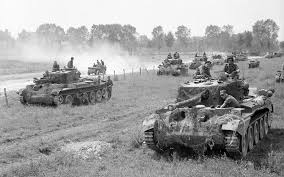
A Polish Cromwell passing a destroyed Pak 40 in Operation TOTALIZE
...and quite a blooding it was to be! Thrown into the cauldron as a part of Operation Totalize, a note to the 10th Armoured Brigade made it clear that there had been very heavy fighting throughout the night of 8/9th August which was still continuing. Maczek was reported as being very upbeat about returning to combat by Polish war correspondent, Maciej Feldhuzen on the 8th. A week later he is reported as saying to John Wilhelm, a Reuters reporter, that the 1st PAD were akin to modern Hussars and couldn’t wait to get to grips with the enemy again. He underlined this by categorically claiming that the Polish were good tank soldiers and once again compared them to the 16th Century Polish cavalry.


Monty with 1st Polish Armoured Division
On arriving in Normandy the 1st PAD had a briefing given by Montgomery, with only officers down to squadron level attending. This was typical of him. He assumed that bypassing the middle men and ensuring that everybody down to the grass roots totally understood what he required of them was just common sense. He explained to them that he viewed Caen as a hinge around which he intended to swing across and smash into the flank of the German 7th Army, with the Canadian 2nd Infantry Division and the British 51st Highland Division in cooperation and with the Canadian and Polish Armoured Divisions in attendance.

(Side note: I used to work in a pub called The Hamlet Court in Southend on Sea (technically the arse end of the world) where this little Scots gent we called Jock, only about 5'2" tall, used to drink. He was always quiet and always avoided the trouble makers. I had opportunities to chat with Jock about his experiences in the second world war... he was actually in the 51st and was one of those that fought his way through the Caen cauldron, across the low countries eventually reaching a town called Wegberg in Germany where a German Fallschirmjager company, under the command of one 25 year old Oberleutnant Martin Poppel, had essentially walled themselves in and refused to come out. Jock was one of the guys that had to dig them out and helped capture him. I was regaled with this tale at the very same time that I was enraptured by Poppel’s autobiography, Heaven and Hell, that described the decisions and actions that he took when he commanded the Green Devils in the town... which just so happens to be the town I was actually born in! It never fails to blow my mind when one considers the links that people have across time and space).

Anyway moving on, once this was all achieved, the two Armoured Divisions were then to attack the main German defence line which stood astride the Caen-Falaise road, the Poles to the left and the Cannucks to the right.

Monty and Maczek reviewing the 1st PAD
The briefing made a good impression on the Poles, but there were details which caused alarm in the Polish ranks, especially those who had already had combat experience. The 1st PAD was to attack the German lines head on but the Polish left flank was to be completely unprotected. This was essentially to be a Polish version of the Charge of the Light Brigade as they would seemingly be passing across the front of waiting guns with no plan of reply. Lieutenant Colonel Franczisek, 2iC of the 10th Armoured Brigade, stated that it went against everything he had learnt in both staff college AND on the battlefields of Poland and France at the start of the war. Skibinski also backed this up when he informed Maczek that he was concerned with the plan. Maczek agreed with the concerns but chose to put his faith in Montgomery, whom he respected as a superior tactician, stating that he felt sure that Monty would have made arrangements to provide either air or artillery support for the Polish left flank, if not both.

Ready to lay the hammer down
Monty explained that the purpose of Totalize was to facilitate the Canadian army launching its southern thrust past Caen on the night of 7th August. The assigned objective was to break the German defence line that sat astride the Caen-Falaise road and push on as far as Falaise itself. Monty described the hastily prepared defences of the 12th SS Panzer Division taking the form of a succession of lines, covering the approach to Falaise with a strength of about 60 dug in tanks and self-propelled guns along with about 90 88mm AA guns given over to their lethal anti-tank roles, all manned by the 89th Infantry Division, 272nd Infantry Division with the 85th Infantry Division to the rear.


A German 88mm firing... not the weapon to get on the business end of...

SS General Hauser
Intelligence was poor from day one of the landings, with only bits and pieces being picked up by the allies whilst on the ground. An example being a report issued by SS General Hauser, who stated that supplies were starting to encounter problems getting through to the troops who needed them, a certain amount of cannibalism of parts now occurring and the greatest need for frugality with supplies and equipment being required of everybody. This of course, was immediately contrasted with the vast ocean of supplies that the US was capable of bringing to bear on the Allied war effort.

There was a serious lack of good intelligence. The Canadian II Corps intelligence summary candidly admitted that there were casual reports of both Tiger tanks and Ferdinand tank destroyers in the area, which would mean that either the 101st Heavy Tank Battalion I SS Panzer Corp or the 503rd Heavy Tank Battalion 21st Panzer Division were in the area.  On top of which, 1000 prisoners had been taken from the German 89th Infantry Division and General Guy Simonds, the Canadian General in charge, still couldn’t be sure of the enemy forces facing him.

The SS 503rd Heavy Tank Battalion. These guys suffered at the hands of Allied bombing beyond belief

General Guy Simonds
Symonds formed his forces up into eight massive columns, each standing four armoured personnel carriers abreast. Prior to the attack being launched, the Royal Air Force was to carpet bomb the Nazi positions in depth with the USAAF 8th Airforce bombing the German reserve positions and then under cover of night, the Cannucks would roll right through the German positions and annihilate everything that they came across. Moving this many troops in columns of armoured vehicles at night presented a raft of problems in keeping them on the right path, so expediencies were designed to keep the columns moving in the right direction. The leading tanks would use surveying by radio direction range finders to fix the correct directions, anti-aircraft guns would fire streams of tracer in the correct direction of march and artillery would mark the targets with incendiary shells.


A US bombing raid over Normandy by the US 8th Air Force Consolidated B-24 Liberators
Once the infantry had debussed, fanned out and mopped up the defenders, they were to continue on and break through the Fontenay-Le Marmion- La Hogue position, exploiting the breakthrough as far as Bretteville sur Laize if at all possible. The following morning, the armoured elements of the attacking force were to swing north and assault the defences along the Hautmesnil-St Sylvain line on the way to Falaise.

The Poles on their way to the jumping off point for TOTALIZE
Maczek divided his assault into two phases. Phase I was to be 10th Armoured Brigade surging forwards and taking the area to the south of Estrees La Campagne and Hill 140, whilst 3rd Rifle Brigade would form the pivot in the area of Cauvincourt. For Phase II, 3rd Rifles were to take over the 10th Armoured positions whilst they would move on and capture the Divisions final objective north of Falaise. 10th Mounted Rifles would provide protection to the open flank on the left throughout the operation. Mounted in Cromwells, which were more vulnerable than Shermans, it was hoped the additional speed would mitigate the risk somewhat. In cooperation with Maczek, Kitching opted to deploy his field artillery in newly captured territory before his armoured brigades advanced, whilst Maczek had his field artillery follow his armour and deploy as needed.

Canadian armour ready to bring the pain!

At 23:00 the RAF piled in over the German lines and a mere thirty minutes later the 2nd Canadian and 51st Highland Divisions went in with their armoured brigades to the front! The assaulting columns were preceded by gapping teams of assault engineers supported by flail tanks. The enemy was so confused by the combination of tactics that were used that Symonds was surprised at the completeness of the success of his assault. The infantry debussed after a four mile drive through the enemy lines and proceeded to clear their objectives. The mopping up operations to the assault fronts proved to be a difficult task however.

The initial infantry attack was impressive, penetrating the German front lines by up to four miles, but the main armoured attacks were delayed until 13:45 on the 8th August for various reasons. One critical reason being that, SS General Kurt (Panzer) Meyer, as a result of the devastation wrought by the RAF and the initial Canadian assault, had ordered forward armoured and infantry support weapons from his reserve marshalling areas, to counter the allied attack. The counter attack failed but it did remove some of the hardest hitting German assets out of the reserve areas when the US 8th Air Force bombed them. These were thus sitting ready and waiting when the armoured assaults were launched, much to the concern of those in charge.

Canadian troops looking towards the fighting
The 1st PAD attacked in two battlegroups. The first comprising 10th Cavalry Brigade supported by the 8th Rifle Battalion, the British 22nd Dragoons and the 2nd Field Artillery Regiment with 3rd Rifle Brigade supported by 2nd Field Artillery Regiment hot on their heels afterwards. The 10th Mounted Rifles, our old friends from Lancut, moved out to the east in order to at least provide some protection for the exposed Polish flank.

At 13:30 the 8th Airforce started their bombing missions... but completely cocked them up! Instead of hitting their assigned target area of Cauvincourt-St Sylvain, they instead bombed south of Caen. Maczek stated that "... as a result of this bombardment the Canadian AGRA (Artillery) suffered most, losing a great number of men and much equipment but our AA (Anti-Aircraft) artillery also lost 44 men. The situation was extremely difficult as the area was packed with various munitions dumps which exploded for 40 minutes after the bombing as a result of the fires caused". Ironically, the Germans emerged relatively unscathed referring to what assets were left in what part of the target area the Yanks managed to hit.

An SS Pak 40 firing from a concealed position
The inevitable results that followed the Americans finest, was that the Polish 24th Uhlans and the 2nd Armoured Regiment came under immediate, heavy and well directed fire from the undisturbed German positions.

Skibinski, positioned behind the first wave, recalls that he was impressed with the fine formations that the combined Polish and Canadians took in their approach to the German positions, when all of a sudden to his horror, a wall of fire erupted from the landscape in front of the left flank of the advancing formations and proceeded to decimate the troops (just as he was originally concerned would happen) along with everybody else! He was right to have been concerned as he watched the tanks burn. Monty's plan was flawed from the start and Skibinski was sadly vindicated.

8th Rifle Battalion do a 90 degree and go for the throat!
The only thing that stopped the attack from being totally derailed by the German position on the eastern flank was Maczek’s prompt 90 degree turn of the Podhalian rifles and a part of 8th Rifle Battalion with an order for them to pile straight into the German positions and destroy the guns. They were, after a bloody and desperate struggle, able to achieve these ends. However, caught between heavy fire to the front and to their flank, the Polish attack began to peter out with the Canadians faring no better. 

Destroyed Polish Sherman being used as cover by a
German Fallschirmjager Panzerschrek team
Within minutes the 2nd Armoured Regiment had lost 26 out of 36 Shermans. Tadeusz Walewicz, a veteran of the regiment, observed that the Shermans were slow and outgunned by the opponents. Of course, it’s well known that it was a trade off of four Shermans for one Tiger in Europe. He recalls that when the order to attack was received at zero hour, they did so along a narrow front which hid well placed and well camouflaged German 88's. The assault was a terrible shock to all but after the initial shock was overcome, the tactics of the 1st Polish Armoured Division changed. This change is confirmed by the war diaries of the Germans who report that, after handing out a mauling to the 2nd Armoured Regiment, the 24th Uhlans began to advance cautiously waiting for reconnaissance reports to return to them before moving. Owing to the Germans artillery and armoured fire the 24th did not actively prosecute an attack and yet still lost a further 14 tanks before returning to the safety of the Canadian lines.

Simonds (right) and Maczek (centre)
enjoying a less serious moment
Symonds, with his well known sympathetic character, started to harangue Maczek (or Mechek as he referred to him when writing) demanding to know 'why don't the Poles get on?' Maczek calmly tried to explain that it was currently an impossible task on account of the superior and carefully positioned German tank destroyers, which were making any assault a suicidal task. Symonds duly blamed the Poles for the failure of Totalize, whilst Maczek, who was closer to the action, was very firmly of the opinion that the Poles had been given too much to achieve given their current strengths.


TOTALIZE is often regarded as somewhat of a controversial operation. Many claim its lack of success was based on the inexperience and timidity of the Canadian and Polish troops committed to the action. The question of inexperience is a moot point when one considers the previous battlefield experiences that the Polish tank crews had had, in Poland and France, but what is perhaps of more interest, is the lack of rigorous information that either formations were provided with, prior to being committed to the operation. Despite the allies being actively engaged in Normandy for two months now, the Poles and likely the Canadians as well to some degree, still had not been furnished with any reports as to how the Germans were resisting so stoutly. Maczek’s chief of staff, Levittoux, had  earlier been sent out fact finding and had been killed as a result, so the opinion became held that the first couple of days fighting that the Poles undertook was more akin to a full live fire training exercise as a result.

Maczek in his Cromwell moving through France in 1944
Ken Tout also makes the observation that there was quite a serious lack of operational unity throughout TOTALIZE as the Poles suffered from a language barrier with their allies and held a different code book, both of which made the Poles rich pickings for the Nazis. Another problem which was prevalent right across Normandy was the ponderous nature to which the British and Canadians responded to any problem. The troops had been so over trained that they resorted to the manuals in almost every situation.

Sq Ldr 'Rad' Radley-Walters with his crew
It could, with some justification, be stated that not one of the commanding allied officers dealt with their zone of battle with sensitivity. None of them demanded, sought out or even received any accurate and timely information regarding the distribution of the enemy to their fore. This of course was all exacerbated by the fact that the armoured columns were leading the attack with supporting infantry too far back to be of any assistance. One officer, Squadron leader 'Rad' Radley-Walters (possibly one of the dudes that scalped Wittman!) recounts that on heading back from the lead vehicle he was able to walk the full length of the column without getting off of a vehicle, and this for over a full 1000 yards.

When the officers in command of the attack, including Maczek and Major General Kitching (Officer commanding 4th Canadian Armoured Division), requested that  Simonds loosen up the formation in order to give the troops room to manoeuvre, Simonds predictably refused.


Major General Kitching (left) and General Guy Simonds (right)
Simonds initially blamed the Poles’ lack of aggression for the collapse of TOTALIZE, that and their perceived timidity. Kitching also waded in on the Poles, stating categorically that the 1st Polish Armoured Division were of no use to the Canadians on the 8th and 9th August. As the Poles had moved up to their jump off points a real, ominous fear cannot be discounted entirely.  The 60 burnt out wrecks of Operation Goodwoods rewards would have been in full view of the new troops preparing themselves to face Nazi guns.  Regardless of this however, there were plenty of Poles who displayed pluck in abundance on the night of the advance. This cannot be disputed.

Every Pole was trained to be one!
The problem of the Poles being perceived as inexperienced and timid continued to do the rounds. Monty wrote in his diary that the 4th Canadian (Kitching) and 1st Polish (Maczek) Armoured Divisions were making little progress and on the 9th in a letter to General Brooke, he wrote that "so far the Poles have not displayed that dash we expected and have been sticky". It’s clear there was a pre-existing stereotype that the Poles were dashing soldiers. Perhaps, Maczek had made a rod for the collective Polish back by insisting that every Pole carry themselves as if they were a Winged Hussar of the 16th Century. They were all clearly blind to the fact that the Poles were still flesh and bone, who wanted to reach home and drop kick the Reds out the kitchen window!

It’s a sobering thought when one realises that the killed and wounded ratios during the fighting in Normandy exceeded the same ratios for the British Expeditionary Force of the First World War.


The Canadians on their way
The Poles and the Cannucks weren’t alone in coming under scrutiny for performance issues. The British 7th Armoured (Desert Rats), 50th Infantry (Northumberland) and 51st Infantry (Highland) had all been a part of the 8th Army under Monty in North Africa, Sicily and Italy and had proven an overall disappointment fighting in Normandy. Maybe too much had been expected of them, after all an old soldier is a cautious soldier and they had been in action since at least 1941 if not earlier. Horrocks of XXX Corps, makes the observation that the North African veterans had not done so well because they hadn’t received nearly enough training for this environment before being committed.

Gods hand is 88mm wide! Fact!
The veteran tank commanders also took unnecessary casualties as they attempted to burrow their way through the French bocage. This is best illustrated by a tale, that both Maczek and Witold Diemel (10th Polish Dragoons) recounted, of a dug in German 88mm that fired a shell from over 2 miles away, with it boring through the turret wall of a Sherman before travelling across the inside of the turret, boring through the next wall and continuing on out of the other side. Just gives an idea of how lethal these weapons were… and they were facing almost 100 of them!

Typical Bocage in Normandy
There were many circumstances that conspired against Simonds, who wanted to be in Falaise in 2 days. Instead it took 9. There was an awful lot of mudslinging over this operation and both Symonds and Kitching attempted to blame the Poles. Maczek felt compelled to defend Polish honour and took the step of having to point out 'the bleeding obvious' to the inexperienced Canadian officers: "the ground was difficult for an attack by armour, having small woods and high hedges. In spite of fairly difficult horizons, the ground was very favourable for the enemy’s AT defence. The enemy was not sufficiently neutralised by our own Air Force and artillery so that the brigade could attack without heavy losses, (unfortunately the air force passed through our own forces, destroying not only part of the artillery but also the ammunition dumped for AGRA (Army Group Royal Artillery). There is a constant threat to our left flank, which will henceforth, menace the divisional operations and my permanent worry".

A well camouflaged PzKpfw VI Tiger I in the bocage
Maczek was certainly justified in pointing out the bleeding obvious to these arrogant and relatively inexperienced Canadian commanders, although what really seemed to flummox the High Command in Normandy was the degree to which the depth of German defences had been prepared. At army level people were still being surprised by it.


Second Lieutenant Tomasz Potworowski, explained everything perfectly when he later wrote "General Maczek, in a more thoughtful analysis admits that there was a certain lack of experience in the two armoured divisions entering the battle for the first time, but that the major reason for the limited terrain gains obtained was the depth of the German defences; unexpected even at Army Group level. The enemy prepared them methodically as a shield for their westward armoured push against the American forces racing inland on the right of the original zone of the landings. Furthermore, our early model Sherman tanks proved no match against the Tigers and Panthers of the very strong SS Hitlerjugend Armoured Division left as a support for the German lines facing the onslaught of the British and Canadian armies of which we were a part".

Polish losses
The next day saw plenty more fighting, but still the Germans could not be dislodged and forced back, their defences proving too deep and well established to be bulldozed through. The 1st Polish Armoured Division was ordered to withdraw, by which time they had suffered the loss of 66 tanks, 5 SPG's, 5 AT Guns and 2 Field Guns deployed as AT artillery. Maczek, interestingly enough, is one of the few who were able to record the German casualties at this time. The dead and wounded are unrecorded but a total of 429 prisoners from the 85th, 89th, 272nd Divisions and the 12th SS Panzer Division are recorded, with German material losses being recorded as 13 tanks, 2 88mm's, 7 75m Pak 40's, a single 105mm howitzer and 14 150mm Mortars. In comparison, the Polish division had suffered 656 killed and wounded. Equipment was all replaced the next day but the casualties were something that the Poles were going to struggle to make good on the best of days.

Destroyed German armour around Falaise 1944

We have seen how the Poles shouldered their own share of the blame for the failure of this offensive, but after the operation was brought to a close Maczek, once again started to rely on his own initiative and develop his own tactical approach to this manner of warfare.

An aerial view of a bombing run
Another operation began on the 14th August with two Canadian Infantry Divisions slated to attack along the Polish left flank. The assault fared no better than TOTALIZE.  Once more, heavy bombers were used to flatten the German positions and once again, on a clear day with perfect visibility, the Yanks dropped their load on the Canadians. Loss of life was significantly higher this time around. The Poles were also hit again, although this time it was the 10th Mounted Rifles, Lancuts own, who caught it in the face. 18 killed and a further 18 wounded. The attack was called off.

It had however been noticed, that the German 7th Army, with its three Panzer Divisions and 16 other divisional size assets were starting to withdraw eastwards, harried all the way. The German communications were routinely being decrypted by ULTRA now and as a result the German escape route was easily anticipated. The Germans were marching straight into a trap which could be snapped shut with a few hours’ notice around Falaise.

On the 12th August, General George Patton could see the way the wind was blowing and he requested permission from his CO, General Omar Bradley, for permission to go and destroy the Germans. He was denied. Primarily, Bradley did not want US forces crossing the path of the British forces in Normandy but also he was reticent about cooperating with Montgomery. This left an 18 mile corridor open for the Germans to use to escape and make full use of it they did!


Polish infantry on Hill 159
The Germans held the sides of the corridor against every effort made by the Polish 1st Armoured Division to break through it between 15-17th August. By 17th August, the 1st PAD stood 10 miles inside the German lines, isolated and completely unsupported. Simonds was to find Maczek on the evening of 17th August on Hill 159 near Moutier an Auge, standing by his tank. Simonds had brought a hand written order from Montgomery himself to Maczek, instructing him to detach a Combat Group sized element and seize Chambois, which sat astride an important road junction through which the entirety of the remaining German 7th Army group was expected to cross.

Polish officers were somewhat taken aback to see Simonds being used as Monty’s personal bitch but this appears to have been another of Monty’s eccentricities and not entirely unusual.

These orders were difficult to execute however, because it would mean a complete change from the axis of march of the Division. Nonetheless, the regiments nearest the new direction of march were formed up into a Combat Group under Lieutenant Colonel Stanislaw Koszutski.  Short of everything, including ammunition, food and rest, at 02:00 on 18th August 1944 they moved out.

Polish troops passing a destroyed SdKfz 250/9
2nd Armoured Battalion, 8th Rifle Battalion and an anti-tank squadron moved out into the night, becoming somewhat disoriented in the darkness. The German and Polish directions of march were so similar that their columns frequently intermingled. On one of these occasions, Koszutski’s column drove straight into the middle of a village held by 2nd SS Panzer and a furious melee broke out which was decided by the Poles and Germans being strafed by a cab rank of Typhoons equally! Eventually the Poles captured the village, only to find out that they had taken not Chambois, but Champeaux, 6 miles north of their actual objective.

In a comedy of errors, Maczek received Koszutski’s report in the morning and he ordered him to proceed directly to Chambois but the radio net was being erratic and receipt of the order was never confirmed. The net then failed completely and he was lost again for the rest of the day. Chambois still needed to be taken in accordance with Monty's orders.

Maczek studying the maps with his officers
Maczek consulted his maps and immediately noted an elongated ridge called 'Mount Ormel' or Hill 262. A little over 3/4 mile long, it thickened into a bulbous head at one end making it look like, as Maczek termed it 'a Mace' or Maczuga in Polish. Maczek quickly gathered his troops and ordered the Maczuga to be seized and held at absolutely all costs.

This single order reveals the depth of understanding that Maczek had for reading the topography of a battlefield, quickly understanding the importance of one area over another relative to axis of march. There are grounds for claiming that this one order almost determined the successful conclusion of the Normandy campaign. Szudek observes that all other orders given by all other commanders in theatre, faded into so much background noise as the events on Hill 262 unfolded. It would seem that other than Maczek, only the Germans realised the significance of Hill 262.

The Polish 1st Armoured Division and Maczek were about to become immortal!

SS advance after an ambush is sprung
As can be noticed, the fighting in Normandy had been bogged down for months because of the stalwart defence the Nazis were putting up and had this carried on, there was a strong possibility of things devolving to positional warfare or even of being pushed back into the sea.  However, Maczek’s order would ensure that the Nazis were cleared out of Normandy by the end of September, with considerably higher losses than they would have sustained if they were allowed to continue on their way unmolested.

Despite being considered by many in the allied ranks as inexperienced, Maczek was quite possibly, the most experienced commander of armour and motorised troops in the entire campaign.  Having waged war in this manner for over 20 years, his negative observations of reckless operations were all borne out once the German positions had been occupied and the depth and strength of their positions were there for all to see.

SS LMG set up ready to ambush
All over Normandy the Germans had been progressively and continually reinforcing and expanding their strongpoints, taking painstaking detail in their fire corridors and strengthening the actual positions themselves. The allied bombing, when actually hitting the right side, was almost ineffective for the most part and once the German lines were overrun everybody, and I do mean everybody, was shocked at how deep these defences went. To exacerbate these problems the allied Sherman and Cromwell tanks (27 and 30 tons respectively) had to be put up against Tiger and Panther tanks (56 and 48 tons respectively) and they had to approach to within 500 metres to even have a chance of knocking one out. The 88mm mounted in the Tiger could knock out the allied tanks with impunity at a distance of over 2 miles and the Panthers 75mm was almost as good as well. The quality of the German tanks made a mockery of the advantage of numbers.

A Tiger  II hidden in the Normandy woodland...

Maczek still had orders to take Chambois at all costs as well as his self imposed task of now securing Hill 262. The 10th Mounted Rifles had been dispatched with Chambois in mind via Lopuvagny and Barou to Trun, whilst 1st Armoured Regiment under Major Stefanowski, moved to Hill 262 and 2nd Armoured Regiment under Lieutenant Colonel Koszutski, was sent to a position 11 miles to the north east of Trun.

Maczek with Skibinski with a fine view of the black epaulette
Simonds warned Maczek that ahead was a single track that was unsuitable for tanks and held by an enemy that will defend with the savagery of despair. Maczek’s reply was worthy of historical record; "The value of the victories of my Division will depend upon the difficulties of the operations you entrust to us". Maczek then showed Symonds on the map a quadrant in which he intended to trap the German 7th Army. Perhaps thinking back to those dark days of September '39 he said "For the first time in years, the black shoulder straps are going to advance" making reference to the fact that all those serving men who had fought in September as a part of the Polish 10th Motorised Cavalry Brigade, had since been given the honour of wearing one black epaulette in remembrance of their old Brigade who had fought so well against the Nazi avalanche.

Lieutenant Colonel Koszutski (Left)
It was during the evening of 17th August that Maczek received his orders to move to Chambois, but Lieutenant Colonel Koszutski promptly led his men almost 10 miles further on behind the German lines to Champeaux. This was because of inaccurate maps, similarity of names and Polish orders being transmitted vocally over the Canadian wireless net. All were contributing factors. 

Koszutski realised that despite being ordered to set off at 02:00, his formation only had enough fuel to go 25km which would just about get them all to Chambois, but they only had 50% of their ammunition establishment available. Being Polish and carved out of stone, he duly set out anyway! 30 minutes later, their French guide disappeared (read: deserted!... or maybe shot by a German sniper who had busily set himself up to hunt, whilst all around him his friends were falling back). Complete radio silence was imposed while the terrain got more and more challenging for armoured vehicles. Approaching a significant fork in the narrowing track, they knew that they had to take the wider of the two but in the dark it was impossible to judge accurately. Pressing on, the narrow track eventually choked. However, attempting to turn around 60 tanks and another 20 various armoured vehicles would have been a farce of biblical proportions so they opted to plough on.

German military traffic control... ummm yeah?
Further on at another crossroads as Gunther relates '... A German traffic controller actually held up two German columns, massed on either side of us giving our tanks priority. The darkness and the fear were his excuse... I am convinced that he soon realised his mistake but was horrified by the danger, saving his own life by allowing us to proceed. After this incident Lt Col Koszutski gave the order to switch the headlights on and the progress was a lot swifter'.

By the end of the 18th August, the Poles had made little headway towards Chambois, but the next day Maczek received an indication that his instincts about Hill 262 were as ever, spot on. He received orders to cut straight through the German lines and head straight for the Maczuga because of what Monty was now seeing on the latest intelligence photographs. Across the miles the two commanders, Maczek and Koszutski, studied the same map and discussed the Maczuga. "Montgomery has ordered us to take the small cross, I agree. But that’s not enough. It’s the heights we must seize. Whoever holds the Maczuga holds the small cross. Whoever holds the heights holds the valley".


A view across the Falaise pocket from the summit of Mont Ormel 'Hill 262'

The die was cast. The cross was not a map symbol but one of Maczek’s personal code names for a feature on the map. This feature was actually a cross roads and it was this crossroads that would decide the fate of the day!

Polish officers discussing the next step...
Situated about 3 miles north of Chambois and dominating the main route to Vimoutiers, Maczek had only about 72 tanks and 2000 troops with which to attempt the seizure.

Seize it they did and the situation that evolved was totally unexpected by both allied and axis commanders. The German commander, Hitler’s fireman and a defensive warfare expert, General Walter Model, anticipated that a retrograde holding action, undertaken by the armoured elements of the II Panzer Corps would be sufficient to hold back the allied tide long enough to allow the escape of elite German troops that were busy ass whooping the allies in the pocket. A holding action of 36 hours was deemed feasible and what’s more, Model did not believe that the Allies could put together a force strong enough or quickly enough to interfere with his finely tuned timetable.

German troops riding on a PzKpfw V Panther...
Kampfgruppe anyone?
On the Allied side of the table, they confidently assumed that the Canadians would soon be able to link up with the US and Polish forces  on the other side of Chambois which would close the Falaise Gap, allowing the extra British Divisions moving up from the south to join forces and start the considerable anticipated mopping up operations of the scattered remnants of the German 7th Army.

However, and this is a big one appreciated by the war gaming community for the last 70 years, the allied commanders had woefully underestimated German command ability in forming scratch battlegroups and in this particular area there was an abundance of fanatical troops who were determined to escape or die trying. What’s more, absolutely no attention had been given to the local pressures that would be expressed by the fifty thousand or so German troops attempting to cross the Dives River and reach the perceived safety of friendly lines only a few miles further on.

Major David Vivian Currie... VC & badass!!!
As a result of this horrendous underestimation, the Germans were able to hold open a narrow corridor across the River Dives near St. Lambert, a small hamlet situated roughly half way between Trun and Chambois. The Germans managed this despite the absolutely incredible heroics of Major D.V.Currie of the 4th Canadian Armoured Corps who with only 200 men and machines, boldly pushed their way through the German tide, planted their feet in St Lambert and refused to budge for almost 2 days, beating off attack after attack. I’m sure it doesn’t need to be pointed out that Currie got a VC as a reward for all his men that died! Still pretty ballsy though!


German Panzers launch repeated attacks against the Poles on Mont Ormel 'Hill 262'
The tide of Germans could not be slowed though, with innumerable combatants escaping over the River Dives via other routes and most managing to find ways to skirt around Trun, Chambois and St Lambert. However, no matter which route the escapees took, they would all have to deal with Hill 262 which lay straight across the remaining exit route and which was already occupied by the Poles who now had their hands full, desperately trying to hold back the entire remaining  II SS Panzer Corps attacking the Poles from the opposite direction.

The Poles finally realised their predicament. There were only 2000 of them and they were marooned on top of a hill with 50,000 Germans trying to get out one way and an entire SS Panzer Corp trying to kick the door open from the other!

An M10 Achilles surrounded by used shells on Hill 262
The 1st Polish Armoured Division secured Hill 262 on the morning of 19th August 1944. A Combat Group led by Lt. Col. Stefanowicz, comprising 1st Armoured Regiment, Podhalian Rifles and a squadron of tank destroyers (likely to be M10 Achilles), occupied the position and formed an all-round defence just in time to beat back a strong attack from the north east. A dense column of enemy tanks, armoured vehicles of all types, horse drawn carts and an enormous mass of infantry hove into view moving confidently past the ridge, unaware that it was already in Polish hands.

Germans surrendering near Chambois
Stefanowicz opened up with 50 guns and 100 machine guns. Few Germans escaped this onslaught, boxed into their route as they were in such a compact fashion. The explosions within the German ranks went deep into the night. German counter attacks were swift in coming and desperate in their nature, continuing for the next two days. Combat group after combat group of the German 7th Army threw themselves against the Poles. Maczek threw absolutely everything into the battle that he had. The 9th Rifle Battalion went in, the rest of the Podhalian Rifles and Koszutski’s force now relocated, joined the fight as well.

To the south the Polish 10th Mounted Rifles and 10th Dragoons were ordered to get into Chambois and link up with the Canadians as quickly as possible, in order to plug the gap with the Cannucks who should already be there...

But they weren’t!

The Polish 1st Armoured Division attacks Hill 262 'The Maczuga'
Chambois was still occupied by the Germans, so the Poles duly assaulted and managed to gain possession of the town by evening. These troops managed to make contact with American elements which gave rise to the rumour that the Falaise Gap had been closed, but it hadn’t. In fact, the Poles were only in possession of three loosely connected positions. On the Maczuga were two tank regiments, three infantry battalions and a single anti-tank squadron. At Chambois were 10th Dragoons, 24th Uhlans, an anti-tank squadron and the newly arrived II Battalion/358th US Infantry Regiment, whilst at Hill 113 a little to the north of Chambois, one could find 10th Mounted Rifles with two anti-tank squadrons.

A 5.5inch Heavy Field Gun Battery in action...

Another destroyed Tommycooker in Normandy
The position on the Maczuga was compared by one Pole to that of a person in the middle of a column of marching ants. At one point a group of 16 Tiger I tanks ploughed into the defences and were promptly taken on by 12 Sherman tanks. They didn’t even blink... even when half of them fell prey to the attacking behemoths. An FOO (Forward Observation Officer) of a Canadian 5.5inch medium artillery regiment, Captain Sevigny, had been attached to the Poles and he was able to bring the fire of 16 guns down almost on his own trench. Dozens of shells arrived with pinpoint accuracy for once and the German tank assault was crushed out of hand.

Sevigny, a French Canadian, records in one of his pamphlets about the battle that 20th August was the most crucial day for the Poles "... I could not believe my eyes when the Bosche marched against us singing Deutschland, Deutschland uber alles. We let them come to within fifty yards, then we mowed down their ranks... but other waves followed... the fifth arrived! Not having any more ammunition, the Poles charged the enemy with their bayonets (me speaking: what is it with the Polish and their bayonets? I mean, really!?!?!?!). On this day we had endured eight such assaults. What fanaticism! One of the wounded near me had the appearance of a child. I read in his pay book the date of his birth, April 1931! He was thirteen. How horrible!"

The Germans who attempted to escape 
Sevigny goes on to recall how on that same night, the wounded Polish officer in charge of this sector, pulled together the remaining 15 men who were still capable of fighting and told them that he didn’t believe that the Canadians were going to relieve them and that they were down to five shells to each gun with only 50 rounds per man of rifle ammunition. One of the next attacks provided welcome reinforcements in the shape of 15 Poles who had been forced to fight for the Germans. They promptly changed uniforms and sides and became a part of the Division.


By 21st August 1944, it finally looked as though the Poles on the Maczuga would crack and be overrun by the never-ending waves of German infantry and armour attacks against their positions. However in a classic case of deus ex machina from the direction of Trun, tanks from 4th Canadian Armoured Division arrived.

...the battle was over by 14:00.

German losses at Mont Ormel - Hill 262
When the Canadian Grenadier Guards finally fought their way through to the Poles, assisted by a local Polish counterattack, they found the picture that greeted them at Point 262 one of the grimmest they had yet seen. Body parts were everywhere. Almost a thousand wounded lay all over the place and about 700 POW's remained loosely guarded in a field close by. One of the prisoners was German Corps Commander, General leutnant Otto Elfeldt, commander of LXXXIV Corps.


Aerial shot of the Chambois pocket battlefield
The Poles had suffered terribly through the experience though. No supplies had been able to reach them. They had not eaten, had little water left, were low on ammunition, were not able to care for their wounded and none of their softskins had been able to reach them at all due to the surrounding Germans. In the battle for the Falaise Gap, of the 2000 Poles on Hill 262, the Poles suffered about 1,450 casualties of which 450 were killed or missing. This amounted to about 20% of the total Corps combat strength. By contrast, they were able to claim over 5000 prisoners of the total of around 40,000 prisoners the allied Corps captured during this battle, whilst over 10,000 were killed.


A destroyed PzKpfw IV with dead crewman
By the end of August 1944 the allies had completely destroyed Germanys Army Group B (7th and 15th Armies) as a coherent fighting force with the loss of about 400,000 men in total. 200,000 being made prisoners of war.

An interesting side note concerns the deep and unremitting vitriol that existed between the allied forces and the SS that fought in Normandy and most especially the 12th SS Hitlerjugend Division, who had moved into Normandy in March 1944. The Canadians absolutely loathed this division, as they were known to have shot men who had surrendered. According to McGilvray, an absolute order was issued on D+12 that no 12th SS were to be taken alive. It was never written down or recorded, but it was considered fact that the 12th SS had no redeeming features at all and were simply murderous thugs. The Division had drawn its manpower from the indoctrinated Hitler Youth but by the time they served in Normandy they were on average 18-19 years of age. By the standards of the day, they were fully grown men and responsible for their actions. Not, as some historians presume, child soldiers with guns and a chip on the shoulder.

There can be no doubt however, that the allies had their examples of troops acting in just such a manner as the 12th SS.

Again standing tall is Maczek. He continued insisting on his troops acting honourably and there is no record of any Poles committing any atrocity such as those committed by their Canadian comrades. He sought to see the war through to the end, perceiving Hill 262 for what it was, simply a point on a map that dominated the terrain for miles around.

A Jagdpanther attacking with infantry support
Victory was costly for the Polish 1st Armoured Division however. It had lost just under 350 killed, another 1000 wounded and over 100 still unaccounted for. When he reported these worrying losses to the Commander in Chief, General Sosnkowski, he was quick to add that regardless of losses the division was still itching for more action. He was greatly relieved when the wish for more action was approved. General Henry D. Crerar, CinC of Canadian 1st Army, in a letter also stated that he was more than happy for the Poles to continue with them despite being almost 3000 men short of establishment strength at this point.


4th Canadian Armoured Division had received orders to head Southwest towards Trun in an effort to link up with the US forces incoming. Maczek also received similar orders but having seen the incredible logjam of broken German vehicles blocking all of the roads, instead of taking the safe route around the countryside to reach the Yanks, he opted for the more difficult direct route.

SS General Paul Hausser
He ensured all headlights were turned on... and drove straight through the German positions.

Amazingly, the Germans were totally taken in by the brazen nature of this action and mistaking them for either 12th SS or 21st Panzer, the Poles were directed straight to the headquarters of 7th Army. Maczek duly drew up an armoured circle around the headquarters and took SS General Paul Hausser prisoner along with his staff. Not only did Maczek have the 7th Armies high command trapped, but he was also positioned upon the final road out of Normandy that was open to the Germans.

An RAF Typhoon Cab Rank persuading the Germans to leave!
All hell let loose. The Poles attacked and were also attacked on all sides, including from elements of 9th Panzer. Having assembled 21 miles east of Chambois, they had driven back at breakneck pace and were now trying to break Hausser out of the mini pocket. The battle lasted for two days with no let up at all and the only available support coming from cab ranks on queue. The RAF Typhoons decimated the German armoured formations and the Poles clung grimly on as the German dead started to pile high around them.

Polish troops standing in a destroyed German column
The Germans lost over 5000 men facing the Polish 1st Armoured Division here, including one general, six colonels, 55 tanks, 44 guns and a whole raft of other equipment and weapons. Amongst the prisoners taken in Normandy were several thousand Polish who happily changed uniforms and were able to make up the numbers of the Polish 1st Armoured Division.

It is telling that when Crerar visited the site of the battle afterwards he stated that he had "... never before seen such devastation on such a scale and it was evident that the whole fury of two SS Corps attempting to break out of the ring was unleashed against the Poles".

The face of the enemy...

According to McGilvray, after Normandy, a British Ministry of Information press release gave a view of the end of the Normandy Campaign: 'It was the Poles - actually an Armoured Division - under the command of General Maczek, who, as it is only now officially disclosed, played a leading role in sealing the Allied victory in Normandy, closing on 21st August the gap which was the only remaining outlet for the battered German army east of Argentan.

During six days of very heavy fighting, the Polish Division took upon itself the fury of two entire German SS Corps, taking about 5000 prisoners including one General and 140 officers'.