Showing posts with label C7P. Show all posts

Monday, 4 September 2017

Flames of War Polish - Something for the road? Like a C7P and some TKD's?

So, whilst I was modelling (and bleeding) my through the Black Brigade for Flames of War there were inevitably a few extra little pieces that slipped through the net with them which I charted the sculpting and making of in previous blogs but then I realised that nobody will have seen the finished articles... and thats because these vehicles were not actually fielded with the Brigade in September '39...

I am of course talking about the C7P Recovery Tractor and the TKD self propelled guns that the Warsaw Armoured Motorised Brigade took into battle with them.

Anyway these three little pieces are all done and dusted now as well so I thought I would just post some quick shots of them so you guys can have a peruse:

The C7P Recovery Tractor

So a quick word about this one. Other than the track sections which came off of an existing 7TP tank absolutely everything else on this was sculpted by yours truly.

I had to do the roof a couple of times in order to get the right angles on it but ultimately I got it.

I had the same problems casting this up as I did with everything else. There were pinholes all over it but painting over them with Vallejo's Plastic Putty diluted with nail varnish remover removed all of them... and yes I do mean ALL of them! :D

The larger holes all appeared on the wheels and track sections which is why the weathering and mud is heavier than expected here. It enables me to disguise any errors that were there

BUT there we have it: my brand spanking new C7P

Enjoy!


The TKD Self Propelled Guns

The second little show piece in this post is of course my two TKD's.

Other than the track sections which were cast copies of Battlefronts TKS' track sections and the guns absolutely everything else on these has been sculpted by yours truly, both inside the vehicle and out.

These were a little more complex than the average so were a royal pain in the ass to get done... but get them done I eventually did...

The crew were provided by Skytrex German Vehicle Crews with the obligatory Peter Pig head swaps...

I don't know about you guys but I'm quite pleased with the results.


So there we have it. A nice short post with some funky photos of some spunky vehicles!

Comments welcome as always guys

Saturday, 20 May 2017

Flames of War: The Black Brigade (Preview)

So its almost the end of May and I still haven't started posting blogs about my Black Brigade project yet.

Truth be told this project is a hell of a lot more involved than I ever expected it to be, all exacerbated by continual problems with the tins of Army Painter Matt Varnish I keep needing to buy and wait for and then a mass of time spent fiddling around with little bits and pieces that could just as easily be saved up and dealt with in one big batch.

Lack of discipline there!!!


Anyway in the interests of actually getting something posted I thought I would just give you guys a heads up on what it is I'm planning to do and then share a photo of where I am up to with the Black Brigade army I am waging war on!

So, I have recently spent a week in Poland and whilst I was there I was able to write a full biography of Stanislaw Maczek, the resolute and gifted leader of the Black Brigade in September '39 which I will be presenting in 7 separate blogs each dedicated to a part of his life. Each of these blogs will be accompanied by a separate blog which looks at in some detail one of the constituent formations of the Black Brigade, briefly looking at its history, combat record in September '39 and finished off with a part about the modelling of the formation being looked at. 

Finally in August I will do a post that is specifically dedicated to the uniforms of the 10th Motorised Cavalry and the Warsaw Armoured Motorised Brigades. I have long been of the opinion that the 10BK was clothed in Cavalry uniforms and with some minor modifications (such as head gear) this uniform remained barely changed by 1939, on top of which the September of 1939 was one of the driest on record and as such I find it almost ludicrous to suggest that the troops were fighting in their winter issue great coats which the majority of companies sculpt there figures in. Essentially what I am saying is that of you want to field the 10BK and absolutely insist on accuracy and variety, you are OK with a bit of modelling then you can use cavalry miniatures and use Peter Pig heads with German helmets and Polish berets. Anyway these are opinions I will prove or disprove in August when I finally receive some materials that will allow me take a close look for everyone who is interested.

In the meantime though, I just wanted to share a photo with you all.

Not a great photo, but it shows where I am up to with this gargantuan ball ache that is called the Black Brigade:


... so much still to do * Sob *

Still...

FIX BAYONETS!!!!!

Tuesday, 28 March 2017

Casting: The Black Brigade (Update)

OK ladies and gentlemen;

After three months work (quite literally!) I have finally finished sculpting, moulding and casting all of the 'must have' vehicles that I need to have for my Black Brigade... finally I can get back to painting!

So I thought I would give you guys a State of the World (of the Black Brigade) address so you can keep abreast of whats going on.

This is, as I have mentioned more than a few times previously, my first venture into casting so I whilst I was aiming for the best I was at least aware that the likely results would have unforeseen problems that I would have to address and overcome as I went.

Even using a vacuum chamber and pump air bubbles are a bitch that are a pain in the ass to resolve! Casting is actually prohibitively expensive, both in cost of materials and in the time that it takes to actually do. Principally because when you decide to do casting you cannot use the workspace for anything else concurrently because all of the bits and pieces that you need to use just kind of spreads. The cost of materials is surprisingly expensive, especially when talking about making the moulds. I had to use an entire months disposable income to purchase a 2kg kit and I've used about half of that already on these vehicles.

This isn't a project for the faint hearted...

Anyway, this is where I am with my Black Brigade at the moment:

The casting efforts to date
Just a quick view of all of my casting efforts to date. This image shows everything except a couple of misfires which I've kept around for use of parts.

2 full platoons of Vickers E type A and type B's
The thing that started this whole thing was a lack of decent sculpts of Vickers E tanks out there, this was the first vehicles sculpt I had ever done and I have to say, now that they are cast and ready to rock and roll, they must still be my favourites (with the possible exception of the C7P's)

You will notice that the machine gun turrets are metal, and that's because I couldn't be bothered to sculpt my own as I had so many spares laying around after making my 7TP jw platoons, I decided to use them as they were the same as the ones used on the Vickers E's in 1939. A convenient shortcut! 

...and these babies are pretty much bubble free!

C7P artillery and recovery tractors
Not strictly a vehicle that was used by the Black Brigade in 1939 they were however attached to the 121st Light Tank Company in 1938, and as I need to use them for other forces in my Polish army I thought I would post them here anyway. 

I doubt they will see much use BUT I'm so proud of my sculpting on this little baddass that I just couldn't pass an opportunity to show them off!

You can see that there are actually bubble cavities on these but they are small enough that they will be easily disguised and/or repaired by my reckoning.

Polski Fiat 508 Lazik staff cars and Polski Fiat 508/518 Light Artillery Tractors
 Here we can see the bare bodies of the Polish staff car (which will also be used for my Piechoty Company and Anti Aircraft platoons) and the light artillery tractor that hauled the anti tank guns for the Brigade.

I really struggled  with all of the light vehicles as if I pulled them out too soon the vehicles would deform so badly I wouldnt be able to reform them, and on some of them if I left them to cure for too long the fenders would be so brittle that when I pulled them out they would snap so I would have to time it properly to pull them out of their moulds whilst the curing was still in the Green Phase but quite advanced so that the cast still had a little flexibility. 

On the whole its worked out quite well and what bubble cavities there are can easily be filled although on the artillery tractors the tread board that comes forward from the rear wheel arch is a consistent problem with the casting and may take a little more brain energy to fix

Polski Fiat 508 Tczankas
I'm quite pleased with the motorised Tczanka's that I've run off. The forward radiator grill isn't quite where it should be but on the whole, and considering the abject lack of of images and schematics available for design I think I've produced something quite convincing.

You can see that the third one along has a few more defects than the others so I would say that I'm likely to attempt casting up more until I can get more of the quality of the first in the row.

Polski Fiat 508 Furgon's
These light utility vehicles were used to ferry around the HMG platoons and such like so I couldn't get away with not having them. They were the last to be done and took the longest of the light trucks because of the enclosed cab which I had quite a bit of wrangling with to get right (ish) LOL.

The castings of these were completed quite early and so have a lot of the initial casting flaws so although I've got four on display here I'm currently running a few more off so that I can see if I can get casting quality up to the last one that was cast (the first in the row above).

I'm also pretty sure that I've got a bit of scale creep on these so I may have to go back to the drawing board and increase the size of the wheels very slightly... more on that later! 

Polski Fiat 621L's soft backs
If there is one thing that the Black Brigade fields in spades its trucks and half tracks. All of these (to the tune of at least 24) need to have soft backs as I am not a fan of seeing military trucks with nothing in the back!!!

I need so many of these that I think Ill be casting these up long after I've finished casting everything else! Thankfully the design is simple with very little undercutting that could lead to mould tear and the mould is quite well built anyway!

Light Truck Wheels
As you can see from the above image I anticipate needing a load of wheels for the light trucks and staff cars so I made a couple of different designs and just kept running them off. 

I'm likely to need more as air bubbles in these are really a pain in the ass BUT with the right amount of prodding and poking with cocktail sticks usually gets rid of the problem!

Pneumatic Tyres
The Polish Motorised Artillery Regiments had all of the wheels on their guns replaced from spoked wheels to giant pneumatic tyres and whilst I have enough metal ones for my Light battery of 75's the 100mm Howitzer battery needs a lot of conversion both to the tyres and the gun shield so I decided to cast up some options!

Windshield frames
With so many light trucks and staff cars now in my Polish army there is a constant need for windshields so I created some light and flat moulds which I could pour micro amounts of Polyurethane Resin into... and THIS is the reason why I bought the Fast Casts Resin that I did. Because its capable of curing in really REALLY thin sheets which resin usually cannot do as the curing process relies on internally generated heat from the chemical reaction.

No problem here though!

Staff Car seats
...and finally we come to the last element that needs to be independently cast; the front seats for the Polski Fiat 508 Lazik staff cars.

Not much to say about these really!

So there we have it. This is where I'm up to. I'm still casting up extras just to see if I can improve the quality of the models that I will actually use although I don't see me doing that for much longer as I only need a few now.

I also haven't included the 4TP and 10TP tanks here as they are both quite complicated moulds and I need a bit more time to get my head around how I will resolve the casting issues due to the complex undercutting and heavy details around the cannon barrels...

More on that later though. In the meantime:

FIX BAYONETS!!!!

(I wonder if that will ever be cliched?) 

Monday, 27 March 2017

Casting: Casting the Miniatures

Finally we come to the actual casting of the miniatures. Everything has arrived. Nothing left to chance. I am finally in a position to start turning out the miniatures that will mean the difference between a Polish 10th Motorised Brigade comprising anything but the equipment that they actually used and a Polish 10th Motorised Brigade that is historically accurate portraying the gear that they were tooled with. All I had to do was take the plunge!
...
Just me and my tools! (You know what they say about bad workmen and their tools right?)

All the moulds are made and I was ready to rock and roll... and I just so happened to have a day off from my job which is taking altogether far too much time from my hobbies these days. I tucked in my bottom lip and struck out.

Now, I have read a LOT about casting and as such I felt that I was pretty well informed. I thought I would know how to overcome the problems before they occurred and bought into my own bullshit that I would be able to produce work of an outstanding quality

How wrong I was!.. but more on that later.

First thing that I decided to do was to lay out my work-space in such a way that I would have everything to hand quickly. 

When you are mixing polyurethane resin, the pot life (i.e how long it is usable in its mixing vessel) is only a couple of minutes long so you need to be quick. By a couple of minutes I mean that 2-3 minutes is considered standard. I opted to have a Long Part B which would give me a pot life of between 5-7 minutes. The is very misleading however. The pot life includes the time that its pourable consistency is akin to thick treacle which for what we are doing would prove useless.

The beginning consistency of the Polyurethane Resin that I've chosen (TOMPS Fast Cast Polyurethane Resin) is more like milk which is perfect for miniature casting because you can start by slush casting the inside of your mould, thereby ensuring that the resin touches and sticks to all of the undercuts and fine detailing on your miniature.

If the resin thickens too much this will become impossible and you will be left with gaping holes in your miniature when you extract it from your mould.

The first thing that I did was place my disposable cup onto my electronic scales and turn the scales on, which gives a beginning reading of 0g


The set up of the casting workspace. Moulds to the left, resin at top and mixing pot and scales in the middle... complete with disposable chopstick stirring rod.
Its a well known fact that Polyurethane Resin is sensitive to its mixing ratios which if you get it wrong can lead to vehicles that either never cure or sweat once cured. Neither of which is a result that you want. When I received my Polyurethane Resin Part A and Part B I was quick to notice that there seemed to be a lot more of Part B than there was of Part A and this is because the instructions for use are very specific about using a 1:1 ratio of Part A to Part B by weight... which is why I have electronic scales in the picture. 

34g of Part B in the disposable mixing container.
When I first started I decided on mixing up a big batch that I would use for all of my moulds and duly when about measuring a large amount (about 70g worth) of Polyurethane Resin by adding Part A to Part B which was already in the cup. I proceeded to give it a thorough stir and it was indeed the consistency of milk which I was happy about. Then it went into the degasser to degas it.

Pointless exercise! The milky consistency means that air bubbles are not generally caught in the cup so this was effectively wasted time.

However after about 30 seconds in the degasser I whipped it out and started to pour it into my moulds quickly. Once full the moulds were put back into the degasser so that it could do its work on the rapidly thickening resin.

A very bad picture of the moulds being degassed. Lots of net curtain reflections :D

This was worth the time! There were bags of air bubbles being pulled out of the mould and after a couple of minutes I pulled out the moulds from the Vacuum Chamber and left them to cure on the desk.

The first moulds sitting on the desk waiting for the resin to cure.
The demould time for this resin is supposed to be 30 minutes. Bear in mind however that the smaller and thinner the piece to be removed from the mould the longer that the curing process will take. This is something that I had failed to take into consideration... to my cost!

After a half hour or so had elapsed I started to remove the castings from their moulds. The largest of the moulded vehicles were solid enough, although if pressed and twisted hard enough would deform. This is called being in the Green Stage which is where a casting is solid but still retains some slight flexibility. With vehicles that have intricate parts such as fenders and like this flexibility post demoulding becomes extremely valuable as you are able to move things around slightly.

The smaller vehicles such as the Polski Fiat 508's were still far too soft to be removed and so had to be reput back into shape and left. As it happens, with the correct mixing of the Polyurethane Resin these smaller vehicles take about an hour to cure hard enough to remove from the moulds without being destroyed. At about an hour the vehicles are still in their Green Stage so retain some limited flexibility.

The first vehicles being released from their moulds
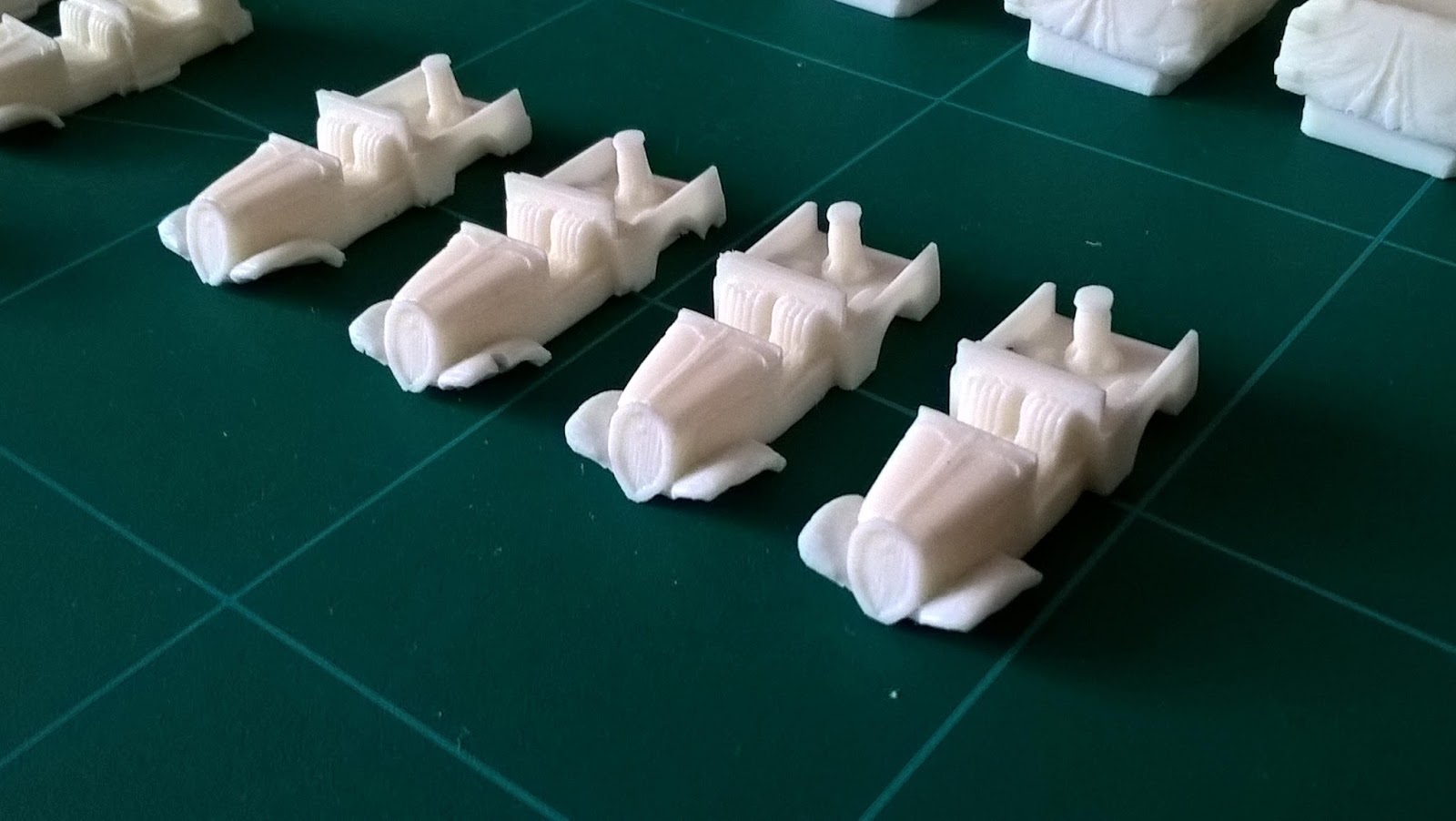
Now, it has to be said that on removing the vehicles from their moulds I was mighty pleased with what I had achieved, and that pleasure over rode all of the flaws which jump out at you. It turns out that despite having a de-gasser there are things that I must have not done effectively enough because as you can see from examining the C7P and the Polski Fiat 508 Furgon there are small cavities all over the miniature meaning that there were air bubbles trapped all over the place

My first C7P  still on its resin funnel which needs to be cut away, and showing all of the cavities.
The first C7P had its flaws. There were plenty of cavities all over it BUT the issues were small enough and localised enough (predominantly in the area of the tracks) that I am rather of the belief that most of them can be fixed with putty filler and failing that when painting I can weather the vehicle and plaster it with MIG's mud to disguise the casting errors. 

The first Polski Fiat 508 Furgon showing the fender cavities

Another view of the Furgon from above showing the fender cavities
I've spent the whole day casting now and I've had plenty of opportunity to try different things to see what works and what doesn't.

I have to say that I feel that I have it nailed now. The vehicles no longer have any air bubble cavities, cure well and look good.

I decided soon after my first attempt that I would need to mix up smaller amounts of Polyurethane Resin and pour just into one or two moulds at a time. This meant that I would be able to make use of the milky consistency of the resin to get into all of the mould details and wouldn't have to wrestle with a rapidly thickening sludge!

I no longer pour the mould full straight away. There are parts of each mould where air collects and in order to get rid of these air bubbles I only initially put a small amount of resin in and massage the resin into the mould extremities by twisting and turning, pushing and pulling the mould. This isn't fool proof but it does make a massive difference. This is especially useful when doing stuff like turrets and you need to get the resin down the gun barrels.

Once the resin has invaded all nooks and crannies I will then pour the mould full and place into the vacuum chamber and switch the pump on. I make sure that I leave it a good while now on. I don't mind the resin curing inside the chamber for as long as its in there unless there are a mass of air bubbles that are pulling the resin over the lip of the mould. In this instance I keep thumbing the air tap on the vacuum pump on and off to tease the air out.

Again this isn't fool proof but the vacuum pump does 90% of the work, with me providing a bit of manual vibration giving the last 10%!

...

And this ladies is the quality of what I am getting now:

A brand spanking new Vickers E tank. No defects, no air bubbles... just lots of Polish goodness! 

This is a casting of a Vickers E that I have done towards the end of my current learning curve. There are no air bubbles on the casting and the detailing is accurate and high, Now I just need to do another 9 of these!

I'll do an update post when I have cast all of the resin vehicles for the Black Brigade so that you can see whats going on OK?

Whats that?

Fix BAYONETS!!!!!


Sunday, 5 February 2017

Flames of War: Sculpting the Polish C7P Artillery & Recovery Tractor

So, I am finally coming to the end of all of this sculpting business I have set myself... and by end I mean the first milepost in a ridiculous mountain of vehicles that I have set for myself over the next couple of years! LOL, but where the Black Brigade is concerned now that I have finished sculpting my C7P I only have two vehicles left to sculpt, the Polski Fiat 508 III Furgon pick up truck and the TKS-D tank destroyer that the Reconnaissance Battalion was rumoured to field a pair of in September 1939. Small fry!

So the C7P was a bit of a challenge as there is a superstructure that requires rather a lot of detailing at ridiculously small sizes. Quite a challenge... but what actually is the C7P?

THIS is a C7P, allocated to the 10th Motorised Cavalry Brigade

C7P (Ciagnik Siedmiotonowny Polski - 7 ton Polish Tractor) was a Polish tracked artillery, recovery and combat engineering tractor used by the 2nd Polish Republic before and during World War 2. 

The tractor was designed by the design bureau of Witold Jakusz of the PZInz company between 1931 and 1934.

C7P Artillery Tractors

In March of 1934 the Polish Army, following appraisals of many other prototypes, finally approved the C7P tractor to be its standard heavy tractor vehicle. It was considered essential for towing the heavier guns in the Polish arsenal such as the 220mm Mortars.


Around the year 1925 the newly reborn German military had started to modernise and expand the border protection emplacements along the Polish border areas and it was planned that at the possible outbreak of war between France and Germany in the future Poland would advance to occupy these fortified areas of East Prussia and Western Pomerania. A few old Italian 210mm mortars left over from WW1 wouldnt be enough to do the job!

In 1929 talks were opened with the Skoda works about a  newly designed 220mm Mortar that they had just presented to the world.

Following the application of over 70 modifications and adjustments to the design of the Skoda mortar 27 of them were supplied to Poland by Czechoslovakia between 1935 and 1936 and entered service as the '220mm mozdzierz wzor 32' (Mortar Model 32)


One problem that continued with these mortars however was the provision of ammunition. The High Explosive shells that were in development were not finished by the time the war broke out and the mortars were instead supplied with anti-fortification shells which yielded a terrific explosion and concussion wave but very little in the way of fragmentation pieces.

At the time of developing this Skoda weapon it was decided by Polish High Command that the 1. Pulk Artylerii Najciezszej (1st Heavy Artillery Regiment) would operate as a totally motorised asset. As mentioned above, various tractors were tested in 1931 and ended up with the C7P being the only one that fulfilled all expectations.


For transportation purposes the mortar could be reduced to three manageable sections (the barrel, the bed and the base plate) which each pulled on a Czech designed trailer and so three tractors were allocated to each gun. Additional tractors were allocated to pull ammunition trailers which were designated 'R' and were of Polish design. Delivery of these trailers however was slow and as a stopgap a number of Polski Fiat 621 trucks were redesigned as Ammunition Carriers.

Following the issue of mobilisation orders on the outbreak of war the 1. Pulk Artylerii Najciezszej was able to put three independent squadrons into the field; the 11th, 12th and 13th). Each squadron comprised of three two-mortar batteries, so each battery listed as having 11 tractors, making 33 for each squadron.

At the outbreak of war each squadron remained in its depot area at the artillery ranges near Gora Kalwaria until called upon.

11. Dywizjon Artylerii Najciezszej (6 mortars and 33 tractors) was given its marching orders on the night of September 4th/5th. The squadron was moved through a variety of locations until it finally found itself at its final position in the Tomaszow Lubelski cauldron on September 22nd due to orders to support retreating infantry struggling to disengage with the pursuing Nazis.


Despite using anti-fortification shells, these 128kg shells caused terrific damage to the Nazi psychology and was twice instrumental in this battle in forcing out German troops from newly won territory with their spectacular explosions.

Artillery duels also occurred with German batteries, although the effects on the Polish squadrons was negligible, although finally advancing German armour was able to destroy almost all of the 2nd batterys tractors. When all of the ammunition was finally expended and a breakout on foot alongside other troops proved impossible due to the Nazi encirclement the Poles opted to destroy all of the mortars in situ!

12. Dywizjon Artylerii Najciezszej (6 mortars and 33 tractors) left the depots on the night of 6th September. Three days later, whilst en route to Lwow, they met up with the 13th Squadron and travelled together for a while.


On the night of 16th/17th September both squadrons were ordered to move to the Romanian Bridgehead (A last ditch defensive position amongst hills with the friendly Romanian border at their backs allowing a safe fall back position if all else failed) although this plan also collapsed soon after due to the Soviet stab in the back on 17th September.

On September 21st the Squadrons troopers dismounted and assisted in the struggle for Kamionka Strumilova, then mounting up again continued onto Grabowiec where they were attacked once more. Enough tractors and guns were damaged that the troops were forced to scatter.


13. Dywizjon Artylerii Najciezszej (6 mortars and 32 tractors), on departing company with the 12. Dywizjon Artylerii Najciezszej, the 13th chose a route to the Hungarian Border (the safety destination for the Polish army once the Romanian Bridgehead became untenable) via  Brzezany but was attacked en route by Ukrainian nationalists and was finally surrounded by Soviet troops on 19th September with all assets falling into Soviet hands.


The Soviets captured seven mortars which certainly included  one from the 11th or 12th Squadron that was not evacuated from the Nazi-Soviet territorial dividing line in time.

C7P Recovery Tractor

The secondary recipients of the C7P tractors were the armoured units in the Polish army.
According to a mid 1939 inventory some 18 tractors had been allocated among the armoured battalions as follows:

Centrum Wyskolenia Broni Pancernych (Armoured Training Centre) at Modlin, equipped with Vickers E tanks, tankettes, wz.29 Ursus Armoured Cars: 7 Tractors

2nd Armoured Battalion at Zurawica equipped with Renault FT-17's, Vickers E tanks, 7TP tanks and  tankettes: 5 Tractors

3rd Armoured Battalion at Warsaw equipped with 7TP tanks: 4 Tractors

4th Armoured Battalion at Brzesc equipped with Tankettes and wz.34 Armoured Cars: 2 Tractors


In April 1939 Dowodztwo Broni Pancernych (Armour HQ) ordered 32 C7P's for immediate delivery. This order status up to September 1939 however remains unclear. Whilst we can be certain that some of this order were delivered to the Glowna Skladnica Broni Pancernych we cant be sure how many and where they were distributed to.

What confirmed information remains in existence points to the fact that 4 Tractors were delivered to the 21st Tank Brigade equipped with the French made R-35 tanks and the handful of Hotchkiss H-39's, mobilised at Luck, and three others remained within the 5th Armoured Battalion at Krakow.


According to a Table of Organisation & Equipment of 1939 each mobilised company of 7TP tanks should hold a single C7P tractor and tractors were also sent to both the 10th Motorised Cavalry Brigade (10BK) and the Warszawka Brygada Pancerno-Motorowa (Warsaw Armoured Motorised Brigade) before the outbreak of war.

There are plenty of photographs to be found of the Black Brigade on deployment to the Czech border in 1938 where the C7P's are shown alongside the tanks of the 121st Tank Brigade, however there are no photographs yet found of the C7P's taking a part in the September Campaign other than one photograph of German troops recovering some of the Black Brigades Vickers E tanks using a recovered C7P inferring that at least some C7P's were deployed along with the 10BK

A C7P under German control recovering one of the Black Brigades Vickers E (Type A) tanks...


Modelling the C7P

...and so we come to the modelling and sculpting of very own C7P! 

If Im to be honest I was looking forwards to doing this one, although perhaps a little intimidated because once again I would utilise Battlefronts 7TP tank track sections, to make my life that little bit easier (and of course fill in the spaces that Im incapable of completing myself).

The body was a different matter though. I would normally choose the easy option and go for maybe a T-26 body and build up the new superstructure on top of that but there was such a radical rebuild for this hull that I decided that it would probably be easier to just build a completely new hull from scratch and then build up the detail layer from there. Following my builds of the 4TP and the 10TP this completely new hull build didnt offer me any problem so I opted to start there.


The first thing to do was to ensure that the track sections were ready to be put straight onto the side of the new hull when built so I had to file the inside edge totally flat by getting rid of the Battlefront fitting guides whcih slot into Battlefronts resin hulls. Once this was done, consulting schematics I just had to fit the steps to the hull side on the track sections and file flat the middle sections of the long fenders so the little bars that are normally in evidence are removed.


Moving onto the body, the first thing that I did was, using 1mm styrene sheets build the basic hull and superstructure shapes and fill them with epoxy resin to give the model some serious rigidity so it doesn't get compressed in the mould making process later on.

Where curves were needed in the final design were needed, layers of styrene were used, with each successive shape layer stacking on top of the one below, but with the edge being withdrawn a determined amount with the final top styrene layer being the same size as the top of the curved areas shape. 2 part Epoxy Resin was then applied to bulk out the remaining ziggurat appearance of what is meant to be a curve and then left to cure over night.


The engine section at the back was built using 4 layers of 1mm styrene laid vertically with a heavy application of epoxy resin on the top to give me something to work with the create the sloped finish whilst the front was left off for the fine detailing stage.

Once the epoxy resin had set the next task was to regulate the body shape by cutting, slicing and sanding back the resin that was there to fill gaps, or provide a surface to work on such as the curved edges of the roof sides and the top cover for the engine section. Any areas that were far too heavily extruded were sliced back with some of my weird and wonderfully shaped scalpel blades and then the remaining surfaces were all sanded back with a variety of chisels slowly and steadily until the shape required was arrived at.


The final job was to apply all of the fine detailing and this is where these kinds of models really come alive.

The firsts step was to apply the remaining superstructure elements such as the superstructure window plates, the roof air vent and the towing equipment hanging off of the back. The latter two both required independent unit builds that were then applied to the vehicle and then, in the case of the roof air vent, was resined into place, left to cure and sanded back.

The superstructure window plates needed the most care and attention as each side has two plates at angles to the metal track sections complicated by the frontal window section of the two side sections travelling out to the second section from a thinner superstructure frontal plate which has the six windows on. Once the angles were worked out however these didnt prove too much of a problem.

The frontal window plate however was a little more problematic due to the thinness of the upper three windows that needed to be cut out from the styrene sections that were 0.3mm thick for these sections. With such small sections being removed the styrene had a tendency to crack under the shearing stress that the mini scalpels were applying. Eventually on the third attempt I drilled the corners of all windows and just executed straight cuts between them. Problem solved!

Superthin styrene (0.1mm) sheeting was used to model a new frontal glacis plate which then had the hatches scribed into them before being glued on top of the existing superstructure.

The engine grill for the back of the engine section was completed, just as on the 4TP and the 10TP, using a fine brass mesh which was laid on top of freshly prepared epoxy resin and pushed into it slightly. 20 minutes later a clay shaper was used to scrape away all of the resin that had come through the mesh so that the shape of the mesh was proud of the resin. This was then placed against the front edge of the sanded and shaped engine block. Again left to cure over night the edges of the join were sanded back and shaped the next day.

All panel lines were scribed and all hinges were constructed using 0.5mm styrene rod and 0.1mm styrene sheet.

The side windows of these vehicles, were not actually windows but open access areas that were covered using canvas sheets so these obviously also had to be modelled. Here I rolled out the epoxy resin (Magic Sculpt) until it was perhaps 0.3mm thick and then using a flat shovel bladed scalpel was gently lifted off the work mat, and then using clay shapers was modelled into the access areas and then shaped. All in all I'm most proud of this work on this model as I believe that it looks convincingly real to the naked eye, and with no paint!

Finally, after all of the body details had been applied only the rivets were left to do.

...

and finally they were done! Et voila

One other little mountain finally conquered. There are other bits to add, such as the vertical handrails but these I intend to model in brass, and after the casting is proven successful!

So, what do you guys think of this little guy?

Now where was I? Oh yeah;

Fix Bayonets!