Painting 10mm Dropzone Commander 'United Colonies of Mankind' Dropships... The Condors
So its been a little while since my last blog post and I thought that it may be interesting for those of you who keep asking me about techniques and I how I do things with my UCM forces the actual process that I go through to get my 10mm Sci Fi minis game ready.
One of the most ubiquitous assets available to UCM commanders is the Condor Dropship, and as I have 11 of these bitches to work my way through I thought using the first three to put together a painting tutorial would be a grand idea.... so here we go...
1. The plastic Condors require a little building and unlike every resin kit that Hawk Wargames do, it has a clear canopy. In the interest of continuity across the collection I will be painting over this. The build is thankfully really easy and takes no more than 5 minutes to get it ready for painting.
2. The first step is to put a layer of black primer over the kit. Whether this is done by spray can, airbrush or brush is irrelevant so long as its a thin even layer with suitable paint. The primer layer allows further paint layers to bond properly with the surface of the kit without which your kit will suffer from significant flaking as it is handled through the games it will be used in. ALWAYS prime ladies!
3. I am a big fan of my airbrush now (which is ironic as I had it sitting in an attic for almost 15 years before I dragged it out and decided it was perfect for my UCM). Ive cheated a bit on this kit as I know significant other layers are going to be applied, but Ive opted to utilise my priming level as one of the three block colours that I use for my Urban Camouflage scheme.
The first step of airbrushing after applying the first layer of paint is to apply the stencils for the blocks of colour that are least dominant on the final image. In the case of my UCM the colours are Olive Green, Buff and Black, the black being the least dominant. As you can see from the image above I have applied a collection of stencils that I have used multiple times onto the body of the Condor. Whatever colour I spray over the top of these stencils now will leave black blocks in the shape of the stencils when all the stencils have been removed.
4. Over the top of these freshly applied stencils the second layer of paint is applied. I use Tamiya XF-57 Buff mixed with Tamiya mix with Tamiya XF-20 Enamel Thinner with a ratio if 1:1. With doing these large block colours I always use a wide spread high delivery nozzle. This means that a lot of paint is used BUT the time that it takes me to do is cut by about 70%. A couple of passes and a couple of adjustments for hidden angles and Bosh! Job Done!
Another good thing about these Tamiya paints and application with an airbrush is that it dries REALLY quickly so you can get almost straight onto the applying the stencils for the blocks of Buff that you want to keep whilst applying the most dominant colour.
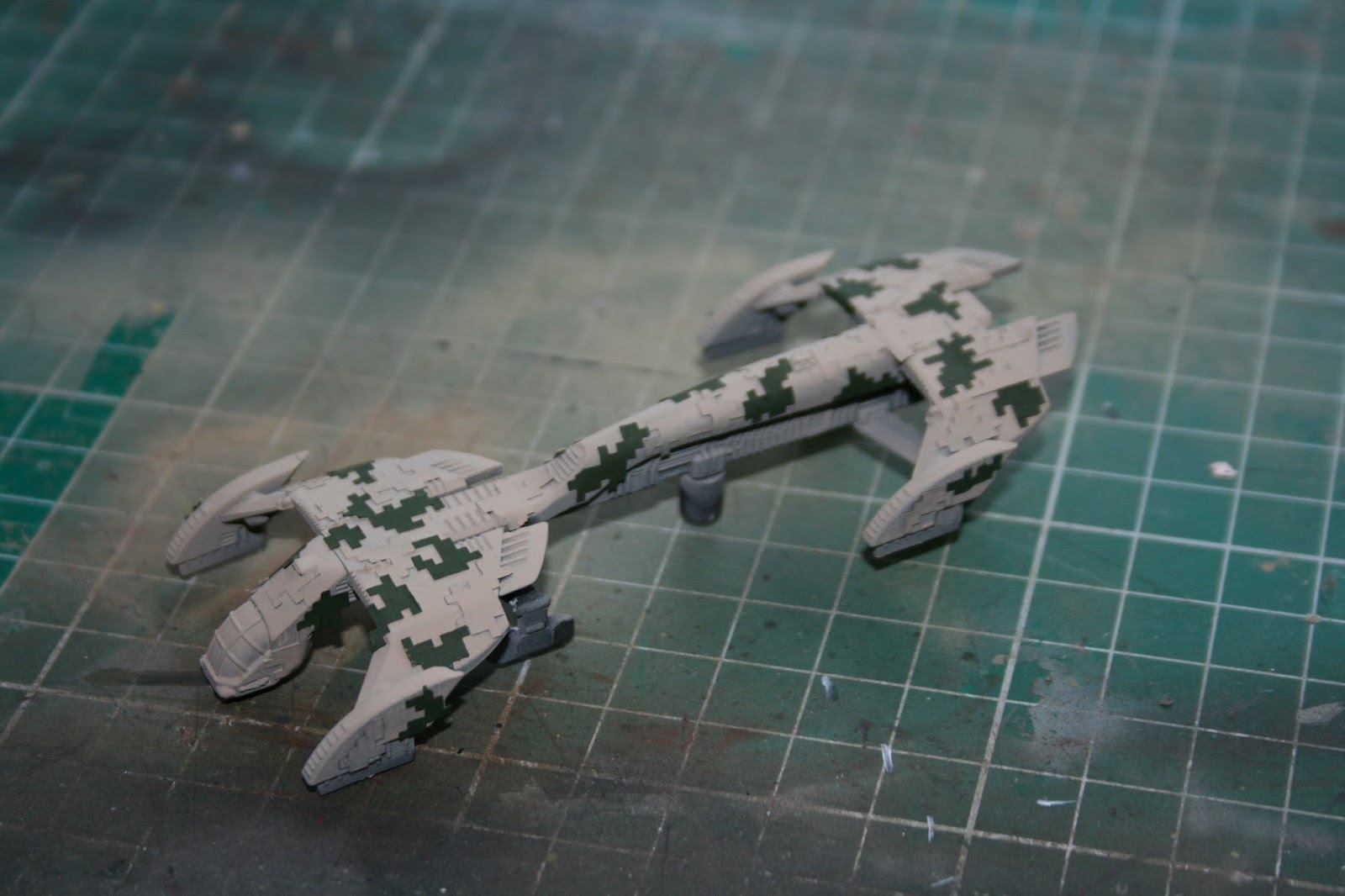
5. With the second layer of stencils you should apply slightly more and slightly larger ones that on the previous layer of stencils. The previous stencils that you have painted over should be left on and the new stencils applied above and next to them in an interlocking fashion.
The next colour to be applied is the last colour to be applied by dry brush and should be the most dominant colour on the miniature. To achieve this you need to make sure that, whilst the previous stencils are all interlocking there should be more space that will be occupied by the green paint on the non stencilled areas than on the stencils which will be removed to reveal Black and Buff anyway.
6. The green that I use for the dominant colour is Tamiya XF-58 Olive Green, again diluted 1:1 with Tamiya XF-20 Enamel Thinners. Again sprayed with the wide spread high delivery nozzle making sure to get in all of those nooks and crannies.
NOTE: Before you remove the stencils make sure you leave them on over night so that the paint can cure and bond to itself. The stencils, whilst being low tack stencils still have enough to tack to pull away a lot of the paint that has been applied...
7: Which is what happened here. Having removed all of the stencils and stored them safely away on their stencil sheets for future use you can see just which parts of the miniatures paint cover is damaged. This is a proper ball ache because for this miniature to become presentable now, each section that has had paint pulled off of it will need to be manually repaired... and unfortunately Tamiya paint does not lend itself very well to the paintbrush in my opinion!
8. But repair it I did. Painstaking and a little disappointingly lumpy but for the tinting and profiling to come it is useable.
9. At this point we have a pretty sterile looking toy. Sure the patterns are pretty but lets be honest; it looks like the My Little Pony of military hardware at the moment so we need to dull the vehicle down and provide some uniformity across the paint range.
The first step in doing this is to apply a Filter! This provides a colour adjustment that is uniform across the whole model which will help to make the model look like an homogenous piece.
The Filter that I use for this type of camouflage is AK Interactives AK076 Filter for NATO Tanks which I apply quite heavily across the whole model. Its an enamel application so odourless White Spirits need to be used to clean your brushes but its well worth it. Already we can see that it has changed everything. The gritty grimy heavily abused hardware look that we all know and love is starting to come through now.
10. We don't stop at a Filter though as its not strong enough to provide the depth contrasts across the miniature that will make the detail pop through when you are looking at it on a war-games table.
We do a step called Profiling now, and for this I use another AK Interactive's product; AK075 Enamel Wash for NATO Vehicles.
An enamel Wash will have far more pigment in its suspension and because of this I apply it quite heavily around all of the grills, weapons and knobbly bits all across the model. I also use the Wash to do something called Pin lining where all of the grooves that travel along the panel lines across the model are picked out by applying the Wash along these grooves with a fine brush and a reliance on capillary action.
The trick here is to leave the model to dry out for about an hour and then come back and with either a brush with a bit of White Spirit on it or a Cotton Bud dipped in White Spirit go over the model and remove the excess Filter and Wash... of which there will be much.
This leaves much cleaner surfaces whilst leaving all of the contrasts and definitions.
11. Flying military vehicles are rarely painted in a uniform single colour (one possible exception to this which sticks out in my mind is the French Aeronavale in Indochina in the '50's that had a uniform blue all across their planes BUT their opponents had no AA capability at all so it was safe to do so!)
Now, as the UCM has to contend with an horrendous amount of AA in the game it has always seemed sensible to me to paint the undersides of their flying machines with a sky colour... in this case Vallejo VAL906 - Pale Blue
12. Just as we did with the topside however, just a single blue paint layer isn't enough to provide the definition and contrasts that we require. Thankfully on the underside of the miniatures we don't need to as rigorous applying both Wash and Filter. For this scheme I only use AK Interactive's Filter AK-071 Blue for Panzer Grey.
Again, apply the Filter liberally and once left to dry for an hour come back and using white spirits remove the excess to tidy up the surfaces.
Leave to dry overnight and then on the next day apply a layer of Varnish. The first Varnishing step is absolutely mission critical because without this layer of Varnish two things will happen. Your handling will rub off your Filters and Washes faster than you can imagine and if you were to apply any further acrylic paint (which we do a lot of here) it will bobble and collect together as the oils in the enamels repel the water based media.
13. At this point we have a model that is starting to look pretty good but I just wasn't happy with what I was seeing. The whole thing looked uniform but perhaps a little muddy and indistinct. I decided to outline all of the black and Buff Camouflage blocks... what a far reaching decision that was... I've been committed three times so far!
The outlining of the camouflage blocks provides a lot of definition to the disruptive came pattern and, well I just think it looks cool... which I guess is why Ive stuck with it!
To outline the black blocks I used Vallejo VAL992 Neutral Grey and for the Buff areas I used Vallejo VAL819 Iraqui Sand.
14. Finally we are coming up on the closing stages of the models. We now need to turn our attention to all of the parts of a model that draw your eye and give the illusion of something real shrunken down.
I dealt with all of the engines and exhausts first applying a layer of Vallejo VAL950 Matt Black mixed with a small amount of Games Workshop Chainmail paint to give a really dark metallic look which is then highlighted towards the edges with just Chainmail. I originally tried to use Games Workshop Copper on the Exhaust Ribs but I felt the effect was just too gaudy so I repainted them using Games Workshop Tinbitz which has been one of my favourite paints for as long as I can remember!
I also did a simple paint job on the canopy using very thin white lines over the black canopy glass, and a simple paint job of Red with White dot reflections on all of the guide lights that these military vehicles seem to be covered with! LOL
15. ...and so to the end. Its time for the decals.
There are no proprietary decals for UCM so a lot of these I had to make myself but it was a relatively simple process and the only ones that I had a problem with were the UCM banners that I did as the black didn't cure properly. The cockpit red warning triangles, Cockpit mascot logo and Banners were all made by me and the large numbers were purchased off of the Internet.
Unfortunately the UCM banners ended up only being able to be used as a painting guide.
To apply decals solidly a layer of Decal Sol is applied to the model first. The transfer is placed onto the model after soaking, positioned relatively quickly and after being left to dry for 5 minutes another layer of Decal Sol is applied to really bond it in place.
Once all of this is totally dry I go ahead and paint the UCM icon over the top of the crap decal... Im OK with the result, even if its not perfect...
The important thing here for me is that the decals and numbers provide a good aesthetic contrast with all of the randomness of the camouflage pattern.
The very last step is to provide a good layer of Matt Varnish over the whole miniature to protect it and Gloss Varnish over the Cockpit panes to give that glassy reflectivity that we all know and love!
Enfin!
...and here we can see the complete squadron of 3 Condors flying along next to each other.
Any thoughts and questions are welcome!!!
Occasionally I manage to squirrel away some free time. When a self confessed geek manages to combine an artistic temperament, an obsession with all things military and a little free time the inevitable result can only be one of two things; he will end up a gaming console addict or a wargamer and modeller of all things explosive! I went for the TNT! This is my space to talk about all these projects!
Tuesday, 9 June 2015
Thursday, 28 May 2015
The United Colonies of Mankind lay the hammer down...
So after quite a bit of work and a lot of late nights the United Colonies of Mankind (UCM) for Dropzone Commander finally have enough assets to take the field against the Post Human Republic, Scourge, Shaltari and Feral Resistance...
Here is my take on the UCM (although for some reason my photography never seems to do my painting justice! :(
So after quite a bit of work and a lot of late nights the United Colonies of Mankind (UCM) for Dropzone Commander finally have enough assets to take the field against the Post Human Republic, Scourge, Shaltari and Feral Resistance...
Here is my take on the UCM (although for some reason my photography never seems to do my painting justice! :(
The ground assets so far. Only a few dropships so far but the rest are on their way!
A couple of Bear APC's with their Legionnaires and Praetorians
A closer look at the Praetorians with their Bear APC
A striking view of the Air Mobile elements so far...
A closer look at Bear APC 'War Wagon'
One of the Anti Aircraft Point Defence Rapiers 'Hooters'
Another one of the Rapiers called 'Rat Man'
A complete UCM Main Battle Tank Sabre Section
The complete Gladius Heavy Tank Section
A Kodiak command APC 'Hawkeye' complete with ability to call down an area effect orbital strike!
One of the Taskforce's Longbow artillery pieces
The Eagle Gunship
One of the Airmobile Condor transport sections
A closer look at Condor 13
One of the Albatross Heavy Lifters
The attached Airforce support squadron with both Archangels and one Seraphim
So this is my UCM army up to date. There is still plenty more to paint but the painting schemes and how to do them have been worked out and settled upon...
Long live the United Colonies of Mankind!
Tuesday, 19 May 2015
The UCM are coming...
So after much haranguing from members of my club who want to see what is going on, on the tool bench with regards to the United Colonies of Mankind force that is about to descend on the Cradle Worlds, I decided to share a sneak peak.
The Air Force of course paves the way so its only fitting that they should be seen in the skies above the cradle worlds first...
Ladies and Gentlemen; The Air Force!
... and for those of you who wish to stand in our way... Watch the Skies!
So after much haranguing from members of my club who want to see what is going on, on the tool bench with regards to the United Colonies of Mankind force that is about to descend on the Cradle Worlds, I decided to share a sneak peak.
The Air Force of course paves the way so its only fitting that they should be seen in the skies above the cradle worlds first...
Ladies and Gentlemen; The Air Force!
The Squadron
The Archangel Wing
Archangel One
The Seraphim Strike Fighter
... and for those of you who wish to stand in our way... Watch the Skies!
Monday, 18 May 2015
Grande Armee: The Austrian Advance Guard from Wagram 1809 in 6mm
So, its been a little while since I have posted a painting blog but thats not to say that haven't been slaving away over paints and brushes.
Im neck deep in getting some Dropzone Commander UCM assets ready for presentation BUT as it has been a while since I posted I thought I would let you all in on what I had finished off in preparation for moving onto Dropzone Commander.
So, I procured for myself John H. Gill's seminal masterpiece trilogy 1809: Thunder on the Danube which gives the complete history of Napoleons absolute pfisting of the Habsburg monarchy!
I don't know about the rest of you but when I choose an army I usually go for the underdogs and/or losers and most especially if they look dapper in their clobber!
Thats the main reason I chose the Austrians (as I already own French and Spanish armies of the period in 15mm. This is my first 6mm Napoleonic Army). The Austrian army of this period (1809) was commanded by Archduke Charles who is one of the only people to have ever defeated Napoleon using an army of his own, with no allied contingents. For me this was reason enough to choose the army.
I have to say however that by the end of the first volume of Gills trilogy I was well and truly disavowed of my erroneous notion that the Austrians were probably capable but unlucky. Bravery was certainly not missing in the Austrian ranks of 1809 and the fact that they could keep troops in the field following a relentless series of kickings the French and Confederation troops doled out to them in the first month of the campaign says a lot about their personal qualities BUT, and here is the caveat, these poor troops deserved a military hierarchy that could do more than polish their epaulettes!!! I have never in my life read about such a collection of puddings! All collected in one military establishment... at the same time AND unlucky enough to face somebody of Napoleons character, let alone Davout, Lannes, Montbrun, Bessieres, Wrede and so on! They never stood a chance. Its small surprise that only one of the Austrian corp commanders saw active service after the campaign was over!!!
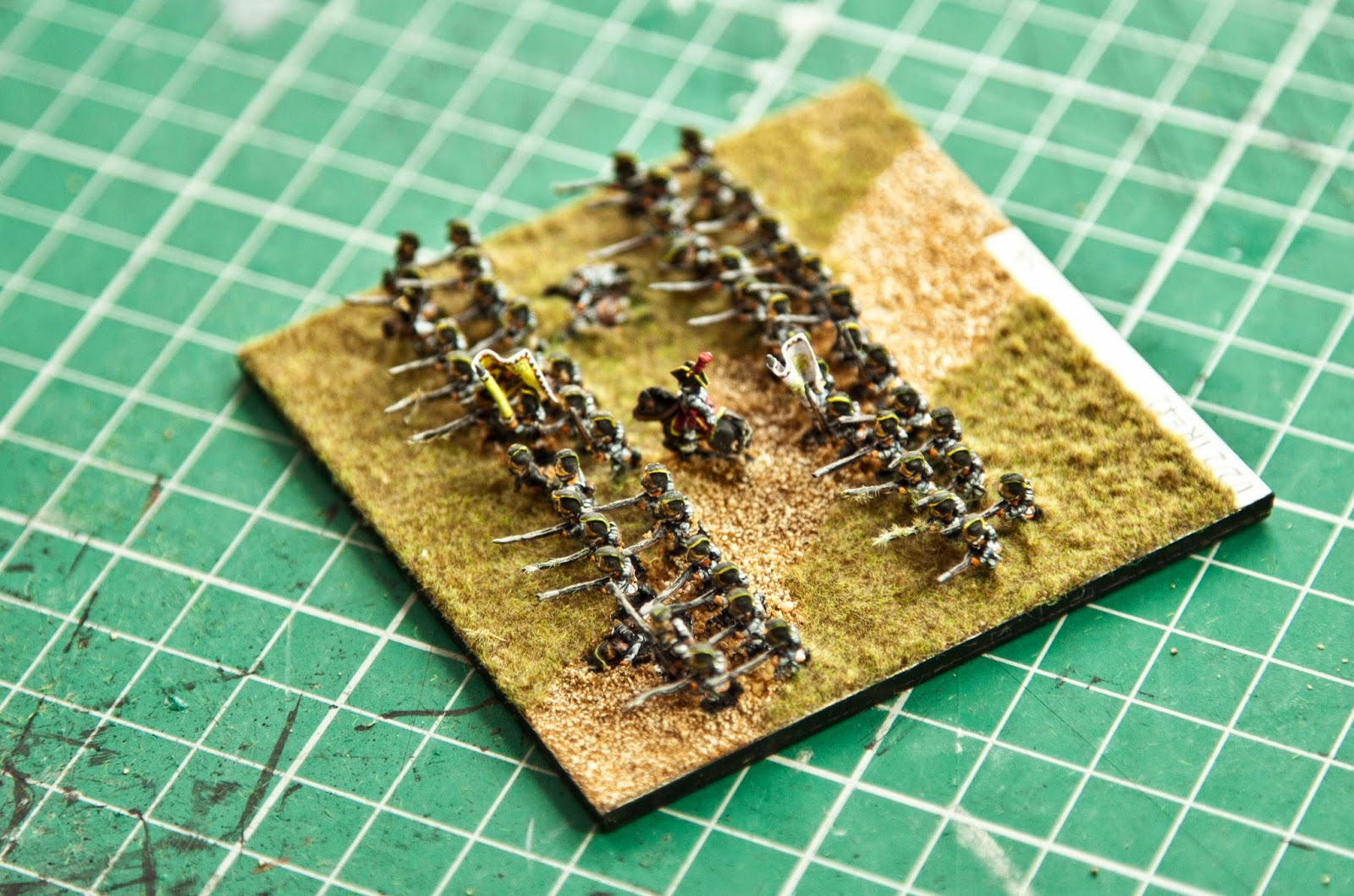
The Advance Guard commanders however were another kettle of fish entirely. Schuttermayer! What a man!!!!
Anyway, having read deeply into this developing disaster and having witnessed photos of Jim's Frogs marching around the corner I felt a sudden rush of panic and realised that just the one corp wouldn't be enough... so I decided that at the very least my army would need to field the army's Advance Guard led by the capable FML Armand Nordman who was actually killed at Wagram along with 3 other Austrian generals.
... and of course an army that is fielding two separate corp at least will need the custodianship of a senior general of which Austria had only one that was worth talking bout...and that was Archduke Charles himself!
So, its been a little while since I have posted a painting blog but thats not to say that haven't been slaving away over paints and brushes.
Im neck deep in getting some Dropzone Commander UCM assets ready for presentation BUT as it has been a while since I posted I thought I would let you all in on what I had finished off in preparation for moving onto Dropzone Commander.
So, I procured for myself John H. Gill's seminal masterpiece trilogy 1809: Thunder on the Danube which gives the complete history of Napoleons absolute pfisting of the Habsburg monarchy!
I don't know about the rest of you but when I choose an army I usually go for the underdogs and/or losers and most especially if they look dapper in their clobber!
Thats the main reason I chose the Austrians (as I already own French and Spanish armies of the period in 15mm. This is my first 6mm Napoleonic Army). The Austrian army of this period (1809) was commanded by Archduke Charles who is one of the only people to have ever defeated Napoleon using an army of his own, with no allied contingents. For me this was reason enough to choose the army.
I have to say however that by the end of the first volume of Gills trilogy I was well and truly disavowed of my erroneous notion that the Austrians were probably capable but unlucky. Bravery was certainly not missing in the Austrian ranks of 1809 and the fact that they could keep troops in the field following a relentless series of kickings the French and Confederation troops doled out to them in the first month of the campaign says a lot about their personal qualities BUT, and here is the caveat, these poor troops deserved a military hierarchy that could do more than polish their epaulettes!!! I have never in my life read about such a collection of puddings! All collected in one military establishment... at the same time AND unlucky enough to face somebody of Napoleons character, let alone Davout, Lannes, Montbrun, Bessieres, Wrede and so on! They never stood a chance. Its small surprise that only one of the Austrian corp commanders saw active service after the campaign was over!!!
The Advance Guard commanders however were another kettle of fish entirely. Schuttermayer! What a man!!!!
Anyway, having read deeply into this developing disaster and having witnessed photos of Jim's Frogs marching around the corner I felt a sudden rush of panic and realised that just the one corp wouldn't be enough... so I decided that at the very least my army would need to field the army's Advance Guard led by the capable FML Armand Nordman who was actually killed at Wagram along with 3 other Austrian generals.
The Austrian Hauptarmee Advance Guard
FML Armand von Nordmann
The Hessen-Homburg Hussars
IR4 & 6th Vienna Woods Landwehr
IR44 & 1st Vienna Woods Landwehr
Palatinal Hussars & 1st Jager Battalion
Stipsicz Hussars & 13th Grenzer
The Advance Guards attached Horse Artillery Battery
... and of course an army that is fielding two separate corp at least will need the custodianship of a senior general of which Austria had only one that was worth talking bout...and that was Archduke Charles himself!
Sunday, 29 March 2015
Grande Armee: Basing 6mm Austrians for the Austrian Hauptarmee of 1809
The thing about Grande Armee and 6mm figures is that there is just so damned many of them to paint... but even after you have achieved all of the hard yards, those mini masterpieces can still end up looking like an absolute heap of shite!
With the size of the figures being what they are (yes, for those of you out there that are not so maths flash the figures are about 6mm tall from bottom of boot to eyes, or about half of your little finger nail in height!) if you are a foot or more back from them they all kind of blue into one!
...or do I need glasses?
So it becomes a question of sculpting the bases to be interesting enough to draw the eye into a closer analysis of the miniatures themselves.
Grande Armee, being a rule system that allows manoeuvre at an army level, as opposed to a divisional or brigade level, it stands to reason that each of the 3" square bases represent a 'zone of control' for the regimental and brigade groupings that are on the base... which for us modellers out there roughly translates as 'room to sculpt a beautiful Garden of Eden on each and every base!'.
So... here is an example of one of my humble efforts at basing 6mm figures and how I did it!
Following on from where we left IR42 on its nice wooden base I opted to rebase on thicker MDF bases which would likely take a lot more beating from moisture ridden products such as PVA glue and such like.
Once transferred onto the base, and the figures left to set properly the base then needs to have its ground covering. The entirety of the base, including in between the miniatures is given a liberal covering of PVA glue and is then smothered under fine grade sand. Mine has small grit mixed into it as well. This is then shaken off and the base tapped until all loose material is removed.
Once the ground covering is left to dry solid the base then has a heavy dry brush of Vallejo Pale Sand applied to it. High summer in Austria is dry... (the weather around the Battle of Wagram notwithstanding of course!). This provides the high contrast heavily textured base covering.
In order to maintain the presentability of the miniature bases the final stage of painting is to recover the edges of the base in matt black. The black base lining isolate the base from the model scenery on the table and focusses the eye on it.
The next thing to do in the base scultpting is apply the grass layer... and so out comes the trusty 'Flockbox' by Warpainter. As these are 6mm figures and European grass being what it is I opted to use 1mm Static Grass and chose a mixed coloration. I don't really like the vivid green flocks as they are too gaudy to use at 6mm. That kind of colouring is better suited to larger scales.
If you look at photographs taken from altitude you will notice that the environments colours have been somewhat leached from what you see. Because of this I prefer to opt for colours that are a little more muted which is why I opt for the mixed colouring.
The base is painted in area blocks with PVA glue to emulate terrain with broken grass coverage, with the base then inverted and travelled back and forth over the Flockbox laden with static grass.
The result is as you see...
The very final stage is the addition to the base of the scenic items like random rocks, shrubs and hedges...
These scenery items comprise model railway cork scatter which is diced and sliced into suitable rock shapes, and artificial foliage which is used for both shrubs and hedgerows.
The finished result should give an overall impression of landscape that your average soldier would be willing to die for ....
.... and here for your perusal is the entire Austrian I Corp for Grande Armee
Et Voila!
The thing about Grande Armee and 6mm figures is that there is just so damned many of them to paint... but even after you have achieved all of the hard yards, those mini masterpieces can still end up looking like an absolute heap of shite!
With the size of the figures being what they are (yes, for those of you out there that are not so maths flash the figures are about 6mm tall from bottom of boot to eyes, or about half of your little finger nail in height!) if you are a foot or more back from them they all kind of blue into one!
...or do I need glasses?
So it becomes a question of sculpting the bases to be interesting enough to draw the eye into a closer analysis of the miniatures themselves.
Grande Armee, being a rule system that allows manoeuvre at an army level, as opposed to a divisional or brigade level, it stands to reason that each of the 3" square bases represent a 'zone of control' for the regimental and brigade groupings that are on the base... which for us modellers out there roughly translates as 'room to sculpt a beautiful Garden of Eden on each and every base!'.
So... here is an example of one of my humble efforts at basing 6mm figures and how I did it!
Following on from where we left IR42 on its nice wooden base I opted to rebase on thicker MDF bases which would likely take a lot more beating from moisture ridden products such as PVA glue and such like.
Once transferred onto the base, and the figures left to set properly the base then needs to have its ground covering. The entirety of the base, including in between the miniatures is given a liberal covering of PVA glue and is then smothered under fine grade sand. Mine has small grit mixed into it as well. This is then shaken off and the base tapped until all loose material is removed.
Once the ground covering is left to dry solid the base then has a heavy dry brush of Vallejo Pale Sand applied to it. High summer in Austria is dry... (the weather around the Battle of Wagram notwithstanding of course!). This provides the high contrast heavily textured base covering.
In order to maintain the presentability of the miniature bases the final stage of painting is to recover the edges of the base in matt black. The black base lining isolate the base from the model scenery on the table and focusses the eye on it.
The next thing to do in the base scultpting is apply the grass layer... and so out comes the trusty 'Flockbox' by Warpainter. As these are 6mm figures and European grass being what it is I opted to use 1mm Static Grass and chose a mixed coloration. I don't really like the vivid green flocks as they are too gaudy to use at 6mm. That kind of colouring is better suited to larger scales.
If you look at photographs taken from altitude you will notice that the environments colours have been somewhat leached from what you see. Because of this I prefer to opt for colours that are a little more muted which is why I opt for the mixed colouring.
The base is painted in area blocks with PVA glue to emulate terrain with broken grass coverage, with the base then inverted and travelled back and forth over the Flockbox laden with static grass.
The result is as you see...
The very final stage is the addition to the base of the scenic items like random rocks, shrubs and hedges...
These scenery items comprise model railway cork scatter which is diced and sliced into suitable rock shapes, and artificial foliage which is used for both shrubs and hedgerows.
The finished result should give an overall impression of landscape that your average soldier would be willing to die for ....
.... and here for your perusal is the entire Austrian I Corp for Grande Armee
Et Voila!
Subscribe to:
Posts (Atom)


