Well over the last three months my life has been literally turned upside down. I'm coming to the end of a VERY drawn our purchase of a house which has seen move halfway across the country to end up crashing at my best mates whilst I take up a new position at work. This, I can with a certain degree of certainty state, has played havoc with my will, much less desire, to carry on writing blog posts for a while!
However, if I don't get these done then I don't get anything else done either so.... here we go!

So now that all of you fine fellows have had a cursory introduction to the Slovakian army of 1939-1942 and seen a couple of Slovak thingys, I thought it was best if we were to finally jump in with the infantry!
You can't get much more basic than this when looking at a new army so I thought that it was the best place to start where the footsloggers are concerned.
Let me begin by setting the stage; you will notice when I go into the history of the Slovak infantry that their section sizes are considerably different to the section sizes that I have modelled my Slovak army on, based on Alex Kaczynski's fine piece of work for Flames of War V3; Poland in Flames. In actuality the infantry sections should only have three bases... but I decided not to let this minor point stop me! More bodies for the bayonets right?
So the infantry of the Slovak army were the backbone of the state BUT when Slovakia managed to shuffle loose the mortal coil of Czech oppression (* cough cough *) the potential survival of the State itself was very much a question mark...

All through the war the Slovak army used the prewar Czechoslovak Army training methods and manuals which by the time of the uprising in 1944 was hopelessly outdated and inadequate for use on the then modern battlefields BUT in 1939...
Any discussion of Slovak army, and more especially where this blog post is concerned the infantry, must begin with the modern history of the Czech army as the Slovak army was really the last surviving son of this military system with which it entered into the cauldron of the Second World War.
In 1958 an anonymous investigator of the CIA wrote:
"The ability of the Czech to soldier has been proven in both world wars, and twice during the short history of the Czechoslovak Republic the Armed Forces have reached a very high degree of military proficiency only to disintegrate in the wake of political events. Fully mobilised and judged one of Europe's finest forces, the Czechoslovak Army of 1938 was rendered impotent by the Munich agreement. After World War II a reborn Army had reached a marked degree of military proficiency by 1948. It was one of the few European Armies capable of conducting corps level maneuvers. But with the Communist coup d'etat in February of that year again the Army was reduced to a state of military ineffectiveness.
In spite of these things however the Czech is basically not a martial individual. The Czechoslovak Army, as such, has never been tested and consequently lacks any real military tradition. With the exception of Ziska, the men who have made Czech history have not been men of letters [this may be a mistake as the majority of Czech history makers in fact were men of letters]. "The Czechs are frugal, industrious, extraordinarily competent, home loving, possessed of inordinate personal integrity, above all reasonable in their dealings with one another and with the outer world... they care little for the soldier, but enormously for the prophet and the man of letters"

Reading this analysis it would be easy to assume that this central European nation were all unwilling soldiers but that would be to ignore the exploits of the expat Czech Legions, of the Slovaks in the Second World War as well as the heroics of a by gone age of Czech history.
In reading the histories of individual Czech units one will note the frequent appearance of the names of Jan Hus and Jan Ziska. They also appear frequently as names of military installations, and it might be said that Czech military tradition has its roots in the lives of these two men. The blind Ziska, an ardent follower if the religious reformer Hus, is one of history's most brilliant generals, As the leader of the Taborites (after the city of Tabor, stronghold of the radical Hussites), Ziska time and again routed the far superior forces of Emperor Sigismund. He never lost a single military engagement, and today his name and the city of Tabor are symbols of the bravest war of liberation in Czech history.
With the defeat of the Hussites at the Battle of White Mountain near Prague in 1620, Czechoslovakia became a part of the Habsburg Monarchy and the Czech army as such ceased to exist.
It obviously doesnt need to be pointed out that Czechs and Slovaks fought for their new Imperial masters for the next two hundred years but perhaps the most important of these Imperial campaigns must be that of the First World War where Czechoslovakian units were involved in the fighting on all sides with very large numbers engaged against the Central Powers, thus earning for themselves the recognition of independence they so badly craved from the Western Powers.
It obviously doesnt need to be pointed out that Czechs and Slovaks fought for their new Imperial masters for the next two hundred years but perhaps the most important of these Imperial campaigns must be that of the First World War where Czechoslovakian units were involved in the fighting on all sides with very large numbers engaged against the Central Powers, thus earning for themselves the recognition of independence they so badly craved from the Western Powers.

As a part of the Austro-Hungarian Empires commitment to the Central Powers war aims, Czechs were being called upon to fight and die for Germanic Imperialism which they associated with oppression in its most visceral sense. When mobilisation was ordered on 26 July 1914 some Czechs refused to obey - others departed from Prague stations with anti-German cries and singing Slav songs. "Maria Theresa lost Silesia, Francis Joseph is going to lose everything" was often heard. On the other hand however the Sudeten Germans formed some of Austria's most crack infantry regiments.
In the early days the average Czech soldier expected that the Russians would be bulldozing over the Germans any day. When the reality of the situation began to reach down to the Czech ratings, with German military dominance becoming clear the desertions started to reach almost epidemic proportions as men went over to the other side in their thousands... in some cases whole units were known to change sides. The most notorious of these was the 28th Prague Regiment which went over to the Russians on 23 April 1915.
30 minutes after entering combat the 35th Pilsen Regiment also deserted en masse. A total of 130,000 Czech and Slovak soldiers deserted and alongside these Masaryk estimated a total of 182,000 ultimately fought alongside the Russians and Western Armies. Approximately 25,000 deserted on the Southwest Front to the Serbians. Of these about 11,000 survived a death march to Albania and 4,000 of them were taken to France as a nucleus of a Czech army in that country.
The First World War was something of an Odyssey for the Czech soldiery as one event led to another and they found themselves migrating here and their across Europe in order to fight the Central Powers. Ultimately about 22,000 were formed in Italy in early 1918 under the command of General Graziani. Officered by Italians, Czechs and Slovaks it was nonetheless under the direction of the Czechoslovakian National Council in Paris. The Czech Army in Italy were cited for conspicuous bravery by General Diaz on 22 September 1918 with their last major engagement on the Piave River in late October.

On 9 August 1918 the British Foreign Office stated:
"Since the beginning of the war the Czecho-Slovak nation has resisted the common enemy by every means in its power. The Czecho-Slovaks constituted a considerable Army, fighting on three different battlefields and attempting, in Russia and Siberia, to arrest the German invasion.
In consideration of their efforts to achieve independence, Great Britain regards the Czecho-Slovaks as an Allied Nation and recognise the unity of the three Czecho-Slovak Armies as an allied and belligerent Army waging a regular warfare against Austro-Hungary and Germany!
Great Britain also recognises the right of the Czecho-Slovak National Council as the supreme organ of the Czecho-Slovak national interests, and as the present trustee of the future Czecho-Slovak Government to exercise supreme authority over this allied and belligerent army."
The sentiments of this statement were almost cloned by Woodrow Wilson's presidency... and thus the state of Czechoslovakia was reborn after more than 200 years.

Compulsory service was introduced to the Czechoslovakian military in 1920 which was a universal requirement for all male citizens. Service liability began at the age of 17, although military inductions usually began at the age of 20 for a two year period of active service. All male citizens remained active members of the reserve pool until the age of 60. In 1919 a French military mission was established for a period of ten years during which time they were primarily responsible for the high state of efficiency ultimately achieved by the Czechoslovakian army.
Under the provisions of the new constitution of the Republic, the President was the supreme head of the Army. The country was divided into four military districts and comprised 12 Divisions and a number of independent Brigades.
The Army of 1920-1938 was considered very effective and efficient, well disciplined and true to the principles of the Republic. No man could enter Officers School until he had finished his service in the ranks, and there was no class favouritism within the schools. Drill was strenuous and obedience to the command hierarchy imperative. Sudeten Germans also served and were in no way discriminated against [although evidence is now available indicating a somewhat different situation socially]. Later on, Hitler's Sudeten German followers were surprised by the large numbers of Sudeten Germans who flocked to the Czech colours in the critical days before the Munich crisis.
Under the provisions of the new constitution of the Republic, the President was the supreme head of the Army. The country was divided into four military districts and comprised 12 Divisions and a number of independent Brigades.
The Army of 1920-1938 was considered very effective and efficient, well disciplined and true to the principles of the Republic. No man could enter Officers School until he had finished his service in the ranks, and there was no class favouritism within the schools. Drill was strenuous and obedience to the command hierarchy imperative. Sudeten Germans also served and were in no way discriminated against [although evidence is now available indicating a somewhat different situation socially]. Later on, Hitler's Sudeten German followers were surprised by the large numbers of Sudeten Germans who flocked to the Czech colours in the critical days before the Munich crisis.

With the election of Benes in 1935 rearmament was pushed forwards and for the first time in Czech history, the Czechoslovakian Army became popular. By 1937 the strength of the Czech Army totalled 10,059 officers and 153,356 enlisted men. It was by this time regarded as one of the finest armed forces in Europe, both with regards to equipment and training. A total reserve pool of over 2,000,000 existed by 1938 and mobilisation was ordered on 21 May 1938. The mobilisation orders were carried out so quietly and efficiently that it even took Hitlers Nazi State by surprise. In late September all men up to the age of 40 had been called to the colours!
At this time the Army placed its faith in General Sirovy whom they had likened to Ziska with his patch over one eye. On 22 September Sirovy told the people of Prague:
"I guarantee that the Army is standing and will continue to do so on our frontiers, and will defend our liberties to the very end! Do not allow any internal enemies sway you to the belief that the Army could possibly change its attitude!"
"I guarantee that the Army is standing and will continue to do so on our frontiers, and will defend our liberties to the very end! Do not allow any internal enemies sway you to the belief that the Army could possibly change its attitude!"

But the attitude did indeed change, Benes accepted the Munich Decision, and the Czech fortifications were handed over to the Germans. Not only the German army stood poised to attack, but so too did the Polish and Hungarian armies along the Northern and South Eastern borders. The Czechoslovakian Army's spirit had been contingent on Western support, but now their strength was sapped and General Sirovy was forced to announce:
"I have lived through the most painful moment of my life because I have had to fulfil the most painful duty that could ever have befallen me, a duty which is worse than death. And because I have fought in war and know the conditions under which a war may be won, I must tell you frankly, even as the conscience of a responsible Army demands, that the force which in this hour would rise against us compels us to recognise superiority and act accordingly... we are a fortress that is surrounded by forces stronger than ours... we shall fulfil the conditions which have been imposed on us by force..."
As was the case in World War 1, Czech and Slovak soldiers began defecting to Poland, Russia, Yugoslavia and other Eastern European countries and eventually to France. On 2 October 1939 an agreement was signed between the French government and the Czech Minister in France to reconstitute the Czech army in that country. A French Military Mission was assigned to it and General Ingr became CinC. Thousands of these Czechs later escaped to England during and after Dunkirk. Czech flyers participated in the Battle of Britain, and the Czechs continued to serve with British forces as a welcome addition to the Allied military effort.

Meanwhile in Slovakia a different picture was evolving. Slovakia had declared its independence of the Czech lands and became a Nazi puppet state. The Hlinka Guards and their affiliated Hlinka Youth were formed. They were created according ot the pattern of the Italian Black Shirts and the German SS and SA Corps, including black uniforms and the Fascist salute. They were armed with light weapons and were organised along military lines. The Hlinka Guard was the organisation responsible for the removal of Czechs from Slovakia and the deportation of thousands of Jews. In addition, a Slovak Army participated in the German attack on Poland. Its operations were confined to the Polish territory along the Slovak border and it occupied communities that had been ceded to Poland in early 1939.
In June 1941, a Slovak Army of over 50,000 men participated in the attack on the Soviet Union. The size of this force soon dwindled to just over 16,000 because of the defection of Slovaks to the Russian forces. In 1943, this Slovak 'Security Division' under the command of Jan Vesely was moved from the Soviet Union back to Italy. There it was tasked with building bridges and fortifications as a part of the Axis war machine.
Those who deserted to the Russians joined the Czech Corps which fought with the Soviet Forces against the Germans. In the summer of 1943 the Slovak Government offered to send a further 10,500 Slovak troops to Germany in order to form labour units. The troops in Trnava and Senica revolted and refused to move. On 29 August 1944 over the Banska Bystrica radio, the insurgent Slovak National Council called on Slovakia to rise up and throw out the Germans that had been invited in by Tiso. Lieutenant-Colonel Jan Golian ordered the Slovak armed forces to begin combat operations. From the outset however they were at a very definite material disadvantage. The Germans entered the combat zones from numerous different direction with vastly superior forces supported by the Hlinka Guard. The Slovaks lacked heavy arms and artillery, air support and adequate stocks of small arms ammunition. The Western Allies attempted to assist the Slovak insurgents with some arms and armaments as well as British and American Advisory Groups. The Soviet contribution was half hearted at best. Although in the best position to actually render practical assistance, they time and again failed to fulfil promises of material help such as flying in the Czech Brigade from Russia and to launch an attack under Marshall Koniev through the Carpathians. Instead of troops they flew in Soviet partisan officers, political commissars along with Czech and Slovak Communist agitators and politicians. The Czech Brigade under Colonel Vladimir Prikryl was flown in but much later than promised. The Soviets also launched a half hearted attack towards the Carpathians across the Dukla Pass, but when the Germans presented surprisingly tenacious resistance they abandoned the project and things for the insurgency deteriorated dramatically afterwards.
On 28 October 1944 General R Viest, who had succeeded Golian as the Commander of the 1st Czechoslovakian Army in Slovakia, issued an order to continue the fight "...until the victorious end!" As a result of this partisan asymmetric fighting continued right up until the liberation of Slovakia in April 1945.

An interesting side note is US President Roosevelts reference to the Slovak insurgents on 28 October 1944: "The people and armed forces inside Czechoslovakia have joined actively and gloriously with their countrymen abroad in the ranks of the nations against tyranny... We Americans salute our Czechoslovakian comrades-in-arms who are today so bravely contributing to the liberation of their homeland and the rest of Europe."
Before the Munich Crisis occurred in 1938 the Czech army itself was a highly drilled state organ with some seriously in depth tactical and operational training carried out from top to bottom of the system with almost everybody starting at the bottom. The Czech army could with some justification be said to have been one of Europe's true military meritocracies.
By the end of the war these tactical doctrines, combined with the firepower available to the Slovak inheritors of the Czech military system were shown up to be outdated and in need of serious reconsideration BUT the important point to bear in mind here is that between 1939-1941 the Slovak military had the reputation of being a highly efficient and worthwhile ally.
Sadly, as it turned out, the command functions in the Slovak military were not up to scratch causing their German allies no end of headaches on the front line although these hiccups were overcome it did damage the perception of the reliability of this ally.

As with most powers the training that a soldier had to go through was divided into Individual Skills, being sub-divided into Technical Skills and Tactical Skills and Co-operative Skills again divided into Technical Skills and Tactical Skills which, once learned to an appreciable degree were expanded to the Technical and Tactical Skills of fighting as a part of a platoon. All of which were bolstered by a whole raft of specialist skills such as Fighting in Woodland Environments, Fighting in Urban Environments, Defence Against Armour, Anti-Aircraft Defence, Night Fighting, Defence Against Cavalry, Fighting in Gas Environments, Artillery Protection, Night Marches and such like.
The Czechoslovakian system was extremely thorough and prepared their troops for anything to a degree that was easily the equal of any other military in Europe in the '30's.
The training that all Czechoslovak soldiers had to go through was highly codified into a number of different service manuals that went to somewhat ridiculous lengths in their efforts to perfect and streamline the soldiers skills. One could quite rightly say that it was micromanagement of the highest order. Even how to stand up and lay down were examined and rigorously documented as this excerpt from the NCO's Field Manual 1935 demonstrates:
The training that all Czechoslovak soldiers had to go through was highly codified into a number of different service manuals that went to somewhat ridiculous lengths in their efforts to perfect and streamline the soldiers skills. One could quite rightly say that it was micromanagement of the highest order. Even how to stand up and lay down were examined and rigorously documented as this excerpt from the NCO's Field Manual 1935 demonstrates:

"20. If a soldier changes his body position, he must do so quickly to achieve the goal in as short a time as possible and so as not to damage his weapons.
21. On the command:
"To the ground!"
the soldier kneels on his right knee, leans with his left hand onto the ground and at the same time lays his rifle, which he holds in his right hand over the site, slanting left over his left forearm so that the barrel does not touch the ground. His head is slightly raised in the original direction.
If a soldier has a machine gun, he opens his left leg with his left hand, kneels on his right knee, leaning his left hand on the ground, placing the machine gun to the right on the ground and lying down to his left.


22. On the command:
"Rise!"
pulling the rifle to the right side of his body, leaning both hands on the ground (not on the rifle), placing his left bent leg as far up between his arms and body as possible. He moves his right foot forwards, putting his rifle on his leg and stands in the original direction."
... and this carried forward onto every dimension of the soldiers art. Where their platoon attacks are concerned the Czech forces were progressive enough to establish a system that modern armies such as the British army still use today.

Further on within the same manual we look at how platoon attacks develop:
134, a squad attack develops almost automatically when it touches, if the squad leader directs the team's fire and movement to overcome the enemy resistance or the attack is ready in advance.
135. A team is always attacking an established resistance, after a shorter or longer stop from the starting point of the attack, which is either the place where it was placed or when it is touched, it is the place where it must continue to advance with its own fire.
To attack, the squad receives an order under Article 194 from the platoon commander at the starting point
136. A team is always attacking an established point of resistance, after a shorter or longer stop from the starting point of the attack, which is either the place where it was established or when it contacts the enemy, it is the place where it continues to advance under its own fire.
The squad gets its command from the platoon commander under Article 194 whilst at the starting point.
The Team leader:
- will show the soldiers where the enemy is,
- notify them of the task (the goal to be captured)
- place and task of supporting troops
- determine the formation of the platoon,
- will allocate the task of the light machine gun, assault unit and grenadiers and give the command to knock out enemy assets.
This command is given by the team leader as far as possible at the starting point of the attack or, if he does not know all the circumstances, completes it during the attack.

For example:
a) Commands of the team leader for an attack, to which he is assigned for example in contact (Fig. 20).
"Machine gun with loaders here. Shoot the enemy between two bushes. We do a bypass from the left. Deputy with the first strike unit to go down behind the bushes. Others in cover behind me!"
After reaching a suitable position to the side of the enemy position the team commander gives the orders to execute the attack.

b) The squad takes its starting point for the attack (against a deep trench) about 700 m away.
“Enemy on the slope where a small break in the terrain begins (indicates). One point of resistance in front of the yellow field, next resistance point situated in a group of bushes, left 4 fingers to the right of the single tree.
First team to seize the left half of the yellow field. On the right in the field is the 2nd team of our platoon, its target; right half of the yellow field. 4th team of our Platoon to target points of resistance going right from the single tree.


Places!
Forward!"
Surrounding - command to start firing machine guns, assault unit and grenadiers - given during the procedure.
c) An order to attack a fortified position from the starting point of the attack on the safety clearance.
"Just before us there is a ridge and behind it is a connecting trench. On the left, as you see the larger area of yellow clay, there is another ridge; behind it is a short connecting trench to the shelter or to the machine-gun station. About 150 m to the rear is another trench parallel to this trench ahead.
Our team will take over the intersection of the second parallel trench with the connecting trench. To the right of us 1st and 3rd teams of the platoon have similar tasks.


We'll go out in the skirmish order near to the obstacles we are trying to eliminate. After passing the obstacles the assault troops immediately deploy and throw grenades.
Grenadiers fire from here to the trench until the team crosses the obstacles, then quickly follow on behind us. We're going after the artillery fire on my command. "
136. The units rotation of formations are: knots and skirmishers.
As a rule, knots are only fit for use so long as it is light machine gun shooting, i.e. usually from a distance of 1200 m from the enemy, and until the enemy infantry fire becomes effective. They usually sequence one after the other.
Flexibility is necessary when, in addition to the firing of light machine gun, we can use rifle firing, that is, usually from a distance of about 600 m, or when even the smallest cover needs to be used due to increasing enemy fire efficiency.
The width and depth of the team's attacking formations should not exceed 50 m.


137. 'The team takes the offensive shape at the starting point of the attack, facing the target, so that it too can fire. At the starting point of the attack, the team is always together, usually in skirmish order; if they are to strike behind as well, they will go out of the way at the same time, and the distance between the clusters will be reordered after the attack. If a team is to cross through its own troops, it will approach itself in the formation (knot, crowd or in skirmish order) corresponding to the possibilities of enemy fire, the shape and coverage of the terrain, and cross in skirmish order with one jump in order to not mix with them."
Relatively thorough... now just imagine countless handbooks for each branch of service covering any and all eventualities on the field of combat.

So... the troops were exceptionally well trained and as a result of this were very well regarded across Europe. The main problem for the Slovaks came after the declaration of independence because with the exodus of the Czech officers all that was left were the small minority of Slovak officers with an overall lack of experience in large combined arms operations... which is what led directly to the German frustrations with the Slovak command organs!
Relatively thorough... now just imagine countless handbooks for each branch of service covering any and all eventualities on the field of combat.

So... the troops were exceptionally well trained and as a result of this were very well regarded across Europe. The main problem for the Slovaks came after the declaration of independence because with the exodus of the Czech officers all that was left were the small minority of Slovak officers with an overall lack of experience in large combined arms operations... which is what led directly to the German frustrations with the Slovak command organs!
Now, despite the fact that there is a bottomless well of resources to tap when investigating the Slovak armies training methodologies, the fact is that we will never reach the end of it and as such it is probably time to move onto the painting and modelling part of the post:
Before we go any further I should point out that every single miniature in this company was a Battlefront 15mm Romanian until I nipped off their heads and replaced them with Peter Pig heads to turn them into Slovaks. Either the ones with the Slovak Helmets that Martin sculpted for me or else the ones with the Soviet Pilotka Caps which fulfil a good proxy for the Slovak field caps.

So, where painting all of the infantry is concerned its a relatively simple affair. They are done the way that I do them to look good from about 5ft away. Scrutinise them from up close and all of the flaws in the painting will probably slap you in the face but from arms length away they look splendid!.
The first step is to prime, and as with most of my other historical stuff, I prime with a black etch primer. You can buy these from any hardware store but the 'etch' in the primer ensures an exceptionally strong substrate to the acrylic layers that will go over the top, the etch actually referring to a micro dilute acidic content that eats microscopically into the surface of the model creating an uneven surface for the paint to clutch to whilst providing a nice and smooth top layer as the paint levels out and dries.

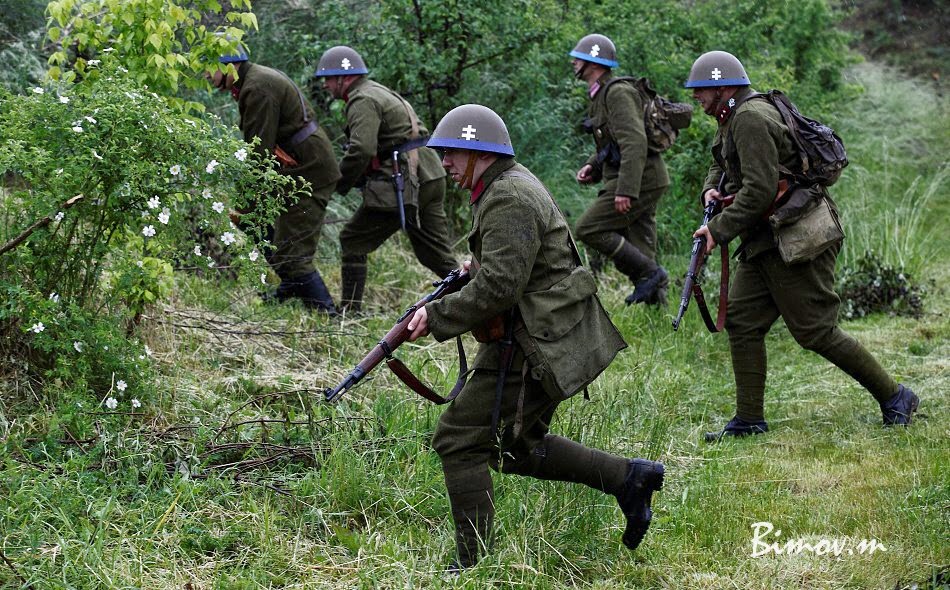
The lions share of the work done on WW2 miniatures is the main uniform and where the Slovaks are concerned after a somewhat lengthy research period I decided to ditch the (re)coloured photos from the past and go with the uniform colours that all of the re-enactors in Czechoslovakia are using at the moment. In my experience all of these re-enactment guys are anal about accuracy so I would trust their opinions a lot more than raggedy old photos with amateur enthusiast recolour treatments.
My base coat was done with Vallejo's 887 Brown Violet for the deepest layers of the uniform. The first highlight, which presents the largest overall surface area that will be seen at the end was done with MIG's 113 Khaki Green No3 (Brit 1939-1942) with the final highlights along all of the raised edges being completed with MIG's 058 Light Green Khaki. This covers all of the cloth uniform and the puttees.

The helmet has a single coat of 50/50 mix of Vallejo's 897 Bronze Green and Vallejo's 887 Brown Violet with the blue helmet band having a basecoat of Vallejo's 925 Intense Blue, highlighted with a 50/50 mix of Vallejo's 925 Intense Blue and Vallejo's 943 Blue Grey. The little Slovak crosses are all hand painted with thinned down Vallejo's 820 Offwhite.
Everything else is all gravy after painting the uniform.

All of the Canvas bags and straps have a basecoat of Vallejo's 921 English Uniform applied with block highlights of AK Interactives 3072 M-44 Uniform Green Ochre Khaki whilst the leather belts and ammo pouches are basecoated in Vallejo's 045 Charred Brown and highlighted with Vallejo's 983 Flat Earth.
The boots are any matt black whilst the Gas Mask Tins are basecoated with Vallejo's 980 Black Green and highlighted with Lifecolor's UA224 Olive Drab Faded Type 2.

The rifle bodies are basecoated with Vallejo's 826 German Camo Medium Brown with the highlighted grain lines painted with Vallejo's 981 Orange Brown. All metal work is painted black firstly and highlighted with Molten Metals Steel. The rifle straps are basecoated with Vallejo's 880 Khaki Grey and highlighted with a 50/50 mix of Vallejo's 880 Khaki Grey and Vallejo's 819 Iraqi Sand.
Where the skin is concerned you can paint it how you please but personally I use one of AK Interactive's paint sets for 'Flesh and Skin Colours' and I've never looked back!

All of the bases are actually really simple. I buy all of my bases from Tony at East Riding Miniatures. Hes a bit of a legend and REALLY helpful. They are all laser cut MDF which allows for easy scoring of the base surface.
I then glue the miniatures to the scored surface and apply a thin layer of tile grout over the top. Once this is dry I glue a layer of one of my sand mixes over the top. Generally speaking I create my own mixes for base coverings as I REALLY don't like a lot of the crap you buy from the shops. Its generally speaking far too gaudy in colour or uniform in texture for my tastes.

I like the generally fine sand BUT I like to have lots of the little stones in there so I can create some colour contrasts with the dirt on the bases.
Once dry the whole base is given a basecoat of Vallejo's 826 German Camo Medium Brown and given a heavy drybrush of Vallejo's 814 Green Ochre.

All of the little stones on the bases are then given a basecoat of Vallejo's 995 German Grey and roughly highlighted (to create a jagged uneven texture) with any lighter grey of your choice but personally I go with Vallejo's 992 Neutral Grey.
The sides of the bases are now painted Matt Black. I never used to bother with this BUT I've really gotten into the clean precise look this lends to the bases. I love it now.
Now we come to the final stage of the bases which is the covering. The static flock that I use is my own mix. I go for something that approximates the dead and dry grass you find on the Steppes with perhaps a little more green in it than usual. This allows an overall base aesthetic that can be used the length of Europe in my opinion.

To provide the final textural boost to the bases though I use a variety of clumps. I had a LOT of problems finding ones that I felt were suitable but after a couple of years I came across a company called Tajima Miniatures whose self adhesive tufts are without a doubt the best I have ever found. I use their stuff by the bucket load now, in great variety.
These all add to the final colour and texture of the bases of this army.
...and there we have it. Once more we reach the end of a voluminous post about guys in uniforms with guns... and BAYONETS!!!!
N.B: There are photos of re-enactors within this blog post. I have not the slightest idea of who they are BUT really admire their attention to detail and as such I have chosen to include them within this blog post without prejudice so that others around the world can see some exceptional examples of what the Czech and Slovak uniforms of 1935-44 looked like for their own projects.


