With the 200th Anniversary of the Battle of Waterloo rapidly hoving into view, I felt it was time to dust off some of my Napoleonic bits n pieces and have a play around.
I spent a long time building up a Spanish Napoleonic army as it was one of the most colourful and diverse of armies during the Napoleonic Wars... that and the fact it was God Awful in the field... which of course made what few field victories that they had (Bailen and Tamames) all the more impressive and satisfying. Lets not forget of course that everybody loves an underdog.
Institutional corruption was so endemic and rife in the run up to the Napoleonic wars that its armed forces were all but run into the ground by the administration. The morale of the troops was at rock bottom and they routinely had to fund and feed themselves. Career soldiers were few and far between and what Corp D'esprit the Spanish had shown the War of Succession, the War of the Pyrenees and the Revolutionary Wars had been destroyed.
However the Spanish were a hardy race with a belief in God that was ingrained into the very threads of their soul and the lowliest peasant in Spain never lost belief that they would finally eject the hated French and their Anfrancesados! The Bonapartist collaborators.
The animosity and hatred that many Spanish Generals held towards each other did much to destroy any cohesive effort that may have been achieved throughout the early years of the war and the introduction of Sir John Moore and later Sir Arthur Wellesley to the Spanish Peninsular was felt to be tantamount to another invasion by a European power, more so because until the day after the French committed their invasion by stealth, Great Britain had been at war with Spain... but then the enemy of my enemy is my friend right?
Spanish Generals such as Cuesta (a decrepit imbecile by this point in his life) and Ballasteros (who incidentally was an enormously capable and vigorous field officer) disliked being seconded to the Sepoy General that many ideas and campaigns collapsed because of their hostility.
Not all Spanish Generals were so hostile to the British army however Lieutenant General Francisco Javier Castanos, the victor of Bailen was able to foster and continue good working relationships with his British counterpart and the Spanish Duc D'albuquerque and the Marquis De La Romana were also capable of playing at the professional table... sadly both D'albuquerque and La Romana died early in the 7 year war.
What beat the French in the end? The Spanish Guerrillas! The word guerrilla which we have today is a term that was coined in this war. The Guerilleros of Spain were described as Napoleons running sore and in Spanish, guerilleros means 'little war'.
When Charles IV and his son, Ferdinand VII, were deposed and replaced with Napoleons brother the whole country rose up in arms. The French realistically could only ever claim to control the patches of ground where they were able to aim their guns. Whole Spanish field armies were able to move undetected whilst even a forage party of the French would need considerable protection to complete their task.
Fascinating!
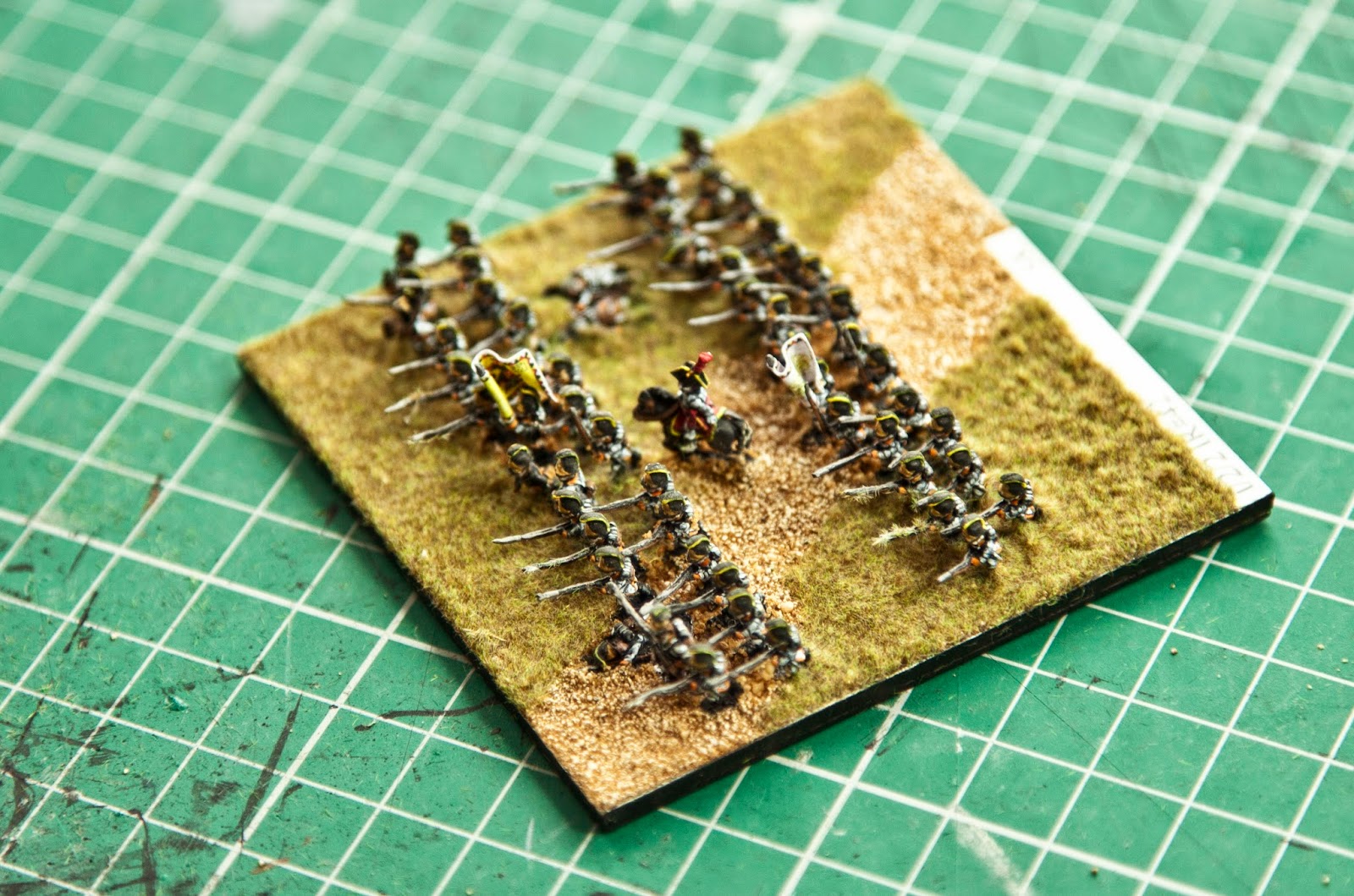
Anyway a long long time ago on a painting desk far away I began painting a Spanish Army. These are some of the regiments and elements that I completed:
All of these miniatures are Essex miniatures. Cheap and with a good level of detail to look really good when painted and arrayed en masse. There is a smattering of Fantassin miniatures in there as well. Ive never been sold on the proportions of the miniatures bodies BUT there are some unique miniatures that a Spanish player would not be able to find anywhere else so I took the plunge and got a load of their miniatures as well, such as the Spanish Engineer Regiment... when painted they actually all look really good as well!
Following the Battle of Trafalgar in 1805 the Spanish Navy did not really have a part to play in the Napoleonic wars so all of the Marine Battalions were employed as foot infantry of the line. This is the 4th Battalion De Marina
A collection of Divisional Generals
Spanish cavalry was some of the worst in Europe at the time of the Peninsular War with an endemic lack of horses and what were available were usually poorly fed and weak. It could be said to some credit to the Spanish that they consistently managed to maintain regiments of cavalry in the field throughout the war. This is the Caballeria De Linea Del Infantado, one of the larger cavalry formations that Spanish had available to them.

Spanish Generals were generally seen as peacocks around Europe with a passion for flamboyant clothing and oversized hats. Occasionally you would come across one or two officers that genuinely cared for their craft and their troops. One of these was Captain General Joachim Blake. Only a Colonel before the French invaded various political eruptions and nepotistic positioning saw him rise to command the strongest of all Spain's regional armies; the Army of Galicia. Regarded by many as an unlucky General, he was conscientious and managed to keep his army in one piece and in the field much longer than his contemporaries.

Captain General Gregorio Garcia de la Cuesta! In his youth a vigorous and aggressive officer who had a clutch of small victories to his reputation by the time of the Peninsular War he was already 67 and long past his prime! A succession of blunders and an inability to compromise with colleagues led to horrific results on the field in battles such as Cabezon, Medino de Rio Seco and Medellin. His personal bravery was never in question, after Medellin fighting as a near invalid, perhaps to the gain of his nation he suffered a stroke in 1810 and died in retirement a year later and has ever after been remembered as a hopelessly proud, xenophobic and reactionary officer. Cuesta's reputation suffered during and after the war, due mainly to his lack of understanding of the deficiencies of the Spanish army but also his behaviour towards his fellow officers and allies.

Captain General Teodoro Reding was a mercenary officer of Swiss lineage and a truly great asset that the Spanish had in their locker! He was a divisional general under Castanos at the battle of Bailen where the Swiss Regiment no3 Reding played such a conspicuous part in the fight. Following the 1808 campaign season he was sent to Catalunia to revive the fortunes of the district raising 30,000 men under his own steam. He was imaginative and vigorous and his men loved him. He met his end at the Battle of Valls in 1809 where the Army of Catalonia was crushed by General Gouvian Sy Cyr's 7th Corps. He was injured by a musket ball and died of fever and complications a week later. A big loss to Spain.
The Cazadores de Olivenza.
La Guardia Reale De Corps
The Royal Life Guard... the cream of the crop of the Spanish military. These troops, along with the Walloon Guards were frequently to be found holding a tidal wave of French back as their brethren fled all around them. Needless to say, their numbers were considerably thinned by the end of the war.
Los Husares De Maria Luisa Y Husares De Espanoles
The lightest and the most dashing of Spanish cavalry regiments was represented by these two Hussar Regiments.
Pedro Caro, 3rd Marquise De La Romana
A career officer of high calibre, he was recognised early in his career whilst fighting against the French in the War of the 1st Coalition and was promoted quickly. He held numerous positions of responsibility before being sent to Denmark at the head of the Division of the North, some 15,000 of Spains best troops which Charles IV had been bullied into providing for Napoleon. When France invaded Spain La Romana colluded with the British and was able to evacuate some 9000 of his troops from Denmark and bring them back to Spain where he was due to supersede Blake as head of the army of Galicia. Sadly, following the battle of Espinosas de los Monteros he was only able to provide some 6,000 men. though he used these to great effect in supporting Sir John Moores retreat to Corunna. Wellington had a good working relationship with La Romana and when La Romana suddenly died in 1811 he remarked: 'His loss is the greatest the cause could sustain'

Las Reales Guardias De Corps Y Las Reales Carabineros
The Royal Life Guards and the Royal Carabineros
Heavy cavalry of the Spanish army was in short supply... but they were around!
Lieutenant General Francisco Javier Castanos
The victor of the Battle of Bailen which sent shock waves around Europe where an entire French army corp surrendered at one go, he fostered a good working relationship with Arthur Wellesley and his subordinate Beresford whom he encouraged to stand and fight Marshall Nicolous Soult at Albuera he was a competent, although somewhat unimaginative officer who nonetheless was responsible for a large part of the successful cooperative operations with the British AND was the man who was behind Beresford's decision to fight and in charge of the Spanish division that prevented the collapse and folding of the British and Portuguese army at this battle!
Los Garochistas De Bailen
Garochistas are Andalusian Cattle ranchers who, when Dupont invaded under Napoleons orders all flocked to the banners. 400 of them were present at the battle of Mengibar where they had a crash course in combat. At Bailen they were formed at the far left of the line with other Spanish cavalry. They repeatedly charged French Cavalry to chase them off and unfortunately were so hungry for butchery they ignored their recall and were lured into an olive grove where waiting infantry slew about 25% of their number. Still... who doesn't want a regiment of cattle herders that stick it to the French?
Milicias Honrada De La Coruna
The Honoured Militia of Corunna - One of the militia regiments raised after the invasion of Spain. This one was raised in Corunna.
Milicias De Canarias
The Canary Militia - A Militia Battalion that was raised in the Canary Islands and sailed to join the fight for the homeland
A view of an entire militia column with two conscript and volunteer regiments, two militia battalions, a peasant band (left by monks of course), a light artillery piece they have been able to scrape together and of course a general officer to lead them to glory!
No Spanish army would be complete without a number of armed peasant bands...
Spain was famous for the multitide of foreign nationalities that fought under the Corona and Ordinanza flags of Spain. Ireland was one nation that provided many troops. In reality by the time of the Peninsular war the Irish regiments such as this one 'Irlanda' was mostly staffed with Spanish but the regimental history and pride remained!
Regimiento Ordenes Militares
The Military Orders Regiment - The Spanish Military Orders were a throwback to the Reconquista from the Moors in the 15th century. Religious centric military institutions, the Regimento Ordenes Militares was the last vestige of this proud tradition and the Ordenes Militares was no exception fighting in many of the major battles of the Peninsular, once again covering themselves with glory.

A Spanish artillery line. Artillery was somewhat of a rare commodity in Spanish armies... because they were all given to the Spanish warship the Santisima Trinidad! The largest ship in the world at the time, carrying over 136 guns! The Spanish field armies had a terrible habit of losing all their guns to the French so massing more than 10 guns on a field of battle was quite an achievement. General Ariezaga before the battle of Ocana in 1809 had managed to put together an army with over 60 guns. An amount of artillery, if it had been put to good use, would have been enough to go toe to toe with the frog batteries.
Spanish breakthrough markers for the game République 2.0 published by Jim at the War Times Journal
Casualty markers for République 2.0
The Combined Grenadiers of Galicia.
It was common practise in the Spanish field armies to withdraw the Grenadier companies from Spanish regiments and combine them into their own regiments and use them as heavy hitting assault troops or as brick walls against which the enemy would crash uselessly. The Combined Grenadiers of Galicia did sterling service at Medina de Rio Seco preventing the early collapse of Blakes army as it withdrew.
Regimento de Ingeneros D'espana
A regiment of Spanish Engineers... I don't even know if these have got many battle honours. I just saw them in a Spanish book and decided that I needed to have them in my army serving the cause!
A typical line division as used in the game République 2.0. Here we see the Tercios de Tejas who, whilst sporting the red plume are actually light infantry, something all Spanish troops were woefully short of until the reorganisations of 1810. A standard 6Ib field battery stands alongside it with the Military Orders and Valencian infantry regiments arrayed behind them. One of the most, if not THE most capable Spanish field officer General Jose Zayas leads this division!
A view of a couple of Swiss mercenary regiments. The Swiss Regiment No 6. Wimpffen and Swiss Regiment No 3. D Reding. These troops were highly professional and highly effective.
Following the British invasion of Montevideo in 1806 and a subsequent disastrous campaign in South America Great Britain had transported many prisoners from this war back to the Thames were they were held. Some of these were cavalrymen from the River Plate area. When Napoleon invaded Spain these troops were equipped with British army equipment and repatriated to the Army of Galicia at Corunna. This regiment of Buenos Aires was known as 'The Reds' because of the equipment and were destroyed as a fighting force at the battle of Medina de Rio Seco when the French caved in Blakes right flank, it was the Colorados that were hit first..
So this is a large part of my Spanish army. The modelling, painting and basing of the figures is relatively simple.
Where the painting is concerned I always paint in sticks with an entire regiment of 24 figures being glued to a stick of wood.
I always undercoat black as it is a good provider of black linking which at a scale where each figure is only 15mm tall this kind of black lining can provide excellent contrasts helping to make the miniature more visible on the table.
Each of the jacket and trousers & waistcoat will have a base coat applied. For this army usually a white or blue although there are exceptions. The blue will be an exceptionally dark blue whilst the whites base coat will be a blue grey.
All of the straps and bandoliers that these troops were festooned with would also have a base coat applied as well, in the same way as for the trousers.
A top coat is then applied. At this scale and with an army of this size I don't find graduated shading to be particularly beneficial as we are going for mass effect.
The rest of the painting is purely for show at this point, and it really depends on how anal on detail you like to get. Me? I love it! Just look at the braiding on my Cazadores de Olivenza and my Spanish Engineers. Time consuming to be sure BUT well worth the expenditure when you see them all together.
The bases were a REALLY simple affair. Beach sand with a little bit of grit mixed in. Glued to the bases with PVA glue and left to dry. They were then covered with a watered down brown ink and heavily dry brushed with a light sand colour. On top of this green flock was added. Nice effect I think, and perhaps more importantly, really easy to do en masse!
...and finally, as a parting note: this army won Salutes painting competition a few years back! :D